
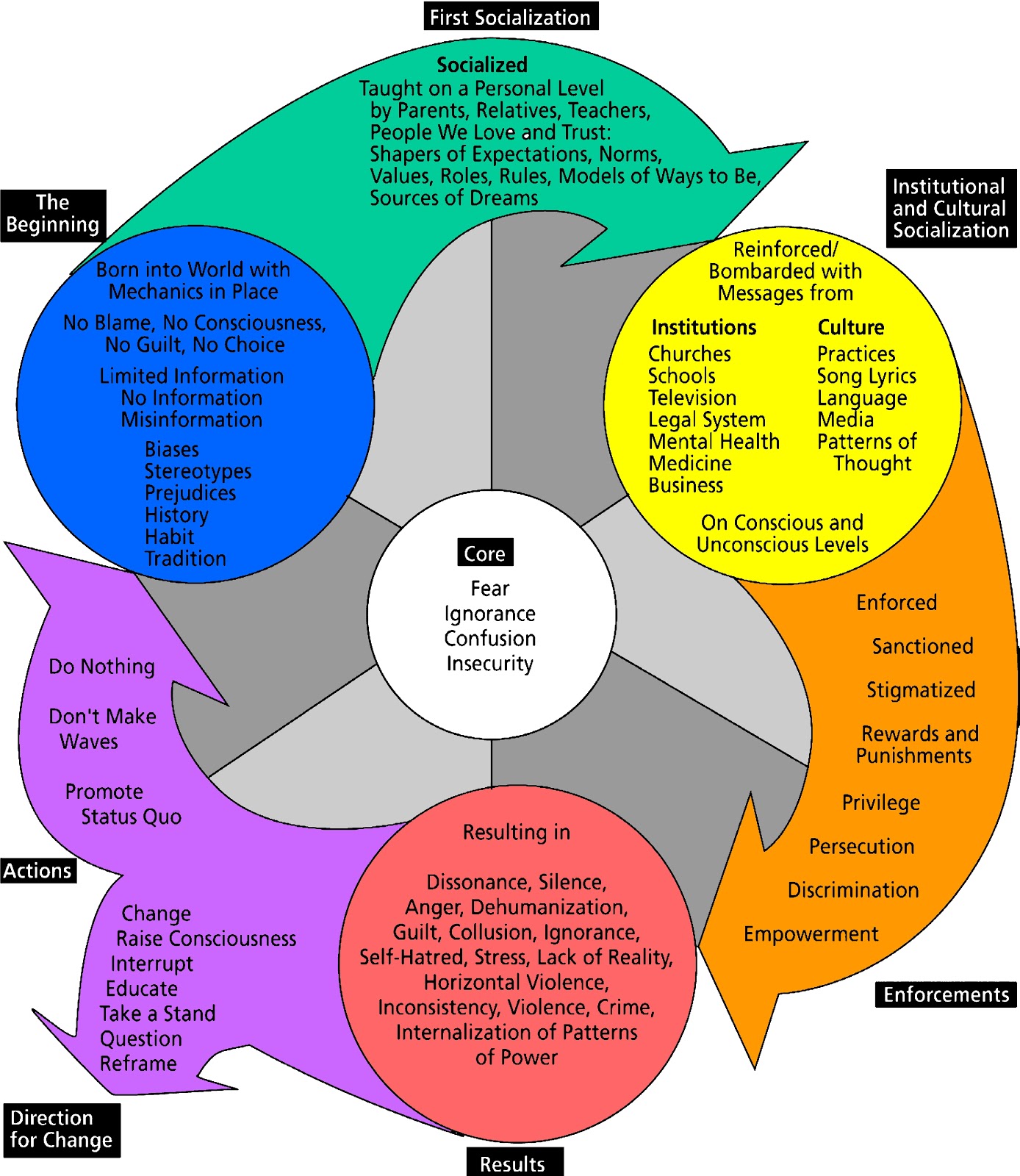
Cycle of Socialization
Throughout my day, I am expected to perform certain roles that are assigned to be by society based off of my identities. A few of my identities that either I have chosen, or were given to me, are: female, CI student, a white American, sister, daughter and roommate.
If we take my identity of “daughter” and put it through the cycle of socialization, the beginning would be me being born to my parents who have expectations of what a “good daughter” is supposed to be and gave me my name. An example of being born into an already socialized world as a daughter is the idea of being “daddy’s little girl,” and there are toys and signs and clothing being produced before a daughter enters the world. The first socialization came from mostly my parents, along side other adults who were in my life at an early age the role of not only being someone’s child but a daughter. An example of that would be a memory of mine, where my grandmother told me that my mother was a good daughter because she was respectful and listened. Part of “training” as kids is learning and understanding the difference between good and bad, and that there are consequences to both. This subjective idea of good and bad heavily influences the socialization process. As a young child, I was given the title of daughter, but I wanted to earn the title of a “good” daughter. Eventually, the identity of daughter also meant being a sister. I think culturally, this idea of “daddy’s little girl” is pushed onto daughters at all ages. There are songs and traditions that encourage it. Reminder: I am claiming the identity of daughter, not “daddy’s little girl.” I am not saying that they are synonymous, but I am saying that society pushes daughters to identify with that phrase. The identity of being a daughter is enforced through privilege and rewards and punishments. I definitely think that because I was the only daughter out of three children, I have certain privileges but also pressures. I am encouraged to get married and pop out some grandkids, but I did/do get special attention from extended family because I am the only girl. The privileges are weird, I personally would like to ask those people why they treat me differently than my brothers, because I get the gender discriminations but I am curious about how numbers play into it. The result of the socialization leads to different pressures and expectations. I think this cycle when applied to the “daughter” identity, happens multiple times because our relationships with our parents are different at age 2, than at age 8, than at age 15, than at age 23, etc… so it’s almost like we have to socialize as we develop into our own selves and as our relationships evolve.
 When thinking about end of life (EOL) care for myself, I find the considerations very different than those for my clients and even for my family/loved ones. At face value, it seems impractical to state my wishes as I am so “young,” but after further reflection, it seems extremely suitable given our knowledge and experience through the nursing program. I know that I would not want extreme measures taken to keep me alive if something were to happen. Although we can state specifics in an advanced directive, such as interventions that are time-specific, I have discussed this topic in great detail with my family members and vice versa. I started asking the tough questions and really taking the time to understand the wishes of my family members and various loved ones beginning in MedSurg II. They understand and respect my wishes as I do theirs, so I feel comfortable leaving the decisions up to them. I feel most comfortable designating my father as my power of attorney. He has medical experience as a firefighter and EMT, which is why my passion for the medical field began at such a young age as I was exposed to graphic pictures, stories, and medical terminology. Although the decision(s) would be incredibly difficult and painful for him, I know that he would be able to speak and listen to a multitude of doctors and other health care professionals in order to make the most rational decision possible about my fate, irrespective of his bias.
 Due to my experiences in the clinical setting, I believe culture plays an enormous role in the matter. In speaking to many about EOL care over the last year, I realize that the latest “fad” seems to be that Caucasian parents do not wish to be a “burden on their children.” Most people would choose not to live with their children regardless of their physical or psychological ailments. However, my parents and I had a heavy-hearted conversation about the genuine meaning of those statements and I shared my thoughts on the situation. I stated that I feel opposite from them and if they had a condition of some sort that they needed assistance and did not have to be in a medical facility or hospital, I would want them to live with me despite their feelings. This has been a recurring conversation with both of my parents, but I feel as if we have finally understood each other. They no longer state that they “don’t want to be a burden” on me. I know that each family feels differently and I do not believe there is a “right” or “wrong” way to feel. In fact, I am aware that many families believe the children should always care for their parents. Irrespective of the decisions, EOL care and personal wishes need to be discussed so they can be respected. It should no longer be kept silent, because it may just be too late…


