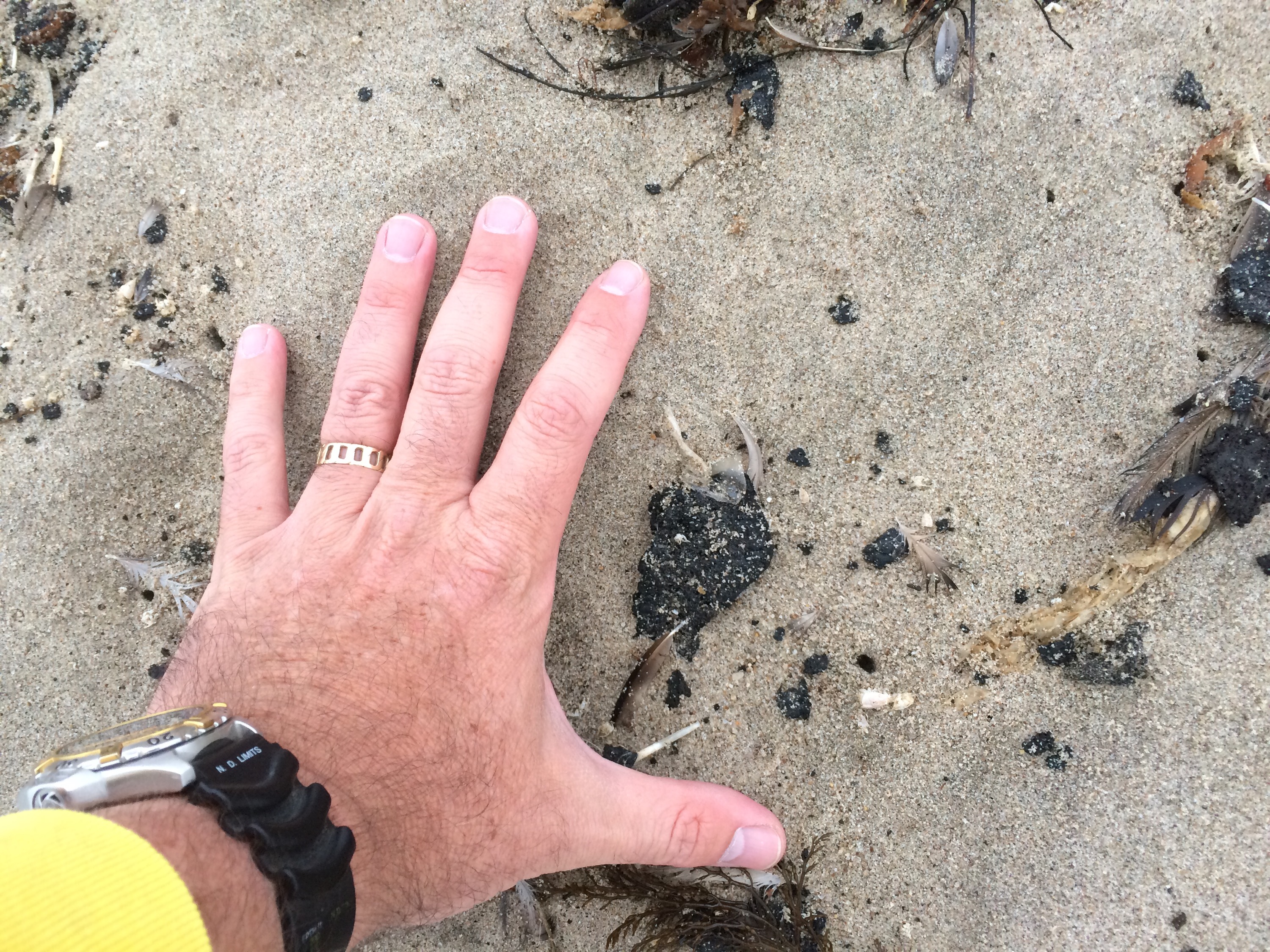
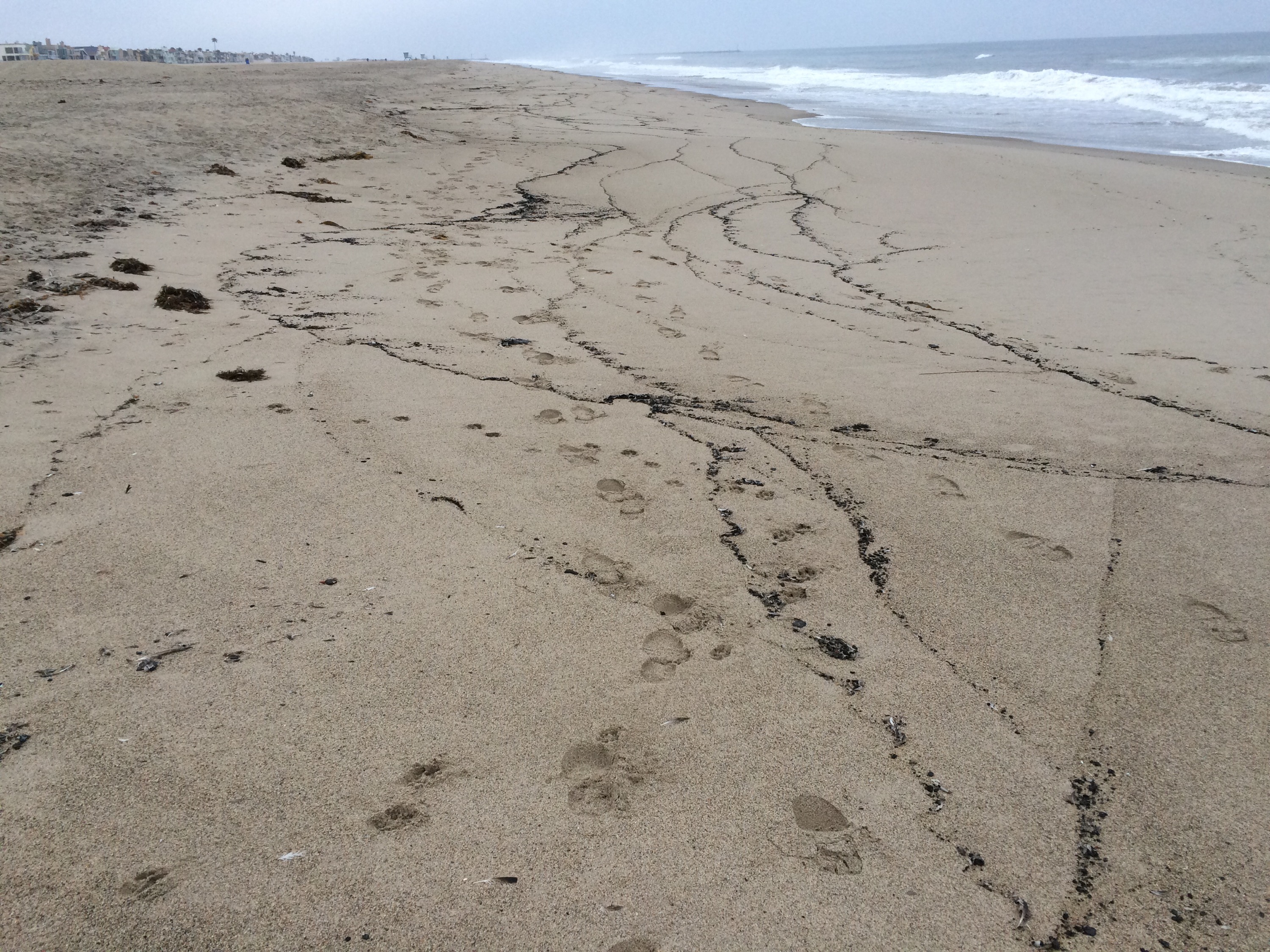
There are many critters particularly at risk with this oil spill. While our historic worry/focus has been on our rocky intertidal communities and on warm fuzzies (such as these cute marine mammals and endangered sand-nesting birds), other critters are at risk too. In particular the animals dwelling in the swash zone of our sandy beaches. What I am most worried about here are the sand crabs (Emerita analoga) that are the food for a huge number of beach-dwelling birds and animals and our California grunion (Leuresthestenuis).
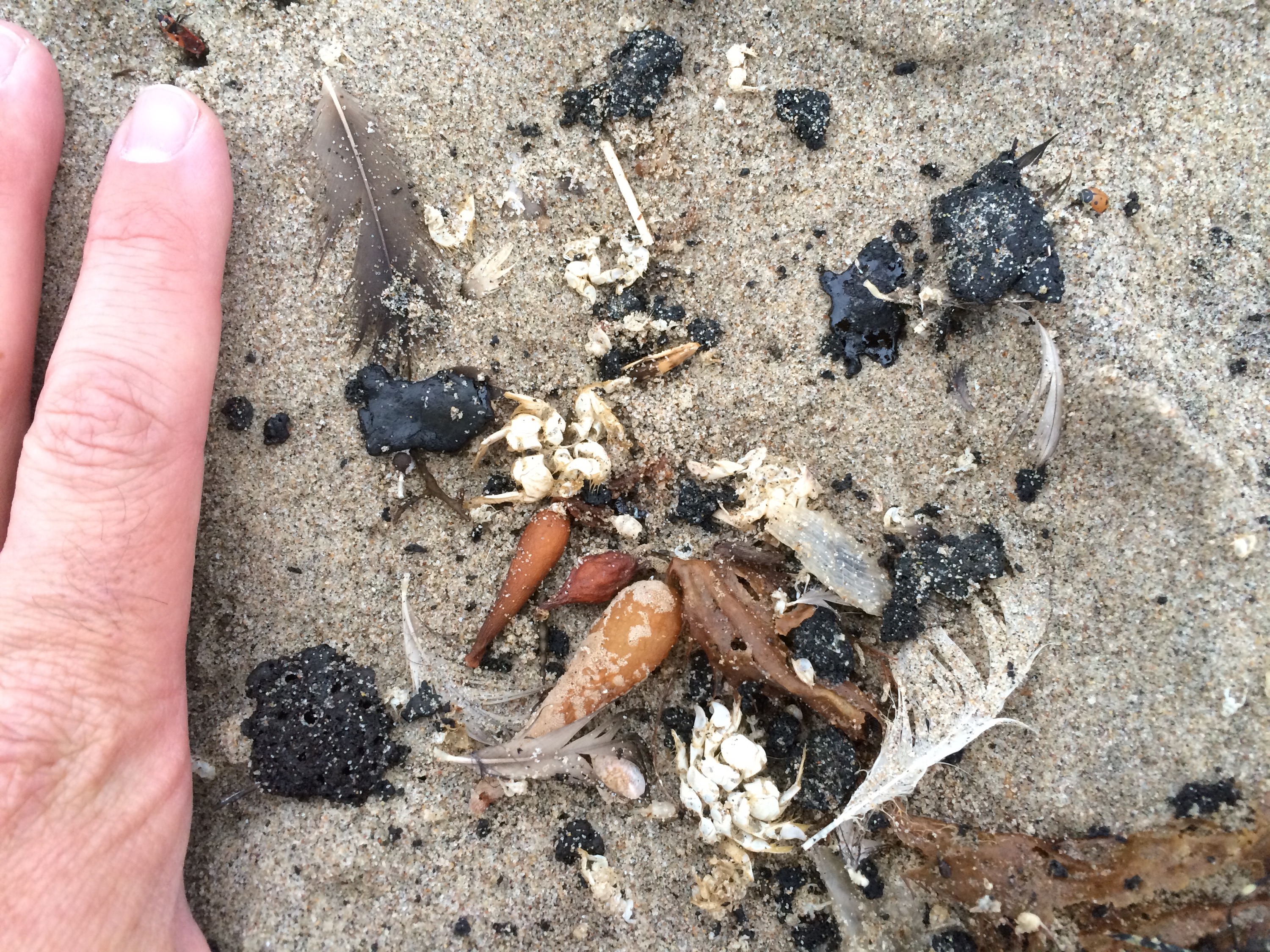
Large sand crab carapace in the fresh tar line at Oxnard Shores, Ventura County on May 30, 2015.
Sand crabs make their living migrating up and down the beach with the tides (they live in the sand, sticking up their food-collectors to harvest their planktonic food and the waves wash over their sand-home), keeping themselves right at the swash zone where the waves hit. That’s right where all these tarballs are washing up. As of yesterday, we have been finding dead sand crabs in amongst the freshest wave of tarballs arriving on our beaches in Ventura County.
It is too early to say if we are seeing a significant mortality event within our sand crab population, but it is concerning that we are seeing so many dead guys (not mere cast-off exoskeletons or dead juveniles).
Given the fact that sand crab numbers have been low this year prior to the onset of the pipeline break/oil spill, any tar-induced mortality might prove harmful to the population and sandy beach community overall. The bright side of this is that these are resilient and highly variable populations and we may see no effect.
A grunion run near Cabrillo Aquarium in Los Angeles, CA. Image: CBS News
When it comes to California grunion, the worry is that we are in peak spawning time. These amazing fish swim up to the beach at night to lay their eggs before rolling and flopping back into the water. Their eggs chill out in the sand until they are ready to hatch with the next series of high tides.
Both sand crabs and grunion are vulnerable to both the toxic oil and the clean-up process alike. Simply skimming the oil off the very uppermost surface of the sand is not an issue, but digging into the sand translates into possibly digging into these guys and killing them. Clean-up crews need to be as careful as is reasonable.
See this e-mail from our queen grunion champion Dr. Karen Martin:
Whatever their source may be, these tar balls have the potential to impact beach and nearshore animals and plants, including the California Grunion…
[the impacted areas] are known spawning locations for the California Grunion, an endemic, iconic marine species. Any eggs still on shore this weekend are ready to hatch and likely to emerge during the high tides at night over the past and next few days. However, the tar balls in the intertidal zone are very nearly in the location of the band of buried grunion eggs.
With all appropriate human safety precautions, when cleaning the beaches, it is important to leave the sand as undisturbed as possible if the contamination is only at the surface. The best practice seems to be gentle manual removal of the surface petroleum, with flat shovels or hand rakes. Some people are using cat-litter scoops.
We are still in the midst of the peak spawning season for the California Grunion. The full moon Tuesday June 2 will be followed by nights with potential runs on Tuesday, Wednesday, Thursday, and Friday. Grunion usually spawn multiple times over their lifespans. It is rare that they die during spawning runs. If you do see an unusual mortality event, please let me know as soon as possible…
…Please recall that after this week the nests of eggs will be present on shore for the following two weeks. Keeping vehicles and other forms of disturbance above the high tide line of Tuesday’s highest tide is the best way to protect them.
Thanks for your care of our beaches and natural resources during this difficult time.
https://cikeys.com/wp-content/uploads/2026/09/ci-logo-ciKeys.png00Sean Andersonhttps://cikeys.com/wp-content/uploads/2026/09/ci-logo-ciKeys.pngSean Anderson2015-05-31 18:51:532015-05-31 18:51:53Grunion & Sand Crabs in harms way
Oil clean-up crews at Haskells Beach mid-morning May 29. 2015
Holy cow! It has been a crazy day. One of our teams sampling Haskell’s Beach (near the Bacara Resort) north Coal Oil Point was basically given the boot. Various clean-up teams are now sweeping the beaches from El Capitan to Goleta and the Incident Command has now shut down public access to all of those beaches. This is a huge expansion of the closure area and seems to confirm our concerns beginning mid last week that much of the oil arriving to beaches down to Coal Oil Point was indeed pipeline crude and not merely regular, background tar seep deposition.
While one of our teams checking Carpinteria found nothing particularly abnormal about the tar balls there at 4pm today, we now have reports of dime-to-baseball sized tar balls washing up on several of our monitoring beaches here in our own backyards in Ventura County. It is unclear if this is related to the spill, but we RARELY IF EVER get this kind of tarring on these beaches. This is certainly an unusual event and seems very suspicious. We need to have the fingerprinting of the oil to confirm but at a minimum, this is very weird.
Here is a quick video by Paul Spaur summarizing the goings on before the beach was closed:
We will post more when we know more.
More boom, less people. Newly boomed off sandy beach edge at Haskell’s Beach May 29, 2015
From the LA Times about 15 minutes ago:
The cleanup response to the oil spill that fouled miles of beaches along the Santa Barbara County coast will now extend to Ventura County, where tar balls have been spotted on beaches, officials said Friday.
The pipeline’s owners said it will dispatch cleanup contractors to Hollywood, McGrath and San Buenaventura beaches in Ventura County, though federal authorities have not confirmed whether the oil there is from the spill.
“Until we know more, we will act as if it is related to our incident,” said Rick McMichael, senior director of operations at Plains All American Pipeline, which operates the pipeline.
Workers continue to clean the shoreline at Refugio State Beach in Santa Barbara County after a crude oil pipeline ruptured on May 19, spilling thousands of gallons into the ocean. Photo: Genaro Molina / Los Angeles Times
By Friday afternoon, crews were cleaning up tar balls at San Buenaventura and McGrath.
Two beaches north of Santa Barbara, also in the Channel Coast district, were closed last week after an estimated 21,000 gallons of oil spilled into the ocean off Refugio State Beach. There’s no indication the tar balls on the Ventura beaches were related to that spill nearly 50 miles away. But officials don’t know where they came from at this point.
“An initial analysis came back inconclusive as to what the source is,” said Kevin McGowan, manager of the Ventura County Sheriff’s Office of Emergency Services. The Emergency Operations Center has been activated to support the investigation and cleanup efforts.
McGowan was with a team early Friday checking out the sites where the oil was reported.
“They range from the size of a dime or a quarter to a dinner plate,” he said. “Stretches (of the tar balls) span anywhere from 10 to 50 feet long.”
No closures were reported Friday afternoon.
“There doesn’t appear to be a significant threat to public health or wildlife in Ventura County at this point,” said Chris Stephens, the county’s resource management director. “Our goal at this point is to find the oil, remove it and mitigate any environmental impact it may have caused.”
Those responding to Ventura-area beaches Friday would assess whether the tar balls need to be cleaned up. County officials said cleanup teams had been deployed to the area.
A fly-over of the ocean done as part of the cleanup efforts of the Santa Barbara County oil spill was expected to include the Ventura County area Friday. McGowan said he had not yet heard the results from Unified Command, but so far, there were no reports of oil in the water off the Ventura coast.
Earlier this week, a 7-mile stretch of coastline along Santa Monica Bay was closed after globs of oily goo washed ashore. Officials said the area might reopen Friday after a two-day cleanup effort.
Update: 6:30pm
My students are reporting lots and lots of small to medium-sized tar balls washing up on western Ventura County Beaches. These tar balls are dense enough to begin forming a line of tar at the strand / high tide line. We are also seeing dead sand crabs (one of the foci of our sandy beach work and a keystone species for sandy beach ecology) intermixed at this tar sand line at McGrath State Beach and Emma Wood State Beach.
McGrath tar ball stand line on May 29, 2015.
Dead sand crabs (Emerita analoga) at McGrath State Beach tar ball stand line which formed on May 29, 2015.
McGrath tar ball stand line on May 29, 2015.
>10cm wide tar ball at McGrath State Beach tar ball stand line on May 29, 2015.
Tar ball strand line at McGrath State Beach in Ventura, CA on May 29, 2015.
Here is a quick tour of our PIRatE Lab’s lab. We have been getting several requests about our lab and decided to give you a sense of our set-up.
Sand samples from across the Southern California Bight.
Open ROV 2.7: The Black Pearl on our custom launching platform.
Our Phantom ROV being overhauled and rebuilt.
We’ve also had lots of questions about oil; what it looks like, what it smells like, and how sticky it is. We have posted our observations about oil before, but here is what the samples look like back in the lab:
https://cikeys.com/wp-content/uploads/2026/09/ci-logo-ciKeys.png00Sean Andersonhttps://cikeys.com/wp-content/uploads/2026/09/ci-logo-ciKeys.pngSean Anderson2015-05-29 23:00:182015-05-29 23:00:18PIRatE Lab Tour
We are preparing to deploy our ROVs and sensors into the oil spill site, and to examine the sea floor for any deposited oil, or affected sea life. We are awaiting approval from the Unified Command. Whenever there is a large scale disaster, whether it is a large fire, earthquake, oil spill or something else, there is a system in place to manage it. It was designed by the Federal Emergency Management Agency (FEMA) and is called the Incident Command System. (ICS)
The ICS essentially establishes a chain of command in regard to an incident, and there are delegated positions within an incident, and it is often not limited to only one agency, those who arrive first assume command, then pass it off and necessary. In the case of the Santa Barbara Oil Spill, the Unified Command is comprised of the: Coast Guard, National Guard, California Department of Fish and Wildlife, Environmental Protection Agency, and National Oceanic and Atmospheric Administration, Department of Transportation and local government. (http://www.refugioresponse.com)
Being that this event is both a physical, and a health hazard, there are many factors that go into managing an incident like this. The area is completely closed off, and authorization for any activity within the site requires express written permission and proper training.
I spent many years as a Paramedic and I am used to operating in situations like this, but not all have, so I’d like to talk a little about an effort to help in a situation like this entails, so others in the future can know the risks and understand the steps that are involved. This will be a bit lengthy, for the internet world, the TL;DR is: Be safe, educate yourself, and realize that though the red tape can be exhausting, but it is there to reduce the likelihood of injury.
Preparation
When a major disaster (or even small for that matter) strikes, many people have the deep seeded urge to assist with the situation. This is a great desire, however there are risks associated with operating in a disaster site. Proper training and preparation are key elements of safety. This is a very key topic in First Responder training of any kind, we call it scene safety. You first make sure that where you are going and what you are doing is providing for your safety, and the safety of others. You don’t do something that you haven’t been trained for because instead of being someone that is there to help, you may become someone that needs help. It is imperative that you be with people who are experienced and have had training regarding the specific hazards of a disaster, and the proper Personal Protective Equipment (PPE) that you must wear, and know how to properly remove and decontaminate it. In addition to being around hazardous materials in this situation, we will be operating on vessels and/or small boats which requires some background knowledge.
Photo Credit: Chevron
Training
Hazardous Waste Operations and Emergency Response Standard (HAZWOPER) is the standard of training which is required to work in a hazardous waste cleanup operation. This is typically a 40 hour class which requires an annual 8 hours of refresher education. (http://www.osha.com/courses/hazwoper.html) This training covers how to properly decontaminate equipment and people, and how to manage hazardous waste types. In some cases when an event is mostly cleared up, those who enter may be allowed to work under the leadership of someone who is HAZWOPER trained, but it ultimately falls under the decision of the incident command.
Photo Credit: Cashman Equipment
Using any kind of scientific equipment in this sort of environment also requires intimate knowledge of your equipment, to minimize the time that you are in the environment, and to ensure it is operated smoothly. A set of Standard Operating Procedures (SOP) is key for operating any set of equipment. The PIRatE Laboratory has developed a set of SOPs for ROV deployment, and augmented the procedures to include decontamination. We also require all of our team members that participate in small boat operations to take the California Safe Boating and Waterways certification course ( ) I will be posting a link up on our blog later to share it with other groups that wish to do similar work. It mostly contains standards such as supervision, steps of operation of the ROV including cleaning, and requirements for operators. SOPs establish professionalism, safety standards and show that you have clearly thought out operation and use of your equipment.
Obtaining Permission
This sort of situation breeds concern among many different subjects: environment, human and wildlife health, property damage, etc. As mentioned before, proper control of the situation is necessary to prevent the risk for those who are unaware of the dangers. The roads, airspace and waterways surrounding and disaster site are typically shut down. Specific permission to enter is granted by the ICS chain of command, and there needs to be a specific, and good reason for it.
Reason for Permission
In order to enter these sites there must be a reason. Our reason for wanting to enter the site is for impact research and assessment of cleanup. We are specifically curious to the deposition and impact of oil on the bethos (sea floor) and organisms in the subtidal area, just off shore of where the spill is. Many flora (kelp, sea grass, etc) and animals could be affected. Oil typically floats on top of water, but there are many factors which can push the oil beneath the surface, such as: oil mixing with dirt (making it tarry and goopy), wave action, heavy wind, vessel traffic, and more. We are also interested in using ROVs as part of the standard response, to assess the condition of the sea floor.
Demonstrating that you are the one to do the job Just because you want to help, doesn’t mean that you are qualified to do what you want to do. Luckily Dr. Sean Anderson and I both have had formal training in hazardous materials. Dr. Anderson is an expert in Marine Ecology, and has also spent much of his career working on oil spill ecotoxicology. He worked on the Deep Water Horizon, and he studied the original Santa Barbara Oil Spill that was in the 60’s. I have a lot of experience in emergency response, both by being a first responder, and also emergency manager. I studied Biology with an emphasis in Marine Ecology and Environmental Science research, and have spent the past 10+ years building and piloting Remotely Piloted Systems. In addition we have a well established team of undergraduate students who have been trained to operate ROVs in remote locations, and with very limited resources. A proven track record of research and due diligence such as SOPs goes a long way when proving that you know what you are talking about.
The Process
With any government agencies, there is paperwork to be filled out, and possibly permits to be obtained. We began by asking local agencies that we have worked with such as the Department of Fish and Wildlife, and the National Oceanic and Atmospheric administration, what the situation looked like at the site. We then moved to request information from the Unified Command, which established a public phone number and website for requests and information. We sent a letter of intent to them a day later, we received a phone call with the details and necessary forms to fill out. We completed all of the forms, and then start the waiting game. Some of the requested information on the forms included: crew members, equipment used, if the members are HAZWOPER trained, decontamination procedures, full detail of desired activity, and resources needed from the incident agencies.
All in all it is a great, but daunting task to undertake. There is a lot of red tape to jump through, but a lot of good can come from the proliferation of knowledge, and this has the potential to aid in the cleanup efforts by identifying additional impacts and can shape better restoration plans. In addition, this could set a new precedence for how oil spills are responded to, by using low cost yet effective tools to look at the entirety of the site that is covered in oil, not just the surface.
Though it sounds very tough, the key is education, and being prepared before something like this happens. There are many volunteer organizations which help people get the training so they can respond to such incidents. These organizations include Community Emergency Response Teams (CERT) http://www.fema.gov/community-emergency-response-teams, International Bird Rescue http://www.bird-rescue.org, and many others.
https://cikeys.com/wp-content/uploads/2026/09/ci-logo-ciKeys.png00Sean Andersonhttps://cikeys.com/wp-content/uploads/2026/09/ci-logo-ciKeys.pngSean Anderson2015-05-29 07:46:202015-05-29 07:46:20Remotely Piloted Systems Research Blog 2015-05-29 07:46:20
Our laboratory has been working very hard the past week and a half, we focused mainly on the environmental surveys that our laboratory performs. specifically in sandy beach ecology and environmental toxicology. We have sent out teams of faculty and researchers to characterize the sandy beaches that surround the site of Refugio State beach, the site of the oil spill.
The progression of our efforts can be seen at http://oil.piratelab.org. We will be working to incorporate our Remotely Piloted Systems into the impact characterization, and we will be documenting that aspect in the following posts!
https://cikeys.com/wp-content/uploads/2026/09/ci-logo-ciKeys.png00Sean Andersonhttps://cikeys.com/wp-content/uploads/2026/09/ci-logo-ciKeys.pngSean Anderson2015-05-29 07:33:192015-05-29 07:33:19Santa Barbara Oil Spill
https://cikeys.com/wp-content/uploads/2026/09/ci-logo-ciKeys.png00Dorothy Ayerhttps://cikeys.com/wp-content/uploads/2026/09/ci-logo-ciKeys.pngDorothy Ayer2015-05-29 03:15:192015-05-29 03:15:19This is my first post