
Hall Canyon Spill

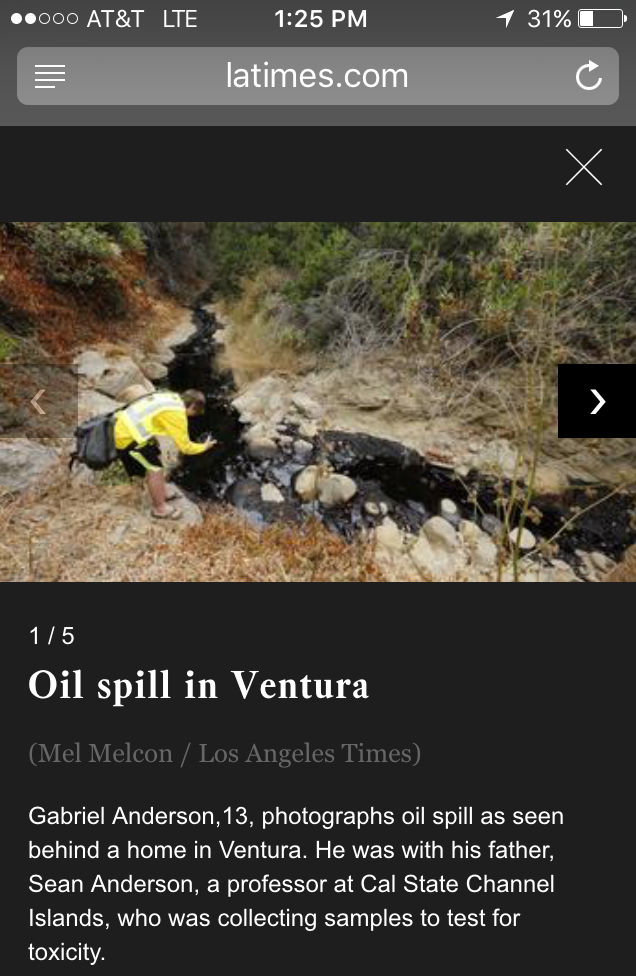
Gabriel Anderson, 13, photographs a section of the oil spill in Ventura. He was with his father, Sean Anderson, a professor at Cal State Channel Islands, who was collecting samples to test for toxicity. Image: Mel Melcon, Los Angeles Times.

Gabriel Anderson, 13, photographs a section of the oil spill in Ventura. He was with his father, Sean Anderson, a professor at Cal State Channel Islands, who was collecting samples to test for toxicity. Image: Mel Melcon, Los Angeles Times.

Yet another start of the summer and yet another pipeline break on the south coast.

A Year of Spilling Dangerously

Our oil infrastructure here in coastal southern California has certainly had a pretty horrid year.  We started with last year’s mid-May Refugio Oil Spill.  The largest oil spill in Santa Barbara County since the infamous 1969 Santa Barbara Oil Spill just kept on giving and giving in the form of sporadic tar balling of beaches across 170 km of coast into late June of 2015.  As a consequence, my students, colleagues, and I spent the late spring and early summer of 2015 tracking tarring impacts across more than 50 of our southland beaches.

Just when we felt we had wrapped up our initial characterization of Refugio impacts, we were thrust into the Aliso Canyon Natural Gas Storage Field Blowout.  That four month-long fiasco in Porter Ranch totally eradicated more than a year’s worth of very hard-won, state-wide carbon emission reductions as we vented more than 97,100 metric tons of methane and 7,300 metric tons of ethane into our atmosphere.  That day in, day out natural gas blowout à la the Deepwater Horizon was caused by infrastructure that predated our energy crises of the 1970s.  That venting and the ensuing management crisis hobbled our nation’s fifth largest natural gas storage facility as it burped out a carbon footprint larger than the Deepwater Horizon blowout in 2010.  Both a healthy dose of prudence and a spate of legislative constraints placed on the storage facility’s owners (Southern California Gas), have kept this key piece of our energy infrastructure hobbled and offline as we enter the time of the year when we most need a nimble and quickly-responsive electrical grid (did I mention we have been seeing triple digit temperatures of late).  So I hope you can forgive me for thinking we were justified in expecting something of a reprieve of energy infrastructure crises as we rolled into the 4th of July holiday.

Unfortunately, we picked the wrong week to catch up on our sleep.

Hall Canyon Pipeline Spill

First map identifying spill site. Image: @avmartinez

First map identifying spill site. Image: VCFD via @avmartinez

Kirk and Kelly Atwater and some of their neighbors woke to what they later recognized was likely a pressure release valve screaming an unusual whine around 4:30 am on Thursday, June 23, 2016.  The Atwaters fell back to sleep, but were soon re-awoken by the pungent smell of oil wafting into their home.  The increasingly strong smell eventually prodded them to walk out of their Ventura Hills home and search for the culprit.  Kirk disappointedly found fresh crude flowing though a narrow creek that bisects his property above Ventura High School around 5:00 am.  He hopped onto his Vespa and motored up to the oil pipeline a few hundred meters up the canyon from his home.  Sure enough, the crude was pouring out of a junction box and flowing into the head of the Prince Barranca within Hall Canyon.  Kirk first called 911 to alert the authorities and then called the “in case of emergency” 1-800 number affixed to the pipeline itself, reaching the pipeline’s operation control center in Long Beach, California.  It was 5:30 am.

Rapid Response

The rest of us woke to news reports of a potentially very large pipeline break just east of the City of Ventura.  Those first few dribbles of news suggested that as much as 200,000 barrels of oil might have been released into a creek and were apparently headed to the Ocean with a possible entry point near San Jon Road on San Buenaventura State Beach, one of our long-term sandy beach monitoring sites.  It goes without saying that oil spills rarely fall on convenient days or happen at civilized times.

The previous evening saw our Sandy Beach Field Crew present the interim results of our 2016 Sandy Beach Rapid Assessment Synoptic Surveys of beach health and our assessments of Refugio Oil Spill impacts as of one year post-spill.  We had just sent everyone off for some well-deserved vacation time when BANG!  New Spill.  Fearing several of our monitoring sites were about to (again) be hit by oil, I began reaching out to our just-deactivated field team.  Several folks reported they could help, but would need a few hours to get back to town/finish-up long-postponed activities planned for that June 23rd morning.  Not wanting to wait, I grabbed my son (a seasoned beach monitor, excellent parasite dissector, etc.) and we bee-lined to the City of Ventura.  On our drive into Ventura, reports started trickling in that the oil appeared contained to the hillside region of Ventura near Grove Street and Grove Lane.  We therefore elected to first check the origin site to confirm that oil was indeed contained near the release site.

We began by conducting a few driving transects from the 101 Freeway (near the beach) inland towards the hills on South Seaward Avenue and associated streets.  Driving slowly with our windows down (and with frequent roadside pit stops), we could detect no petroleum odor as had been rumored to proximate to South Seaward Avenue.  To be sure this was a qualitative assessment.  But as we have seen in the past, were oil to get into storm drains or urban creeks you can rapidly see a progression of both petroleum and smells across the urban/coastal plain as those hydrocarbons migrate seaward through the urban matrix.

Following that brief odor inspection, we headed up into the hills above Ventura High School to get a firsthand read on the spill and figure out if we indeed needed to prioritize additional pre-oiling beach surveys.

Hall Canyon Oil Spill 06-23-16

A Fouled Barranca

Sean inspecting the crude flow in Prince Canyon. June 23, 2016.

Sean sampling the crude flow in Prince Barranca. June 23, 2016.

As we approached the Grove Lane area of the Ventura Hills, we quickly honed in on the cluster of fire, hazmat, and police just off Poli Street.  As our goal was to not get in the way of any first responders, we went a bit farther up the hill from the primary aggregation to see if we might be able to get a sense of the magnitude of the release in this residential neighborhood.  Within a minute or so we came upon a cluster of media disembarking from their TV vans, etc. along with a scattering of County Fire in the side yard of the Kelly and Kirk Atwater.  We introduced ourselves and the Atwaters kindly invited us to come on in and take a look at the spill running through the steep ravine that bisects their property.  After several minutes of answering the Atwaters’ questions, we headed down for an initial inspection.

With a friendly “be careful of the poison oak, its really thick down there,” we shimmied down the ivy-covered bank to where a few intrepid news photographers and videographers were collecting images of flowing oil in the small channel for their upcoming stories.

The pipeline release point was perhaps 500 m upstream from our inspection site on the Atwater Property.  The Prince Barranca lies within the greater Hall Canyon and is a key tributary for local surface water migrating from the upper reaches of this section of the Ventura Hills down to the flatlands of the core of the City of Ventura and eventually into the arroyo that discharges into the ocean at San Buenaventura State Beach (one of our beach health monitoring sites) at San Jon Road.  At the Atwater’s home, the rim of the gorge is spanned by a city water main essentially running straight across the perhaps 200 m span of the top of the channel, suspended perhaps 50 m above the floor of the barranca.  The barranca’s sides run downward at slopes of 20 to 40° which made access a challenge for clean-up crews (later in the day they would cut steps into the slope’s face to make it easier to ascend and descend with equipment).  Oil was flowing in the primary channel such that at peak the torrent averaged about 30 cm in depth (excluding pools) and one to two meters in width.

From afar I initially mistook this flow to be oil being discharged into a low flow channel capturing surface runoff.  As I got closer it became clear that there was no water in this channel and I was seeing pure crude running through an otherwise dry channel.

About 400 m down stream from our inspection point, hazmat teams managed to bolster the berm surrounding a pre-existing debris basin at the end of the daylit segment of this channel before it runs under the core of city streets.  Hazmat pumps and tankers were joined by at least two 3,000 gallon tanker trucks from the clean-up contractors by about 9:30 am.  Major oil flows in the channel had effectively ceased sometime before 9:15 am.

Pumping oil from catchment below Atwater property. Image: @VCFD_PIO

Pumping oil from catchment below Atwater property ~9:00 am.  Image: @VCFD_PIO

By 10:00 am the oil level in the barranca at the Atwater property had dropped perhaps 10 cm (4 inches) and perhaps 20 cm (8 inches) by 10:30 am from the maximum oil level.  From my quick inspection there seemed to be comparatively little soil penetration given the density of both river stone and the thick natural cementing of the sediments in the thalweg.  The pumping out of oil from that debris basin seemed to be the primary driver of the quick draw down of the oil level.

Crew members work to keep crude oil from flowing into the ocean after a spill in Ventura, CA. Thursday, June 23, 2016. Image: Rob Varela / The Ventura County Star

Crew members work to keep crude oil from flowing into the ocean after a spill in Ventura, CA. Thursday, June 23, 2016. Image: Rob Varela / The Ventura County Star.

Spilled Crude

This oil was a light crude that exhibited surprisingly little volatilization.  The heavy marine layer/June gloom clearly helped with that, but the lack of strong odors (confirmed by VOC sniffers in use by the firefighters distributed across the neighborhood) was still something of a mystery.  We collected a few samples of the clean crude for subsequent toxicity experiments and (if needed) fingerprinting.  This crude was extracted from backcountry wells elsewhere in Ventura County by Aera Energy.

Our most recent estimate of total oil released has not been updated since early afternoon on June 23.  We know these numbers are often subject to revision (usually quietly, with little public attention), but for now our official estimate is pegged at 700 bbl (29,400 gal, 111,290 l).  While this was an “up to 700 barrels” number in the words of the official press release from unified command, that seems within the ballpark of what I was seeing in the channel and debris basin.  Look for a revised number when the clean-up crews wrap their operations.

Wildlife Impacts

Residents reported that this barranca is dry save for in the immediate wake of our very infrequent heavy rainfall.  They couldn’t recall the last time the channel harbored significant flow, but it has clearly been at least several years.  Desiccated and decayed algal thalli (presumably Cladophra spp.) in the channel substrate suggest that even the routine bankside irrigation by residents wasn’t enough to support significant algal or invertebrate communities.  While I expect these organisms were more abundant in the deeper pools, those were totally obliterated by the crude oil and not assessable during my brief, post-oiling assessment.

A pair of Cooper’s Hawks (Accipiter cooperii) had recently taken up residence adjacent to this stream, hitting the local Mourning Dove (Zenaida macroura) populations hard.  Other birds that were common include the usual suspects osuch as Buteo hawks and corvids.  I saw no evidence of vertebrates coming into contact with the oil as of mid morning.

Archiving field samples in our lab. This crude was collected flowing in Prince Barranca. June 23, 2016.

Archiving field samples in our lab. This crude was collected flowing in Prince Barranca. June 23, 2016.

The likeliest longer term impact of this spill will be to vertebrate movement.  This barranca is clearly a wildlife corridor facilitating movement of small to medium terrestrial vertebrates (e.g. skunks, bobcats, coyotes) through this neighborhood.  Oil and a lack of soft sediments made detecting any tracks or sign difficult, but the landscape strongly suggests such use (an observation later confirmed by local residents).  It would be great to set-up a few camera traps in the ensuing weeks post clean-up to confirm such wildlife use as our lab has done elsewhere in the county.

IMG_0062

Crimson Pipeline

Initial reports have now confirmed that a pipeline junction experienced some type of catastrophic failure rather than a corrosion-driven failure of the pipe walls per se as we saw with Plains All American’s Line 901 segment in Santa Barbara County that birthed the Refugio Spill in May of 2015.  Oil was flowing from the 25 cm (10”) diameter V-10 pipeline that carries crude from inland production fields in Ventura County to Los Angeles refineries.  V-10 is owned and operated by Colorado-based Crimson Pipeline LLC.  As with so much of our oil and gas infrastructure, this pipeline is old.  Company spokeswoman Kendall Klinger reported that while V-10 was built in 1941, it was well maintained, current with all relevant safety inspections, and has been actively maintained.  Indeed, residents in the Hall Canyon area noted that workers we conducting repairs late into the night (to at least 10:30 pm, using high-output lighting arrays to illuminate their worksite) the evening before the spill.  They were apparently working on that exact segment of pipe that failed and began disgorging oil hours later and subsequently referenced by Ms. Klinger.

Paralleling the Refugio catastrophe, suboptimal detection systems may have been a key point of failure.  Pipeline spokeswoman Kendall Klingler subsequently reported V-10 had been emptied of oil earlier in the week for maintenance work, then subsequently re-charged with oil post-servicing (apparently the previous night).  She suggested that the system was not fully pressurized at the time of the spill and that this lower than normal operating pressure of the line prevented the usual spill detection systems from working.

In the wake of this spill, several news outlets have noted that Crimson has a history of petroleum releases in recent years.

Crimson Pipeline Previous Spill History

Date City County Cause Initial Cost oil spilled (l) oil spilled (gal) oil spilled (bbls) net oil lost (l)
11/20/2006 Long Beach Los Angeles Corrosion $100,060 318 84 2 159
4/24/2008 Ventura Ventura Failed Seal/Pump Packing $654,300 1,061,876 280,518 6,679 0
12/9/2009 Ventura Ventura Equipment Failure $10,347 0 0 0 0
7/1/2011 Huntington Beach Orange Corrosion $911,000 3,179 840 20 795
8/17/2011 Fullerton Orange Excavation Damage (3rd Party) $49,800 318 84 2 318
9/8/2013 Los Angeles Los Angeles Electrical Arc (from 3rd Party) $3,107,125 1,590 420 10 795
10/6/2013 Ventura Ventura Equipment Failure $190,000 79,494 21,000 500 1,590
11/12/2014 Long Beach Los Angeles Corrosion $285,500 795 210 5 477
9/21/2015 Camarillo Ventura Corrosion $41,675 3,816 1008 24 0
12/8/2015 Somis Ventura Excavation Damage (3rd Party) $525,700 33,546 8,862 211 159

This summary is modified from the Pipeline and Hazardous Materials Safety Administration’s pipeline spill database. Data reflects the most recent update (May 1, 2016), I accessed the database on June 23, 2016.


Contractors working the scene and removing surface crude midmorning on June 23, 2016.

Contractors working the scene and removing surface crude midmorning on June 23, 2016.

The federal Department of Transportation’s Pipeline & Hazardous Materials Safety Administration’s pipeline incident database shows Crimson’s California pipelines were responsible for 10 other spills (as of May 1, 2016) caused by corrosion, equipment failure, and other actors damaging their pipes since 2006.  Half of these happened in Ventura County.  The estimated 1,185,000 l (7,453 bbls, 313,000 gal) of petroleum released caused at least $5.8 million in property damage.  It should be noted that nearly all the oil released from these spills was recovered during remediation efforts, that the median oil released per spill was 2,385 l with a mean release of 118,493 l per spill, and apparently one-third of these spills were caused by outside parties’ actions (when other entities were conducted excavation operations nearby a given oil pipeline segment, etc.).  Lastly, it is important to keep in mind that the requirements for reporting any such spills have been tightened up in recent years and now include reporting what had historically been considered a negligible (non-reportable amounts) release.

Crews will need several more days of clean-up to harvest the last of the contaminated soils and associated materials.  Restoration will, of course, be a longer-term game.

Sean & LATimes Photographer Hall Canyon Oil Spill 06-23-16
Sean Hall Canyon OIl Spill 06-23-16d

Helping the Public Understand

Here are a few of the stories that featured our lab or used our lab on background in the wake of this spill:
IMG_0103

Area Expert Speaks on Spill: Ventura County Star

Response to Incident: Ventura County Star

Ventura Spill Controlled: Ventura County Star

Spill Misses Ocean: Los Angeles Times

The Latest Spill Updates: ABC News

California Oil Spilled Near Pipeline: AP Wire Service


Module 5. The last one!

Module 5
Taylor Wing

Wow! I cannot believe this is the end. This class went by way too fast. For how quickly time flew by, the course content was extremely well structured, and I feel as if I learned a vast amount of great information that I will carry with me.

Media influence on consumers has been the most interesting topic for me to learn about. We continued with this theme in module 5. It was fascinating studying how neuroscience helps us understand the influence media has on us. It was compelling to read about the three different systems of the human brain. The third system, the Cerebral cortex, otherwise known as the “Thinking Brain” promotes higher actions or thoughts that rise above the first system. Being able to function above the fight, flight or freeze instincts is what the third system allows our actions and thoughts to do. The Limbic system controls our emotions, not our cerebral cortex, which is our thinking portion of the brain. Media advertisers act on our emotions, such as pleasure or anger to affect our lives and grab our attention, rather than using the thinking portion of our brains that allow us to unravel and construct self-awareness.

One of the activities in Module 5 encouraged me to be a news media critique. I noticed some patterns when it came to who is speaking on the news channels. It tied into one of the articles I read by Peter Hart called, Who gets to Speak on Cable News? Hart explains, “A survey of major cable news discussion programs shows a stunning lack of diversity among the guests” (Hart, 2014). Even with new media, we are still having the same issues when it comes to diversity. Underrepresentation of minorities should be an issue that is resolved by now. The news media is not making positive influences on us when they are not portraying the changing racial and ethnic makeup of society. Just as Lindsey said, all networks and news channels care about are ratings, and to achieve those higher ratings they are not giving us the information we need, rather the information they want us to hear. We need to evaluate the information given to us, just as in one of the articles I read, How to Detect Bias In News Media, “It is essential that news media, along with other institutions are challenged to be fair and accurate” (Cohen, 2016). Unfortunately, people often trust every word the media feeds them. Being media literate has given me insight on how to deconstruct forms of media and determine the true message being depicted.
In Sternheimer (2013), Chapter 9 expresses how consumers are provoking the economy and affecting society with total control and influence. She highlights children innocence and the issue of influence the media has on drug and alcohol abuse. It is easier to view children as sitting targets rather than being able to decide what is true and what is not. Deconstructing media is something that everyone can do. Deconstructing media promotes new ideas and helps form your own opinions, rather than words be put into your mouth. Overall, the information obtained from reading Karen Sterheimers text, Connecting Social Problems and Popular Culture has advocated the importance of being a media literate and for media reform. I took pleasure in reading this book and taking this course.

Module 5

As I was going through the different readings for the week I realized that many of them had something in common. Many of them talk about how different people have power over what is shown in the media and what is going to advertised. These are companies such as corporate companies that have the money to show what every day people see. Robert McChesney pointed out to us that when the corporate companies are closer to the story that is being shown, it probably means that the story is unreliable (p. 375). This is a sad truth because as we watch news programs or anything on television, we should not have to think to ourselves if the story is true or not. I feel as though for it to be on television it should have to be true or have a reliable source behind it. Normal people do not know this as being a problem, so they just figure that what they are hearing is true. If a person only gets their information from the media, then we can see how this is a problem, since much of it could be false.

These news companies put a lot of different factors into what is going to make a good story and what stories are going to take the least amount of time and effort to cover. As Radford showed us in his article, news companies only show stories based on competing stories, the amount of time it will take and where it is taking place (p. 67). This makes me mad because I feel as though the news is there to show us all the important things happening in the world. Knowing that these companies are just showing us things because they are easy to cover and the other stations are also showing it, is irritating. For many people, this is the only way that they see any news and what is going on around them. If they knew that they may not be getting the most important news stories, I would think that they would be mad and have other ways of finding the news. Many people do not realize that these news stations are still companies that are out to make a profit.

Just like the people that are creating the media and news stories we should also look at the people that are watching it. In the article on fair.org, we see the people who are viewing the news outlets the most. We saw from this article that mostly whites watched these programs, and among them, they were mostly male compared to females (Hart, web).  It was not by a little bit that men outnumbered women in watching these programs either, they were way over 60% every time. Thinking of these statistics in this article I was pretty surprised with it. As I thought of my own family and friends I would have thought that there would have been more of a similarity between men and women watching these news outlets. Such as my family, my mother and I watch the news way more than my father and brother. If I had to think from my sociology background though, I would think this is true because men are still more likely to have higher paying jobs. These jobs need these men to stay in tuned with what is happening around the world.

Turning to our text, Sternheimer starts to look at consumption and materialism as a problem in our society. We see how materialism is the new craze among the younger generation. Anytime something brand new comes out, they must have it or else they are going to be uncool. We have started to look at material needs as a necessity and not a luxury. The younger generation has become more obsessed with money than happiness, as the majority of them say they would be happier if they had more money to be able to buy themselves more things (Sternheimer, p. 246). This is extremely sad because this means that they will never truly be happy with what they have because newer and better things are always being made. This is especially sad for the parents of these children because they are unable to always buy the latest and greatest for their kids. In the long run this causes people to work more often to be able to buy all of these things and so then give the children “guilt money” since they are never around (p. 250). There are so many things that we can blame this on, such as the media and advertisements. They are always the ones showing these children that they must have the best new thing. Advertisements many times target the younger generation because they know these children can talk their parents into almost buying them anything. This is a big loop that can only be stopped by parents telling their children no.

One thing that the media often hides from us as Americans is just how many children here in our own country are living in poverty. We always see the commercials for the starving children in other counties (which is great) but we never see any for the children actually living here (Sternheimer, p.275). Most of the people living in poverty in the United States are children, more specifically about 15 million. It is a ridiculous amount in which the media never sheds light on. If we have such a big problem of children living in poverty, why are news outlets or the media in general letting other Americans know about the problem? I feel as though if more people saw this as a problem, then we would be able to as a society, fix it together. Many people probably do not see this as a problem though, because they simply never hear anything about it. This takes us back to the stories in which the media actually tells us about. A better question is though, why do we not see these children that are living in poverty in our own country as a problem? Why do the news outlets not think that this is a problem that they should share with us? Sternheimer bring us a good point however, when we look at poverty, instead of blaming other people, the only people that we blame are the poor themselves (p.282). This may just be the main reason as to why we never see these stories in the news. Although, I do feel as though if we as a society stepped in we could help these people get out of poverty and be able to provide for their families. The United States is always so quick to blame others for our problems, when in fact I think we should stop blaming people and just help to fix the problems.

Module 5 (last one)

This final module has been interesting for me because I generally tend to enjoy learning about marketing.  However, this part of marketing is bothersome to me.  I don’t like the idea of being manipulated or manipulating people and I think that’s a big part of what we learned this week.  I have never been a big fan of the news because I feel like I don’t learn anything new when I watch it.  The questions I have are not answered by the media and now I don’t think they even care what the full story is.  All the network cares about are ratings and people don’t like hearing about the same story over and over again so after they report on it, you rarely hear an update unless it’s some kind of terrorist activity or mass killing.

According to Radford (2003), the news bias distorts reporting and changes how we understand and react to the world around us.  Unfortunately, we trust the news and rely on the media to tell us what we need to know.  However, what we need to know and what they want us to know are rarely the same thing.  After reading the Radford article, I realized how local news isn’t very helpful unless the story directly relates to your life and that the market drives the news and the ratings tell the networks that if they want the ratings, they need to report on things such as sex and violence.  I believe the phrase was “If it bleeds, it leads”.  In the words of Joseph Stalin, “A single death is a tragedy, a million deaths is a statistic”.

I don’t know about you guys but that quote is upsetting because I think it’s true.  When a small number of people die, we rally around the family to help but when it’s a massacre, I think we go into information overload and all we think about is how many people, not who they were.  One other thing I took issue with in the Radford article was that it mentioned that 90% of kids feel safe in their schools.  I want to know why there’s a new story every week in the news telling us how unsafe our schools are.  Why do we have to live in fear that every teacher is a rapist?  Another of the ruined fairy tale myths is that of Lindsay Lohan.  The poor girl was put on a pedestal just so we could tear her apart.  All in all, I learned that there is no way you can make an informed decision solely based on what the media reports (Radford, B. 2003)

After reading the conservative/liberal article on StudentNewsDaily.com, I realized a few things about myself.  First, I am fairly far right 90% of the time.  The few things that put me on the liberal side of the spectrum include my belief that global warming is real and we need to prepare ourselves by finding clean energy sources and also that same-sex marriage shouldn’t be legal.  Although I am very conservative, I don’t believe on infringing upon people’s private rights as long as they are not hurting me or my family.  According to McChesney (2002), there are two functions of journalism in a self-governing society.  These two functions include the watchdog and the informative roles.  The three biases deal with how the journalists decide what news to produce.  Basically, if it deals with a government official, it has a hook and it shows the values conducive to the commercial aims of the owners, advertisers and political aims of the owning class, then it is good news and should be produced.

In Sternheimer (2013), chapter 9 talks about how consumers are stimulating the economy and hurting the environment at the same time.  This can be related back to the videos on ‘The Story of Stuff’ where she talks about the cycle of electronics and the average life cycle of 18 months.  This chapter reminded me that although advertising is everywhere and is geared towards children, the media does not pay for and deliver the toys to my home.  I buy my child the newest Shopkins or My Little Pony toys because I don’t want her to think we can’t afford the things she likes or that her friends have.  However, I see that she probably looks at me and my buying habits and self-control and imitates me.  It makes me feel like I need to be more aware and that I too need to limit my spending because what’s ‘cool’ only lasts a short while and then it’s discarded and taken to the dump and all the toxins that went in to making it were for nothing.

The Sternheimer text was a great book for this class and I feel wiser and hungry for more information after reading it.  Thank you!

Jessica Zarate – Blog 4

In chapter 8, discusses child obesity and provides statistical information to support her theories on recent studies of weight gain in children and adolescents. According to Sternheimer (2013), “Between 1980 and 2000, the number of children classified as overweight doubled for those aged two through eleven and tripled for adolescents twelve to nineteen” (p. 198). One major contributor to child weight gain is high-calorie, fatty foods that children consume while watching television. “sitting and eating in front of the television for long periods of time is a good way to gain weight” (p. 199). In our household, this is a major issue. I want to know why we are leading our youth to live unhealthy lives and set them down the wrong path at such young ages. As an educated adult, I know I need to make better decisions for my children that will benefit them in the immediate future as well as the long run. Going back to Dr. Pabers’ lecture, life is all about balancing the yin and yang. Having said that, television and snacking is not a bad thing, but at some point the tv needs to be turned off and outdoor play needs to be initiated. In my family, there are a lot of changes going on. We are constantly on the move and life is all about survival. For example, I can relate with coming home late after a day of being at work and school. I am tired, have been on my feet and running around all day and hungry. My go to quick fix is popping a frozen pizza into the oven to quickly feed my family, get them ready for bed and start over again the next day.
I can definitely relate to the YouTube video “Impact of Media on Culture”. According to Dugan (2010), he states, “We learn culture from the people around us” (1:55). He then went on to say, “learned behaviors” and families. He commented on how stories are passed down from generations to generations, which creates the family values. According to the video, “Fear that the media has replaced the family as the storyteller” is a major issue. One thing I learned from the video is that we each possess different cultures which we use in different environment. For example, when we are at work, as employees we adapt to work culture. When we are at home we adapt to our family culture, and when at school we may adapt to our school culture.
The media is very much to blame for many, many, problems associated with body image. In the US popular culture tells us that beautiful women are extremely thin and have large breasts and plump bottom. In the media we are constantly exposed to this through images, videos and social networking sites, including and not limited to the fashion industry. Failure to look like these beautiful models seen on television or in the advertisements leaves many young men and women to be faced with body dissatisfaction. According to Sternheimer (2013), “Images of unrealistically thin young women reflect a very narrow version of beauty and the way in which women are routinely valued based on their appearance in popular culture, and in many cases everyday life” (207). According to Dugan (2011) in his YouTube video, “Impact of Media on Culture – Developing a Common Culture” he states, “before mass communication, all culture was local and defined by language, village customs and religion” (1:10). Mass communication creates shared experiences and defines who we are as well as our place in society. Unfortunately, this is where people struggle and develop complexes such as Anorexia and Bulimia. Ideas of right and wrong are shaped by culture which we are exposed through by mass communication (dominant culture). It is very hard to find the balance between the different types of culture which make up our identities. According to Dugan (2013), “People who reject the dominant culture and embrace and preserve their bounded culture are looked negatively on because they distinguish themselves from the dominant culture”. It is interesting to think about subcultures, which is talked about in the series of Dugan’s YouTube videos. Often times, these people reject the idea of the mainstream “American” culture. In an attempt to embrace personal/bounded culture which will cause social tension due to unfamiliarity. People need to look past this and find common ground so everyone can be accepted and loved for who they are rather than assimilate to what is acceptable.
Chapter 10 in Connecting Social Problems and Popular Culture, Sternheimer discusses the connection between consumption and materialism. Adults need to set limits for their children and educate kids on the difference of wants and needs. Sternheimer states, “Children continue to be the focus of our fears of hyperconsumption, especially when it appears that children’s consumer knowledge is greater than that of their parents (247). As a mother of three children, I agree with this statement. Often times my older boys are obsessing over the latest online game, gadget, clothing, shoes, or device they want. Usually, they see these items on tv, online, or from someone at school. For example, one of the latest styles of clothes out right now is “Galaxy-wear”. My boys are insisting that we go online to Amazon or visit the mall to purchase these cool shirts and hats with the galaxy prints on them. As a mother, I know that this is something they want this week. What will they want next week? I know that I will never be able to meet all of their materialistic desires. So what can be done in this situation? This is a conversation I have had many times with family members when discussing my children’s behavior. Maybe I created the monster. Instead of making them work for the things they want I am guilty of going out and buying the item, but asking them to be good in return. Maybe I am to blame for the holidays where I go out and purchase them large amounts of gifts instead of maybe two or three. According to Sternheimer (2013), she states, “We show people we love them with material goods, reward children with gifts, and teach them that holidays means shopping, even if you must go into debt in the process. Consumption is the building block of a capitalist society and has become the hallmark of American culture” (255). This chapter discusses serious issues to address in the consumer- oriented society. Sternheimer tells us that maybe the advertisers are extremely influential on our children. In terms of advertising and consumption, Sternheimer states, “Companies also target fashion-forward young people and bloggers who they think will influence their peers” (259). They do this by giving them free stuff in hopes they will market their products and increase their sales. This is a huge social problem in today’s society. Unfortunately, the media dictates to our youth what is socially acceptable and cool. In order to achieve this coolness, one needs to go out and purchase the beauty product, wear those new clothes, buy that latest album, game, or electronic. Not only do they need these products, they need to look slim and be super fit. This class has defiantly opened my eyes to how the media uses mass communication to target our youth and instill unacceptable values in our children.

Module 4 Reflection

Module 4 had a lot of new content for myself. I really enjoyed the lecture with Dr. Christina Pabers. I learned a lot bout how media and health relate to each other. I would have never thought about that in that way before this lecture but it does make sense. Yin and yang was another fun topic to learn about how yin is more fast paced and yang is more calming so they balance each other out. Even thinking about the palette of your mouth Pabers mentioned how you can eat salt and vinegar chips but then your thirsty so you drink a coke which balances your taste buds. If you eat something salty then you need to eat something sweet to balance it out. I will definitely look at things in a different way trying to balance the good and the bad the better my lifestyle. It also made me more aware of what commercial advertisement try to do with their strategies. Papers also mentioned how shame increases someone’s inflammation and it is sad to think how companies know this but build off of it.

Looking at the Terry Dugan videos I also learned a lot. I really enjoyed one video specifically where he talked about culture. “A person’s “culture” is unique, made up of traditions and our own life experiences” (Dugan, 2010). We all come from different backgrounds and are raised differently. We also go through different experiences which shapes us to become the person we are now. For example if someone was raised in a household where they believed that racism was okay then when they go out into the world their smaller culture of thinking that will not change until they see new ideas about it. They will think it is oaky to hate on other peoples skin colors compared to someone who was raised differently. There are so many things related with culture wether it is positive or negative, culture is a part of our identity.  Culture has changed from becoming local to national. First local culture according to Dugan was, “defined by language, village customs, and religion” (Dugan, 2011). Culture took a turn when radio was presented because then ideas and communication could be spread on a national level using the media tool of a radio. From listening to this video it made me really think about how media impacts our culture on a daily basis. Radio, computers, televisions, newspapers are all sources of where we get information from. The only thing that shocked me was the whole idea behind convergence.  Dugan stated two positives about convergence, “ More channels airing the same information make it easier to get the information and cross promotion increases the audience for a specific message” (Dugan, 2010). The problem with this comes the negatives which talked about how if more channels are airing the same information this leads to fewer sources for that information. This means the fewer the sources then the fewer ideas are presented out there. He states, “ A single set of gatekeepers now control multiple channels feeding information from fewer sources” (Dugan, 2010). Overall people who are consuming this media don’t get the 360 information. There are so many other ideas out there but because the information is limited by the number of sources the world will not be informed about it. Therefore the people will only see one viewpoint and will not be openminded. This actually reminded me of a topic we talked about in another class which is filtering. For example Facebook uses filtering. My teacher had given us an example so I will talk about the same one. Politics is a big thing that has been going on so lets say you have both republican friends on Facebook and democratic. If you click on liberal ideas and like more of your democratic friends post then Facebook will notice this and start to filter the content from your feed about other friends. One day you might wonder what is going on with one friend who is republican but haven’t seen many post and thats because they have been filtered out. This means you ideas and the things you see is starting to get closed off. Even though you might not agree with your friend’s political view it does not mean that you don’t want to see what is going on in their life. There was a video we watched on TED talk called, “ What Facebook and Google are Hiding From the World-The Filter Bubble”. If anyone is interested it is a great TED talk that explains the whole idea behind “Filter Bubble”. Here is the youtube link : https://www.youtube.com/watch?v=p6vM4dhI9I8.

  In chapter 6, Sternheimer proposes a great question, “ do representations of sexuality encourage teens to become sexually active?” (Tollefson, 2016, p. 139).This question is actually quite interesting to me because I did a research study based on this idea. I feel that the representation and images these young pop stars display, in fact, sexualizes their image. These stars are idols and have many teen fans and of course the trends that they set, many will follow. I think that the clothes they wear, such as the crop tops and tiny shorts, that we see becoming more popular in teen culture, definitely sends the wrong message. Any comments or thoughts on this question and how it can affect their health? Sternheimer also brings up a good point and comments “don’t let TV be your teenagers main source of sex education” (Tollefson, 2016, p. 140). Especially with shows that we see today that are very popular such as “Teen Mom” or “Sixteen and pregnant”, these shows are not an ideal representation, although they attempt to be. For me personally, growing up in a very cultural and strict home, sex was not a topic we ever discussed. Growing up, I didn’t find out about sex education from my parents nor did I ever want to ask. I think this is because my parents portrayed this topic as inappropriate and them being so uptight on the topic made it very uncomfortable for my sisters and I to want to ask them questions.

Chapter 6 was all about sex in our popular culture. Sternheimer mentions, “ Sex on TV, in movies, and online understandably makes many parents uncomfortable and embarrassed” (Sternheimer, 2013, p. 168). In my opinion parents need to tackle having sex talks and informing their children about sex head on. It will be better if they’ve been informed about it then taking in things they see from media. If parents are embarrassed and afraid to talk about it children will veer into the direction of media for information which can lead to ad increase in sexual activity because they want to do what they see on a screen or read about. Looking t what Ashley posted I agree with her saying, “ If parents are not informing their children and providing them with the proper education it can be very harmful to their health. They might not take the proper steps to being safe or protected if they are sexually active, because they were not taught” (Farokhirad). Even with education I feel as though we have one health class in high school and one in college and that is it. I do not remember having a health class in elementary that talked about sex. I think now days it is important because media is growing so much that we might actually have to inform kids at a younger age about it. Children are curious and they will eventually stumble on topics about sex.

     Chapter 8 focused on the health problems that are connected with media and health care. I knew about the whole beauty aspect of it but it is so much more than that. Especially after watching our guest lecture as I mentioned above I learned a lot about how media relates to health from lecture and slides. According to the book there are so many ads out there that have an affect on the people. Things like being obese, eating disorders and images of what beauty is suppose to look like are just a few. The sub chapters all went into detail about the health problems that come with video games and television but one of the big problems that we need to worry about is our health care system. “ America’s health care system is in a state of emergency” (Sternheimer, 2013, p. 212). In the world according to the book we are ranked at thirty seven which is pretty bad. So many other countries again are ahead for these things. I’ve mentioned how I am half french before and I think back to France. In France whenever I go visit my mother’s side of the family I never once see a mentally ill homeless person on the street. While here in america I always see them on the side of the road talking to themselves because we don’t take care of our citizens. In France health care is available for everyone and anyone who has a mental illness is properly taken care of. I’m sure there are many other countries in Europe that are the same way. Something needs to change in our country. In the end of chapter 8 Sternheimer asks questions about media and healthcare but overall states, “ In asking these questions, however we need to keep the big picture in mind, that popular culture is not the biggest threat to our health, as fewer and fewer Americans have access to any health care at all” (Sternheimer, 2013, p. 215).

Module 4 Reflections

When watching the video, What is Culture?, by Terry Dugan, he states that culture is something that is learned. I agree with his statement because everyone learns a different culture through their family, friends, school, work, etc.. Although, we all have various individual cultures, Dugan discusses the melting pot and the idea that we, as a society, are becoming a dominant culture. Further, he discussed the eight elements of communication. Personally, what I found to be interesting is that there is noise that can block a certain audience from receiving the message, this noise is something that is personal.

Then, when reading Chapter 6 of Connecting Social Problems and Popular Cultures, I learned that many believe media to be linked to sex. Specifically, many believe that media has increased sexual activity within adolescents. But, Sternheimer knocks down this idea by explaining that the rate of high school students participating in sexual intercourse has decreased by 7% since 1991, and the use of condoms has increased by 13%. From this, Sternheimer is able to clearly argue that media is not linked to an increase in sexual activity within adolescents. Due to the mere fact that we see sex within media today because sex sells, I believe that society assumes sexual activity has increased because it is advertised more often.

Furthering my reading to Chapter 8 of Connecting Social Problems and Popular Cultures, I learned about obesity, anorexia, bulimia, and health hazards. Such as many linked sexual activity within adolescents to the media, many also link obesity to the media as well. People believe that media is responsible for obesity, due to the amount of time people spend watching TV. Sternheimer also explains the link found between eating disorders and magazines. Although, I do believe the images of the models within magazines can have an effect on both men and women, I do not believe that media is the direct link to eating disorders.

Why does media ownership matter?

Hello group members!

I wanted to hear your thoughts and opinions after reading the material in activity 4 of module 5 about the importance of media ownership.

Let me know what you think. I would love to get a discussion going.

Thanks guys!


Module 4 Reflection

In chapter 6 of Connecting Social Problems and Popular Culture, Sternheimer discusses the controversial topic of pop culture’s promiscuity and the effects it has on today’s youth. She presents the argument that although sex may be more present than ever in popular culture, young people are not nearly as sexually active as many fear. The horror stories we see in the news regarding promiscuity often support the theory that kids these days have no morals as a result of the media. However, these stories ignore the vast majority of young people who are sexually responsible or do not participate in sexual activity at all. Sternheimer believes that social structure is to blame for “sexual revolution”, not popular culture. Sex is the media has always existed and always been controversial. In the early 20th century, politicians and activists demanded censorship, leading to the Hays Code. The Hays Code restricted any media content that was not considered to be “wholesome”. This was not just sexual content, but also content that showed interracial couples and questioned corporate America. I am currently in another summer school class that focuses on how the LGBT community is represented in film. I learned from this class that the Hays Code banned the entertainment industry from having any form or suggestion of homosexuality in films. While filmmakers were forced to comply with these ridiculous rules if they wanted their films to be seen, they still found ways to incorporate homosexuality into their storylines in sneaky ways until the Hays Code lost its power within the entertainment industry in the 1960’s. Similar to homosexuality, teen sex has and always will exist. Censoring the way natural human behaviors like these are represented in the media will not change the fact that they will always be present in our society, it only creates inaccurate and harmful stereotypes and assumptions. Sternheimer explains, “just as sexuality seems like a new invention for each generation of teens, the fear of teen sexuality is renewed in each adult generation” (2013, p. 148). Even though most members of the older generations do not discuss the sex lives they had when they were younger, most became sexually active at the same time kids today do. What has changed is the expectations of who teens are. Before industrialization, teens joined the work force, got married, and had kids at a much younger age than people in today’s world. Sexual behavior still began at the same time, it was just more likely that there would be a wedding before. Today, many expect those who are sexually mature to refrain from sexual activity before “socially defined adulthood.” These are unfair and unrealistic expectations to have. Sternheimer claims that the media has reflected the shifting attitudes that society has as time goes on. Instead of it being shameful, sex today is out in the open. Much of our research on teen sex continues to obsess over popular culture, ignoring the complicated influences of politics, race, and poverty. Similar to studies on violence and video games, researchers struggle to find negative connections between sexual behavior and the media. In fact, studies have shown a decline in teen sexual activity over the past decade. I would even argue that the media has made young people more knowledgeable about sex, something that many parents feel to uncomfortable to discuss with their kids. For example, the show Teen Mom made me realize how hard it would be to have a child at such a young age and inspired me to make the effort to get contraception. Overall, sexual behavior in teens has not changed much. What has changed is the way that we talk about it.

In chapter 8 of Connecting Social Problems and Popular Culture, Sternheimer gives an opposing perspective on the idea that the media is to blame for health hazards such as obesity and eating disorders. She argues that the cause of obesity, (along with many other topics discussed in this book) is a much more complicated issue that can’t be scapegoated on popular culture. Blame is often put on the way unhealthy food product market to children and too much time spent in front of the television.  As a society, we should be looking at large scale structural patters to understand  how this epidemic has gotten so severe over the past few decades. Sternheimer beautifully explains that, “While turning off the TV seems like an easy solution, it fails to take into account the complex realities of today’s health care needs and economic realities of many families dependent on cheap, high fat food living in neighborhoods with few safe spaces for children to play” (2013, p. 303). While obsessing over TV being the source of obesity in America, we completely miss the big picture. Sternheimer also discusses how eating disorders relate to the media. Contrary to popular belief, she argues that only a very small minority of people with eating disorders develop them as a result of skinny models who appear in the media. Studies have shown that many women with eating disorders have used their disorders a coping mechanism to deal with abuse, poverty, racism, homophobia, and other stresses (Sternheimer, 2013, p. 209). Although the fashion industry and Hollywood are infamous for employing women with eating disorders, our obsession with skinny is nothing new. For hundreds of years women have been trying different things to make themselves meet the “skinny beauty standard”. It is important to question why extreme thinness became associated with beauty in the first place. Yes, we see skinny in the media all the time, but the idealization of skinny has existed for far longer than the present day media. In conclusion, Sternheimer explains that “while we are busy worrying about what’s advertised on television or how thin models and celebrities are, America’s health care system is in a state of emergency” (2013, p.211). The biggest threat to the youth of our nation is limited access to healthcare. While some still want to believe that we live in the best nation in the world, we are ranked 37th in the world for healthcare and it is only continuing to get worse. Instead of wasting time focusing on somewhat petty factors that carry little weight in the overall influence of our country’s health, we must focus on recognizing the realities so that real change can be implemented.

Module 4 Recap- Taylor Wing

Module 4 Recap

Taylor Wing

EDUC 345


This week is definitely flying by. I cannot believe class is almost over. I am really enjoying these blog posts and I appreciate the feedback I am getting from my fellow group members. The videos and readings this week truly opened my eyes to the influences media has on us.

To start off, Karen Sternheimer discusses the myth that media causes teenagers to be sexually active even though sexual activeness with teens is the lowest it’s ever been with teens. The transition of women moving into different roles into the workforce is connected to sexual promiscuity. Pop culture and mass media are connected. Pop culture can be shared through magazines, newspapers, television, and all other forms of media. Pop culture has the ability to dominate our attention. Media and pop culture are constantly changing. Race, class and gender are directly linked pop culture’s influence on teens sexuality. Media also reflect unrealistic images of women and this casts as a false sense of reality. These fake images lead to dissatisfaction with women and their bodies. They then use this feeling of inadequacy to market products that will “help” their imperfections. It is horrifying to think how much media pressures people to look a certain way. This is a huge reason why there are eating disorders and issues with obesity.  It was amusing to find out our youth are the ones that are not as influenced from pop culture and media as adults are.

Terry Dungan’s YouTube video series gave me insight on the relationship between mass communication and cultural values. He begins by talking about family culture and values portrayed by media. We learn about what is an acceptable family lifestyle through the media. The media is the story teller. People can be negatively influence because media does not show consequences for bad behavior. Terry Dungan shares with us that people fear what they consume in media because they will be encourage to act in bad ways. Cultural influences effect all forms of media, especially television. Mass media can shape our lives positively and negatively. Media and culture are a huge part of our lives. Not only can culture shape our media, but media can shape our culture. Although media has such a big impact on our lives, Dungan talks about how people are not letting media influence their beliefs and life choices as much as they did in the past.  Popular culture is arising and is becoming the new social and emotional influence on our lives. Karen Sternheimer states, “We must look deeper than popular culture— we need to look at the structural roots to understand issues such as bullying, violence, suicide, teen sex and pregnancy, divorce, substance use, materialism, and educational failure” (Sternheimer, 2013). We need to encourage mass audiences to not let the negative influences of media shape their lives. Just as Caterina says, youth is heavily influenced on the media for the image they have of what they are truly supposed to look or act like. Often times the media influences our self- image negatively and that is when eating disorders and risky behaviors are formed. The video I watched in this module that links to the same feelings of dissatisfaction was the Dove Real Beauty Sketches. The Dove Real Beauty Sketches explores the gap between how we view ourselves and how other people perceive us. This commercial is a way media can influence our thoughts and ideas in a positive way. There are ways the media can help change the way we view ourselves and society positively.