Thankful For All the Research Help

Research is always easier when there are research assistants helping. I would like to thank all the research assistants who helped with the field work or entering data. Both types of assistants helped a lot and made the process go faster.

Special thanks to those who gave up an entire weekend to help with field work.

IMG_1847

Left to right: Samantha, Casey, Jeyla, me, Dr. O’Hirok, and Dr. Hartman

DSC_1853

Left to right: Dylan, Patrick, Laura, Me

stream teamm

(top) Left to right: Samantha, Dr. O’Hirok, me

(bottom) Left to right: Dylan, Reily, Brenna, and Kevin

DSC_0201

(top) Left to right: Dr. O’Hirok, me

(bottom) Left to right: Dylan, Tyler, and Sean

Mapping

This past week was primarily focused on producing maps in ESRI’s ArcGIS for my final report. The map below shows the locations of my six study sites in the Former Red Gum eucalyptus grove. It should be noted that this is the first draft of this map. Other than preparing maps, the past couple weeks have been pretty quiet. My last update was focused on the seeding that had taken place. I was fortunate to have two storms come through the area after the seed was broadcast! I will be making a trip out to the study sites in the next week to check on any germination progress. Rain is also forecasted for the end of the week, so fingers are crossed that the forecast holds up!

Field data collection is finished!

Over the pas week, I finished my beach data collection at Santa Clara River Mouth and Goleta Beach County Park with the help of a few ESRM 100 students. Santa Clara River Mouth’s beach has been wiped clean of any invertebrate life, most likely due to the river breach and large swell conditions. Goleta Beach has also suffered a decrease in invertebrate life and beach architecture due to large scale bulldozing efforts needed to protect coastal developments threatened by the large swell conditions. I am looking forward to running the stats on this collection to find significant connections between these occurrences and ecological health of these sites.

scrm with esrm100

I have also been busy this weekend creating a poster on the effects of petroleum and microplastics on beach health with fellow student Dorothy Horn. We will be presenting our poster at the CSU Chancellor’s conference in Long Beach early next month. Findings from the petroleum experiments suggest that the Refugio Oil spill did not have a lasting effect on invertebrate communities but did harm embryo development of the sand crab Emerita analoga.

embryo development

Research Update 2/14/16

This week I submitted my methods draft for my research project. This was the first draft of my methods section and it was reviewed by three of my peers in an in class review session. I took some of the critics and comments and integrated them into the revision of my methods section. While I am still waiting for my professors thoughts and opinions of the draft this preliminary peer critic has helped improve my methods section and given me ideas on how to improve the work.

Intertidal Pool on SRI


Collected Water Quality Data

Yesterday I went out to three of my sites: two in the Santa Clara River and the other San Francisquito Creek. I collected water quality data with a YSI EXO2 probe and my laptop. In addition, I used a GPS app on my phone to collect coordinates of each sample I took. I sampled a total of 24 different spots within these three locations. With the probe I was able to measure temperature, conductivity, dissolved oxygen, turbidity, chlorophyll, and blue-green algae. Today I plan on collecting water quality data from two more sites: Bouquet Creek and Soledad Canyon Creek.

What we did this week

This week the students had a guest speaker from LiMPETS to talk to them about long-term monitoring and why they do it for the sandy beach and rocky intertidal.  Students then played a game of jenga that is representing an ecosystem. Students were to pick up a card and read it out loud to their groups and the either had a direct or an indirect or a positive impact on the ecosystem.  The direct and indirect impacts are the orange and red blocks and the green are positive impacts. The more orange and red blocks that were taken out the weaker the tower so the green blocks were there to support the tower if they were played.

Jenga game IMG_6015

We also got into the rocky intertidal monitoring protocol and students were given some species they might find on the field we have next week. Students then went outside to try to identify some of the algae, and other species.

IMG_6029

Overall I think the students enjoyed their activities for the week. I saw excitement in their faces when they were doing the activities.

More Sand Crabs on their way!

I spoke with Monika Krach from LiMPETS|Greater Farallones National Marine Sanctuary and she has 30 more crabs to send to me for dissection. The great news is that 2 of the sites are from north of San Francisco even further extending the range of samples. I am excited to see what I find!

Weekly AARR Meeting on 2/12/16

Today marked our second weekly AARR meeting since our lead technician Paul Spaur moved on to his new career. Despite missing Paul, he luckily left our lab in pristine working order, leaving us with little to repair. Our goal for this meeting was to finish up our Pufferfish ROV control boxes for our BWET mentoring program, and was overall a success.

IMG_3306

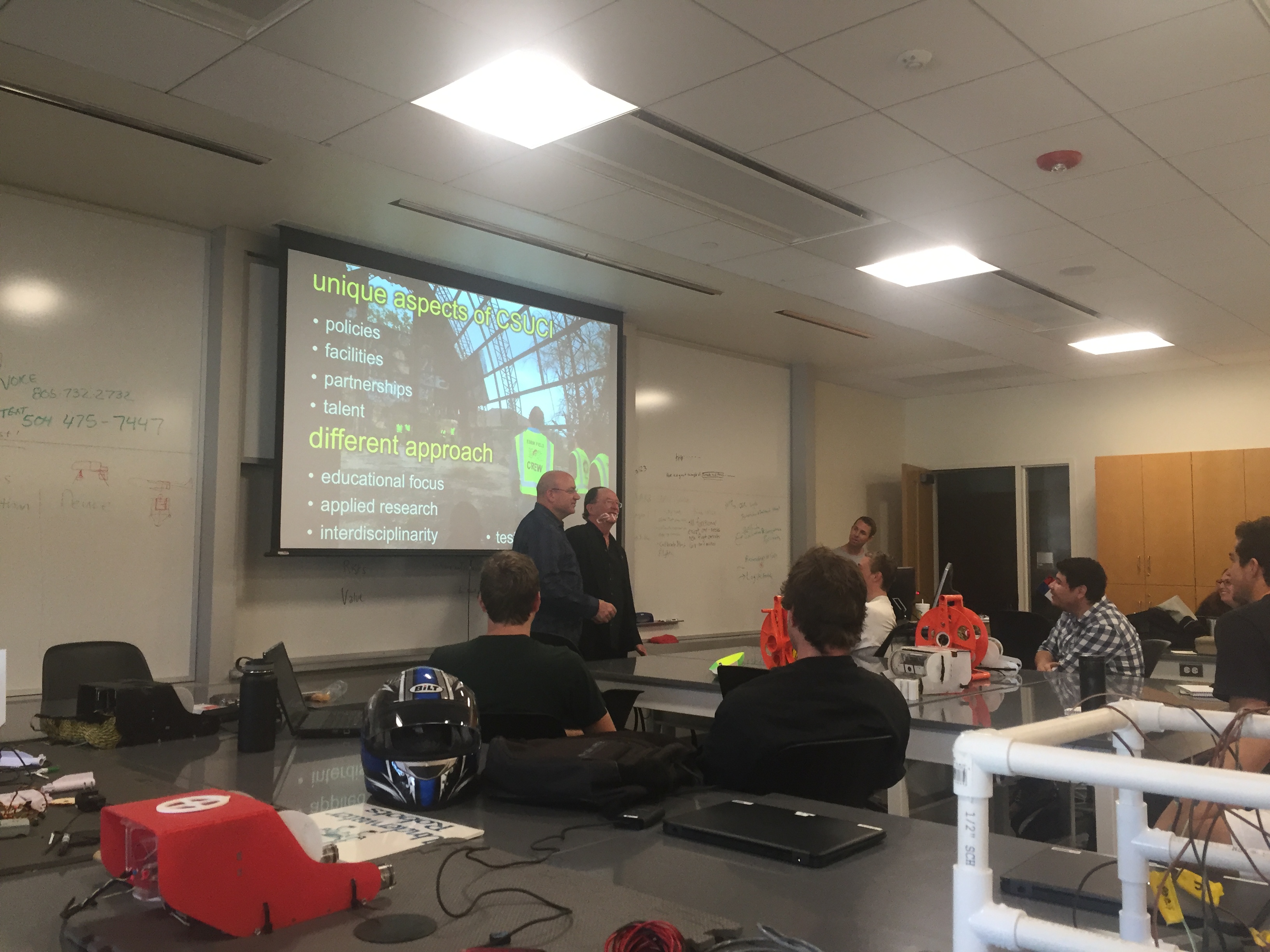
Our AARR lab is continuing to grow, with new students joining us from our ESRM 370 “Remotely Piloted Systems” class. The ESRM 370 class today was very special, starting with an inspiring speech and visit from CSUCI’s President Rush. After, we had an informative presentation regarding the legal side of UAVs, given to us by Jonathan Rupprecht.

IMG_3351

The AARR lab is now looking forward to new projects in the coming weeks, including more mapping, building, and of course soldering.

ENVI Access

I found out some good news today from professor Patsch. I will have access to ENVI from a school computer in about a week or less, which will allow me to do the Dark Object Subtraction from all map years. Atmospheric Correction

Heading to TPSNR Tomorrow!!!

I am so excited that my TPSNR collection permit went through! I will be heading to TPSNR tomorrow to collect Torrey pine pinecones. While collecting the cones, I will record the location of the tree that the cones are collected from on a GPS device. Once, I am finish collecting the Torrey pine pinecones, I will then remove the seeds, which are going to be used in my common gardens experiment. These seeds will then be planted this Tuesday, February 16, 2016, in the CSU Channel Islands greenhouse.

You can see a drop of sap dripping off of the pinecone.