
Intersecting Identities
We are never just one thing. We never even really have one role ever. Everyone is a son, daughter, mother, father, teacher, friend, partner or something else to someone else. And in some ways these labels and parts of who we are make up our identity. All of this is a good way to start to see the world, that each person is a sum of parts. However, many of these labels and identities people did not chose and have no control over. No one has a choice in black or white or Latino. It is all a chance of birth. A persons identity and which parts they see as most important or relevant to themselves is mostly socialization. Within the study of social identity and the role of the world around us in shaping who we are, the cycle of socialization is a great way to understand how people make sense of who they are.
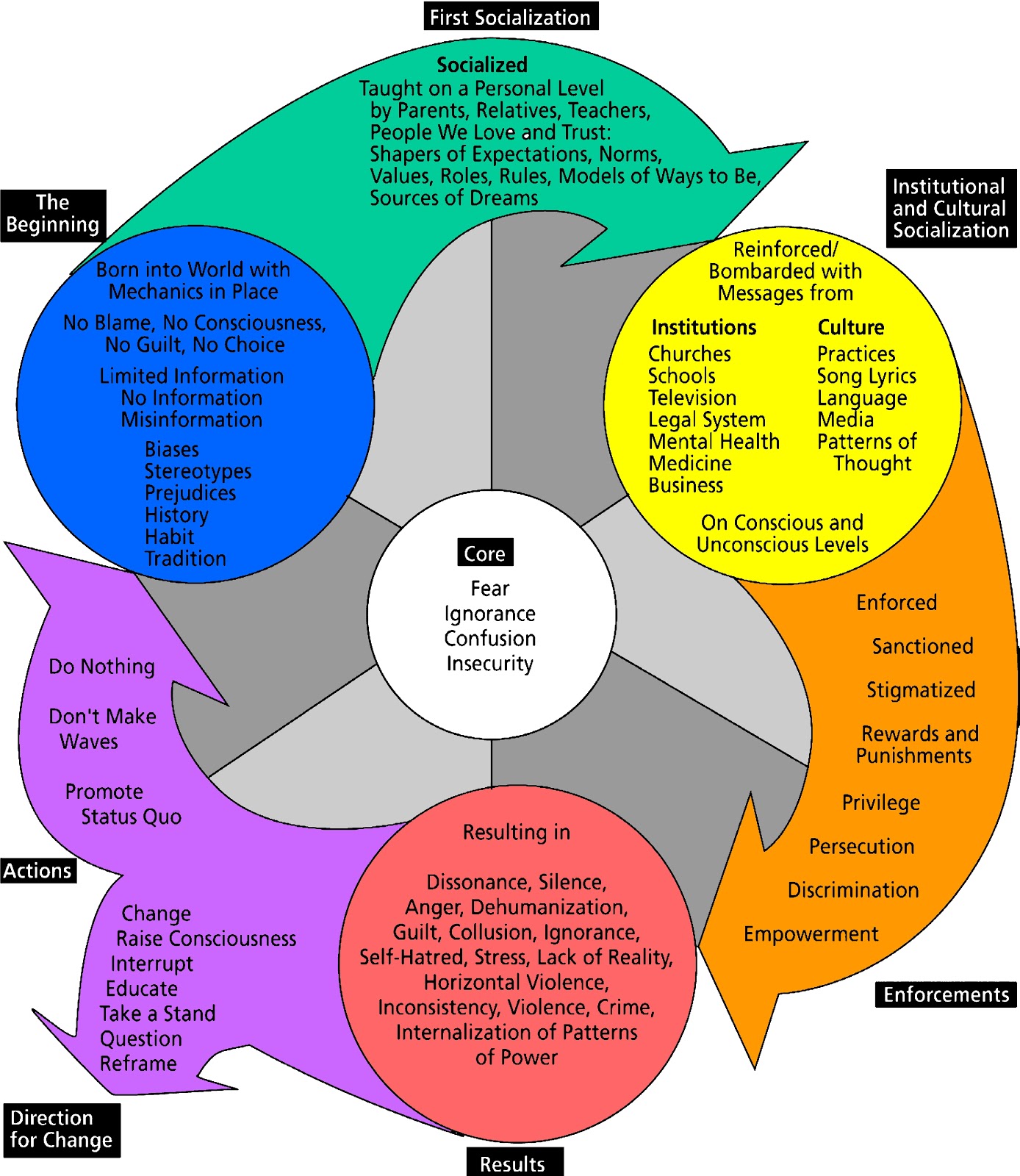
The best way to understand the cycle of socialization is with an example. My own identities are female, white, straight, hard of hearing, middle class, and student to name a few. Now most of these I had no choice on. Let’s take what it means to be female through the cycle of socialization.
First, I was born. Belated congrats to my parents! I came into this world not even really knowing I was female, let alone having the information about what it means to be a girl in the world.
Second, is first socialization from parents, teachers and mentors. This is shapes expectations and values that are important later in life. Personally, I was lucky in this department because my parents were raising all three of us girls to believe that we could be anything we wanted. I was lucky in my other main role model too-my girl scout leader Naomi. She encouraged skills and belief in all of her scouts.
Third is where the outside world (institutions and our culture) either reinforces or bombards people with messages. This is where being a girl ran into some challenges. Television and media, for example, were still telling the message that women were less than men or that there are certain ways to be a girl. Princesses get rescued. Girls can’t throw. Superheroes weren’t for girls. Then there were different messages that girls should like clothes and shopping. (Personally, I only like shopping if its for books).
Forth, messages from the world are reinforced. In school rewards for guys were some times superhero stickers or something along those lines. The girls on the other hand got rainbow stickers or pink hearts for their stickers. It was considered weird if you were a tomboy sometimes. Other kids in elementary thought I was strange sometimes, because like the boys in school I had a Pokémon field guide.
Fifth, is the negative result those messages and reinforcement can have. For me it resulted in silence. I was sometimes almost ashamed of my geeky nerdy side. I would still watch the shows in private, but I wouldn’t talk about them. It was more socially acceptable for guys to have those interests, not girls.
The sixths and final step of the cycle is a choice. You can either choose to accept the status quo and be a part of that message and system or you can challenge to change it. For me I am taking a stand. Women can and do like science fiction and fantasy. We can and do like superheroes and anime. And the women in these media rescue men not the other way around. In fact, women want more heroines and are lobbying for more female superheroes that get equal air time with the men.
 When thinking about end of life (EOL) care for myself, I find the considerations very different than those for my clients and even for my family/loved ones. At face value, it seems impractical to state my wishes as I am so “young,” but after further reflection, it seems extremely suitable given our knowledge and experience through the nursing program. I know that I would not want extreme measures taken to keep me alive if something were to happen. Although we can state specifics in an advanced directive, such as interventions that are time-specific, I have discussed this topic in great detail with my family members and vice versa. I started asking the tough questions and really taking the time to understand the wishes of my family members and various loved ones beginning in MedSurg II. They understand and respect my wishes as I do theirs, so I feel comfortable leaving the decisions up to them. I feel most comfortable designating my father as my power of attorney. He has medical experience as a firefighter and EMT, which is why my passion for the medical field began at such a young age as I was exposed to graphic pictures, stories, and medical terminology. Although the decision(s) would be incredibly difficult and painful for him, I know that he would be able to speak and listen to a multitude of doctors and other health care professionals in order to make the most rational decision possible about my fate, irrespective of his bias.
 Due to my experiences in the clinical setting, I believe culture plays an enormous role in the matter. In speaking to many about EOL care over the last year, I realize that the latest “fad” seems to be that Caucasian parents do not wish to be a “burden on their children.” Most people would choose not to live with their children regardless of their physical or psychological ailments. However, my parents and I had a heavy-hearted conversation about the genuine meaning of those statements and I shared my thoughts on the situation. I stated that I feel opposite from them and if they had a condition of some sort that they needed assistance and did not have to be in a medical facility or hospital, I would want them to live with me despite their feelings. This has been a recurring conversation with both of my parents, but I feel as if we have finally understood each other. They no longer state that they “don’t want to be a burden” on me. I know that each family feels differently and I do not believe there is a “right” or “wrong” way to feel. In fact, I am aware that many families believe the children should always care for their parents. Irrespective of the decisions, EOL care and personal wishes need to be discussed so they can be respected. It should no longer be kept silent, because it may just be too late…

