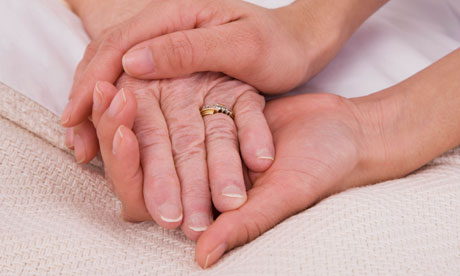
End of Life

Although this is a difficult topic for some to discuss, it is absolutely necessary. As nurses we are subject to seeing more death and dying in one year, maybe even one month, than others will see in a lifetime. I think because of this nurses build up this resiliance to death and dying and in many ways you have to. However, with that being said, it is important to retain your compassion, practice empathy, and always ask yourself how you would want to be treated if you were in that patient’s and family’s shoes?

Death and dying is really nothing new for me and is a conversation that was brought up very early in my engagement to my husband because at that time we were unsure of my mother’s chances of having Huntingtons Disease, as well as my own. I grew up watching the end stages of my grandmother and uncles lives and currently see my aunt’s struggle. The nursing care that my family received from home health nurses inspired me to become a nurse as they were able to bring comfort to my family members in a way I couldn’t. In addition, these experiences with death and dying made me think about how I would like to be cared for and  what interventions to prolong my life I desired. Nursing school has certainly provided me with some insight as well, as I would not want to be stuck in a long-term vent setting for the duration of my life. I think my mother would be the best person to make decisions for me along with a nurse friend who could provide my mother with some insight. My husband is not capable of giving up on anything in his life and certainly not on me, therefore he really wouldn’t be the best person to make health care decisions on my behalf.

I had the conversation again with my family this week asking about what they would want. My husband wants me to allow all possible medical interventions and would never want me to ‘pull the plug’ on him even if they said he was brain dead (even with a nursing student as his wife who was explaining to him that he was indeed dead at this point, he still refused to hear that I would let him go). My mother shares similar thoughts to my husband as she believes a miracle would eventually occur that would reverse these signs of brain death. It is funny how a conversation that is so serious can quickly change into a light-hearted conversation, and I had to ask each of them again in a serious manner to get a real answer in which they both replied that if there were zero signs of life and no possbility of coming back then they would like to be let go.

I continued to discuss end of life care with my mother and we discussed that the above response would be appropriate if this was an acute situation such as a car crash. However, my mother did say that if she were to suffer from a long term degenerative disease such as all her siblings she would not want the g-tube feedings, or any other interventions that would only prolong her mere existance (to which I share a similar view). I was able to finish the conversation by requesting my parents to fill out advance directives which they completed.

Protected: End of life care

This content is password protected. To view it please enter your password below:

End of Life Decisions

shellll

After working several years for a home health and hospice agency, I have cared for several hospice patients and have developed a deep appreciation for hospice. Ideally, I would want to go experience end of life in the comfort of my own home with hospice services. Realistically, however, death can occur in many forms and in emergency situations, I think the best person to help make decisions for me would be my fiancé, or a close friend that can make informed decisions. I believe that culturally, my family being Latino have traditionally relied on family members to help support one another on decisions like these, and without a doubt my family would appoint either their significant other, a sibling, or children as proxies. I have had discussions with my family members about end of life care, but have not officially completed advanced directives. I think as I continually bring up topics like these, my family has become more comfortable discussing this topic and it has become easier to have a serious conversation regarding end of life. When I tried talking to my family members about my personal decision of who my proxy was, they were a bit surprised to discover that I had not selected my parents as proxies. I believe it goes back to the cultural aspect of always using family members. I have decided to appoint a close friend, and my family was very surprised that it was not a family member, but they do understand my reasons.

A Trip to Remember

Before leaving for the trip, our class learned some history about New Orleans, the culture, and the devastation Hurricane Katrina caused, but actually being in New Orleans and experiencing the culture and actually seeing the devastation that Hurricane Katrina caused was not something I would have ever expected to experience. What touched me the most about this trip was speaking with locals that had experienced Katrina and hearing their stories, speaking with professors who care so much about their community, hearing about the lawsuits against big oil companies to clean up and restore the wetlands, and reporters who wrote about the storm, issues, and politics of New orleans. In addition to all this, we were able to do hands on work to directly help the cause. I learned so much trudging through the swamp, identifying native and invasive plants, collecting data, learning to work with different teams, and overcoming many types of discomforts. Lastly, I left New Orleans with my eyes opened to the issues they face and the politics that go with it. I am now aware of the problems and hopefully will be able to make others aware too by education, more research, and political actions. I thank CSUCI and Dr. Anderson for the amazing opportunity to help, be involved, and to learn about this fragile area and its amazing culture and history.

IMG_4687


I got to learn how to cook a creole tomato sauce over shrimp and rice.

IMG_4617


Learning from the great Dr. Nelson from Tulane University about the levee system in New Orleans.

IMG_5087


Enjoying a wonderful evening at Woodlands.

IMG_5004

Got to meet an amazing trumpet player Irvin Mayfield.

End of Life Discussion

My first true encounter with end of life was when my granddad passed away last February. In the last few months of his life he was experiencing progressive cognitive decline with dementia, multiple TIAs/strokes, physical decline such as being unable to care for himself, and frequent  ER visits and hospitalizations. Eventually he could no longer be cared for in his home, so he moved into a board & care, and eventually he experienced another stroke and developed pneumonia. He had been in the hospital for a couple days for this admission and we knew it would not be long. On the morning he passed I was woken up by my mother stating that the nurse at the hospital had called saying his breathing had changed and that we should go over. I was unsure of whether or not I would be able to witness his passing but I went to the hospital with my parents, grandmother, and aunt regardless because I knew I would regret not going. And I was very glad that I went; although it was difficult being there in his passing helped to bring a sense of closure and we were able to be there together saying goodbye.

Luckily before this had happened my mother had initiated a discussion with my grandparents regarding their wishes regarding end of life. With the information out in the open we did not have to worry about making the difficult choices when my granddad became ill and were able to focus more on the time left together. This event also prompted my mom to open the discussion regarding her end of life wishes and to create an advanced directive. She has shared her wishes with me and she has made me her secondary healthcare proxy after my dad due to my healthcare knowledge. My dad has not outright talked about this end of life wishes with me, but through talking with my mom she has shared that his views are similar. Neither of them want to prolong their life to the point living chronically with a breathing tube, feeding tube, etc. I feel the same way, and I suspect that the majority of us would agree after our experiences. I would 100% trust my parents, especially my mom due to her nursing experience, to make the right decisions for me if it were to come to it. However I have not had this discussion yet with my sisters, which would be a good idea to have next time we are all together.

Image: http://static.guim.co.uk/sys-images/Society/Pix/pictures/2010/12/30/1293727279713/Only-4-of-people-have-a-w-007.jpg

Protected: End of Life Decisions

This content is password protected. To view it please enter your password below:

Protected: End of life

This content is password protected. To view it please enter your password below:

Interview