
Archive for month: April, 2015

End of life….
 My husband and I were in the car on our way to visit family for Easter, I looked at him and asked him what he would want for end of life care. I tend to bring up random topics during our car rides, but this particular topic took him by surprised. He asked me what I meant by end of life care. I knew I had to be more specific with the topic. I started by asking him if he would want me to make health care decisions for him if he was in a state he could no longer do it for himself. His response will be with me forever. He told me that he trusted that my decisions for his care would be out of a place of love and years of knowing how he would want to live his life. I was deeply touched by his response and I knew that I felt the same. We both had to lean on each, when we have lost loved ones in the past, but it did not prepare us for talking about the death of each other and I knew it was important for us to explore our feelings.
Our wishes and desires were similar. We both had buried loved ones in cemeteries and felt that even though our loved one’s physical bodies were there, we did not feel that their spirits were. We both agreed to have our ashes spread in a location that was filled with happy memories we both shared. Additionally, I brought up the option of donating our organs. I explained to him that the pink sticker on our drivers license that states “organ donor,” will over ride any feelings of opposition he may have to donating my organs. He then expressed how he would honor any wish I had to donate my organs. I told him that I wanted to specifically outline how my body was going to be donated. I wish not be used for research, because I still want a part of me to remain with him. The conversation during our car ride was harder than I originally thought it would be. The car ride showed me that this should be one of many conversations to come and that both my husband and I should set aside dates that we would begin to outline an advanced directive. I feel that this conversation brought us closer. I am starting to realize the importance of an advance directive beyond advocating for my patient’s wishes to be up held, but to make these situations easier for my loved ones.
Copyright basics
We are not always as conscientious about copyright laws as we should be. Do you understand copyright? What about the photos you post? What about the presentations you put together? As you prepare your presentations, and continue to blog, I wanted to be sure you are informed and are aware of creative commons. CI Teaching and Learning Innovations site has put together a great resource about copyright. Check it out!
Design Doc

second project
Over 120 Dives!

At first we were nervous about such an inexpensive and user created platform such as OpenROV for performing oceanic research. Comparable systems cost 10 times the price, but are unfortunately out of the reach of our funds. The OpenROV 2.6 units had a lot of problems with the motors, and we had concerns with durability. The new 2.7 unit has been so much more robust in just about every arena and has been a great tool. With just a few tweaks we have repeatedly and consistently collected data.
The team is finally getting settled back into repair, design and build mode after spending a combined three weeks deploying ROVs on Santa Rosa Island, where our Research Station is located. The total combined deployments has given us a total of over 120 dives. We are working on two research projects, a Marine Protected Area health study, and a subtidal/intertidal ecology study. The majority of the dives were done with our two transect duty 2.7 OpenROVs: The Remote Underwater Mariner (RUM) and The Black Pearl. We’ve learned quite a bit from using them on such regular intervals.
Lessons learned:
- The motors need to have a strain relief on the copper windings to prevent breakage of the wire and subsequent shorting.
- We used hot glue to better attach the windings to the rear of the stator, avoiding getting glue on the rotor and interfering with the motor mounts.
- The ROV should always be slightly positively buoyant, we use the hold depth function which works great for running transects.
- On one of the last 60 meter transects, our ROV’s tether became completely and utterly tangled in kelp due to heavy surge. Harsh conditions and attempts to pilot out of the tangled mess resulted in the tether being severed at 30 meters from the launch site, because the ROV was slightly positively buoyant, we were able to retrieve the ROV!
- The out of the box balancing of our ROVs needed to have some ballast adjustment because of the tendency to pitch forward on straight transects.
- The video transects we perform require a higher quality video, so we use two GoPro cameras, a forward one and a downward facing one. We mount them on a 3D printed rail system that Paul designed, with PVC skids for protection (the side outrunners are for the intertidal system.) The rail allows for adjustment of position for balance and ballast. Some additional high density closed cell foam floats from fishing nets were used to offset the weight, and provide more buoyancy in the rear.

- The topside adapter boards need to be fully sealed off. One of ours died due to corrosion from sea water splashes, and moist conditions.
- We have a small pelican box with a battery powered wi-fi access point, the wires pass through holes we drilled and then filled with hot glue. This enables us to connect by wi-fi using our toughbooks, with all of the ports sealed.

Two absolute necessities for repeated deployments are a tether management reel (a commercially available slip ring works well to allow the spinning) and if working in uncovered areas, a laptop shade!

End of life

I grew up in a very traditional Mexican family having a difficult time acculturating to the American values and lifestyle. In America, it seems almost customary to have a living willor an advanced directive completed before a loved one is at their life’s end, however in Mexico, this is not necessarily the case. The family (i.e. husband, children, etc.) routinely make the difficult decisions about end of life care because death and dying are not normally discussed within families. In Mexico we celebrate el Dia de los Muertos (Day of the Dead), a day that honors the dead with festivities, lively celebrations, food, drinks, and activities that the deceased enjoyed, however this remembrance only focuses on the deceased and does not consider those who are at their life’s end. In our family, we never brought up death and dying. My mother was very adamant against having this conversation even when her parents were very sick.
Because of this resistance, I had never stopped and thought about what I want for my own end of life care until I started nursing school. As I become more knowledgeable about the death and dying process though theory and clinical experience, I know I do not what to be in a situation where machines, tubes, and wires are prolonging my life if the life I would have with these interventions is not worth living (quality of life is poor). In clinical I see this dilemma time and time again where the family is not ready to let their loved one pass. They continue to prolong life when there is no hope or possibility of ever recovering. I feel that this selfishness only adds to the pain/suffering, hospital cost, delays the grieving process making it much harder to let go. I think my younger sister would be the person that would be able to make the hard decisions for me. My family is very supportive but they all would have a hard time letting go.
I sat with my family over the weekend to discuss these issues and they were not very receptive as expected however opened up as I provided them with more knowledge. I think my best approach was to give examples and possible consequences for end of life care. Although my mother thought it was grim even talking about it she expressed that she dis not want to be suffering or have her life prolonged by artificial means if they have a poor quality of life to live. Poor quality of life to her meant she would be in a vegetative state not able to participate in daily activities. My mother agreed that my sisters would have a hard time making life choices and though my youngest sister and I would be able to make them for her. My eldest sister on the other hand was not very receptive. She thought that there was no need to talk about death and dying. I tried the same approach as I did with my mother, but she would not discuss the topic further. I think she needs time to process the information before approaching her. I was glad she listen to me to some extend because I can see that it made her think about it.
Pull the Plug
Having discussions about end of life and the type of care that we want is extremely important. When I was in 8th grade my grandma suddenly suffered a brain aneurysm. She survived her trip to the hospital but was intubated and on mechanical breathing with a poor prognosis. It was her wishes if it looked like she would to not remain like this if there was only minimal or no chances of her ever getting off life assisting devices. All of my family was there when stopped everything and she passed. While still devastated, at this age I could understand that this was what my grandma had wanted.
At the same time my mother talked to my sister and me and said she wanted the same thing. My mom said she never wanted to be hooked up to machines, to stay that way and never get off. And she has been open about her wishes ever since this time. She has since made me her medical power of attorney. I think this has helped me to be open about my desires as well. I have shared these desires, which are the same as my mom’s and my grandma’s, with my fiancée. And I had to ask him if he could pull the plug. He certainly did not like the topic and did not want to talk about it at first. However, I told him you never know what’s going to happen in life and it is best to always be prepared then to make someone suffer something they do not want. I told him what happened to my grandma and how she was the epitome of health, always busy always running around. And then so suddenly on life support. He finally said that he would pull the plugs if he had to. When prompted for his wishes in the same situation, he wanted the same as me. I think it is very important to discuss and be open with your family and loved ones about the end of life.
Semester Project Update
My data collection is running a little far into April, but it is all really dependent on the planting season in the agricultural fields. I have already seen some evidence of upstream agricultural activity impacting the amount of trash, even in a dry channel. Hopefully this weekend or the next will be the last time I go out to monitor the channels. Looking forward to seeing some changes.
Presentation
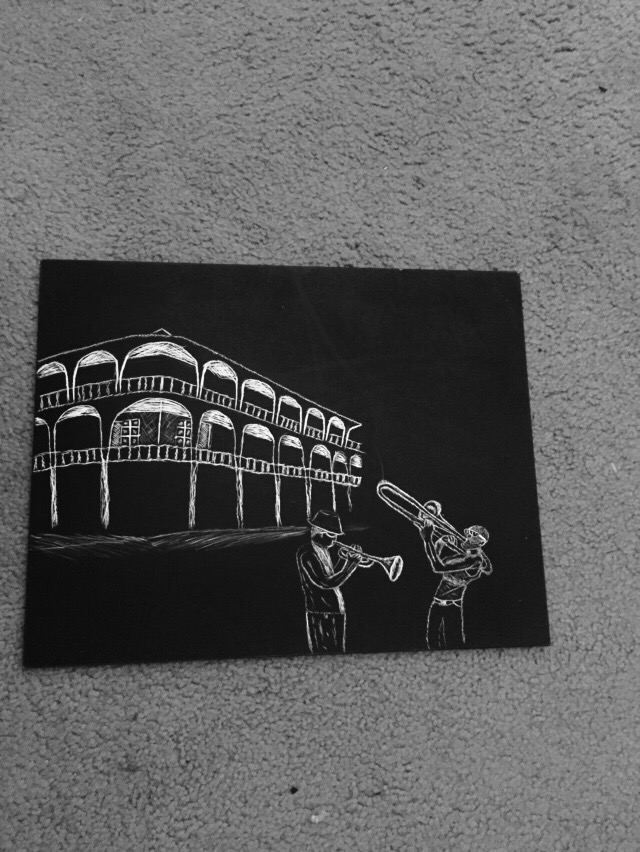
Been working are this piece all day. It’s coming along great. Listening to Irvin Mayfield and working on my project is a great combination!!!
Farewell Dolphins, Fight on Trojans!
So I guess the name of my blog is pretty appropriate; shift happens. This is definitely not a blog announcement I thought would happen after completing only three months in a new job. I’m nearing my ninth anniversary (June 6) at CSU Channel Islands, a place that has become a second home to me. But I will not reach a tenth anniversary.
I am beyond thrilled to share that I have accepted a position as Assistant Professor of Clinical Education in the Rossier School of Education at the University of Southern California (USC). In this position (that starts July 1, 2015), I will teach master’s students pursuing a career in student affairs and doctoral students pursuing leadership roles in education.
Teaching has always been my passion (inside and outside of the classroom); inspiring others to achieve their dreams remains my catalyst. I have a fire within to change our educational system into one that supports the success of all children equally, and I can’t imagine a better way to direct this fire than to prepare future leaders. Even in the most difficult teaching situations, with the most disgruntled individuals, I leave the conversation knowing that I love what I do (I read this blog post today that resonated with this change). I’ve lost sleep over this position, not because I was worried about getting it (since I enjoy my current role and LOVE my team), but because I feel so excited about the opportunity. I am so impressed with the purposeful planning and execution of the programs in Rossier that are infused with innovation, the care taken to set faculty up for success, and the commitment to making an impact in urban settings.
This excitement does not come with some sadness. I applied for this teaching position last September, before I started my new role as an Instructional Technologist; otherwise, I would not have been job searching since I have been enjoying my job. I am sad to leave this impressive team that has been so welcoming. I am sad to leave a University that has been my home for nine years, but I am thankful for the opportunities CI provided me. It is in large part BECAUSE of CI that I feel prepared for this position. I have had the chance to create, reimagine, and redesign programs across campus. CI created an environment that has fostered my innovative nature and commitment to excellence. I have worked with/in three different Divisions at the University: Student Affairs, Academic Affairs and Technology & Communication. In Student Affairs, I worked with Student Leadership Programs, Assessment and Strategic Operations, New Student Orientation, Campus Recreation, and Career Development Service and served as a Judicial Officer and Student Government Advisor. In Academic Affairs, I taught in the Communication Program, University Experience Program, Liberal Studies Program and served as a co-creator of the higher education emphasis in the Masters of Arts in Educational Leadership. I was also a member of the Collaborative Online Doctorate in Educational Leadership committee. In Technology and Communication (with the Teaching & Learning Innovations Team), I have been fortunate to lead the Blended Learning Preparation Program for Faculty and helped to initiate CI Keys, a project that facilitates open connected education and is at the forefront of innovation.
Needless to say, I have given a lot TO CI and I have gained a lot FROM CI. But my biggest gain isn’t about a list of programs or duties, it is from the students whose lives I have impacted (and who impacted mine) and colleagues who have continuously helped me be a better professional and person. Although it is somewhat bittersweet, I think it is time for me to spread my wings. As a first-generation college student, CI instilled the confidence in me to pursue my dreams.
I feel like I have left my footprints at CI and
I KNOW CI has left footprints on my life.

Thank you to each and everyone of you at CI for your support, and thank you to USC for the opportunity.
Farewell Dolphins and Fight On Trojans!!


