OpenROV Live Posting

We will attempt to post info about our subsurface trials of our deposited oil surveys here today, assuming we have connectivity.
https://openexplorer.com/expedition/refugio/#post-3663017




We will attempt to post info about our subsurface trials of our deposited oil surveys here today, assuming we have connectivity.
https://openexplorer.com/expedition/refugio/#post-3663017

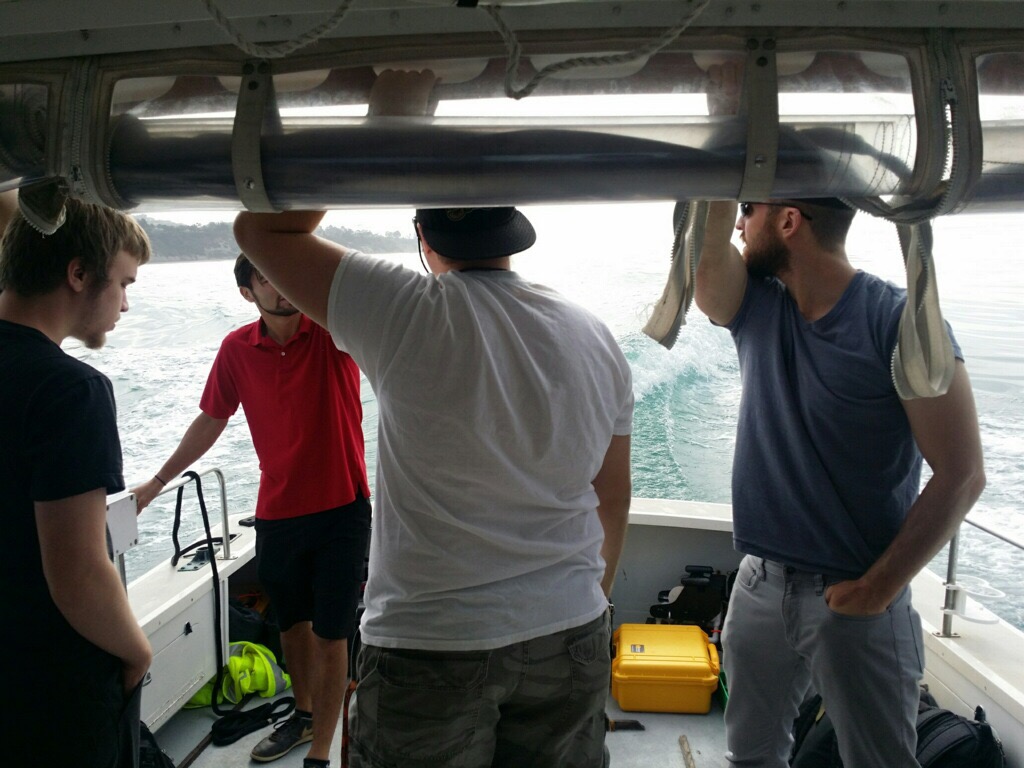
Dr. Clare Steele & ESRM students at Ormond (Arnold Road site) on June 3, 2015.
We sampled our two beach sites at Ormond Beach yesterday. As with our beaches in west Ventura County, we found a generally light to moderate tarring along the strand line. It was consistently patchy with the majority of the beach being only lightly tarred. We did also detect an oily sheen within the sand matrix towards our Arnold Road sites, indicating the beach was hit with a slick in addition to more weathered tar in the last several days.
We found a dead round skate and a California sea lion within the wash zone when we arrived in the early morning. As you would expect in June, we had relatively few shorebirds, but noted several California least tern breeding pairs and many snowy plovers. Most plovers were back in amongst our dune complex, but a few were outside in the main beach area. While I saw the plovers frequently running in and out of the tar/wrackline, I did not see any direct feeding within the tar or direct interactions with the tar itself.
Tar clean-up teams had not yet arrived to clean-up Ormond at the time of our surveys. They were slated to arrive the next day, June 4.
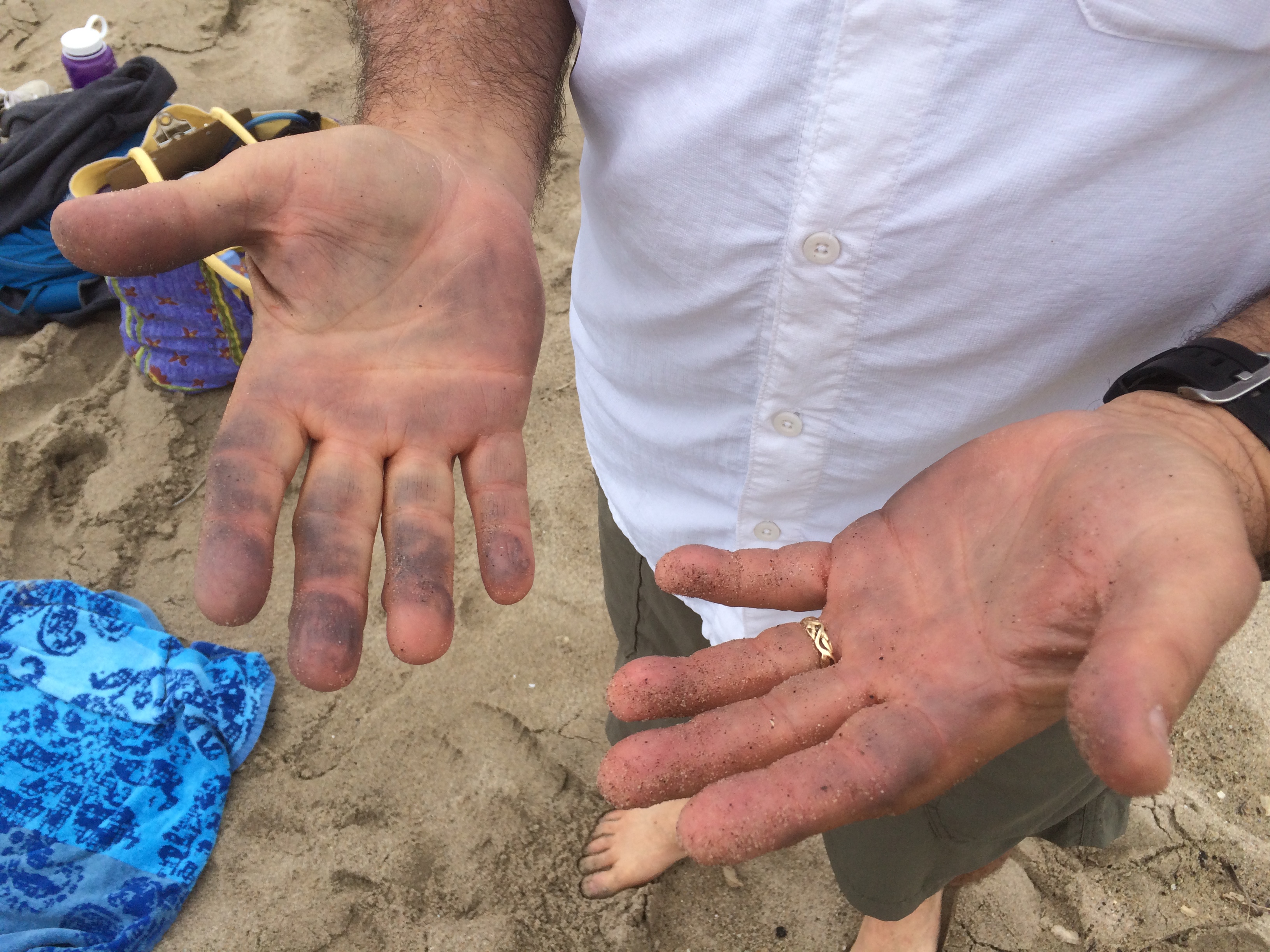
Dr. Don Rodriguez’s hands covered in a light oil sheen following our regular sand coring, indicating an oil sheen hit the beach sometime in the preceding several days. June 3, 2015.

Moderate tar strandline at Ormond Beach. June 3, 2015.

A dead California sea lion at Ormond Beach. This individual was newly located this morning as the tide receded. This photograph was taken several hours later after turkey vultures had begin to attack the carcass. No external oil was evident. There was a similar lack of oil in the nasal and oral cavities. June 3, 2015.
Now we are seeing additional tar balls in Long Beach (in southern Los Angeles County).
This tarring pattern has become all too familiar. We think we are done with the oil “rain,” then we get a highly patchy deposition event which tars beaches with moderate to light tar balls (and occasionally an oil sheen). The event produces a highly variable deposition over several miles of coastline. In turn, this leads some of the public who happened upon a relatively high concentration of tar balls to say “oh my God, there is so much tar here compared to what we normally see here…this is horrible” and others who happen upon a low or non-existent level of tar say “oh my God, this is nothing and totally overblown…this is such a manufactured crisis.” The Joint Incident Command will issue a press release saying it will take a long-time to chemically fingerprint the oil (see my previous post), but they will treat it as related to the Refugio oil spill until they get evidence otherwise. They will then send in a bunch of contractors to walk the beach/pick-up the tar.
We saw this happen in southern Santa Barbara County. Then northern Los Angeles County (the mid Santa Monica Bay/South Bay Cities). Then Ventura County. Then along the Malibu Coast…and now southern Los Angeles County. If this petroleum is not pipeline oil, it is an amazing coincidence.
As of four hours ago, the LA Times is reporting:
A four-mile stretch of the coast in Long Beach was closed Wednesday evening after tar balls washed ashore, threatening the safety of beachgoers, authorities said.
The small pieces of tar began spotting the sand earlier in the day between 1st Place and 72nd Place, said city fire department spokesman Jake Heflin.
Cleanup crews are working to remove the tar, he said.
The U.S. Coast Guard has collected samples of the tar balls for testing, which will help pinpoint the source of the petroleum product. Officials said there was no sign that the tar balls came from operations by the Long Beach Gas and Oil Department.
Laboratory testing will help investigators determine whether the tar traveled from Santa Barbara County, where a May 19 oil spill released as much as 101,000 gallons of crude. An estimated 21,000 gallons of oil spewed into the Pacific.
In recent days, tar balls have washed ashore in Ventura County, Malibu and the South Bay, where a nearly eight-mile section of the beach was closed for three days last week.
Long Beach city officials have advised people to stay away from beaches, cautioning that the tar may irritate skin or cause longterm health effects.
June 2nd and 3rd are the peak spawning days of the year for our California grunion in 2015. These fish are laying eggs and sperm as I type this into some of our newly tarred high tide lines across SoCal.

California grunion eggs from about 1″ down into the sand at Marina Park (Ventura Harbor), Ventura County.

California grunion running at Marina Park beach in Ventura, CA at 23:00 on June 6, 2015.
 Scroll to top