The main reason I am excited to be part of this trip is that we get to study a beautiful part of the world that has had very little previous research conducted in it. The methodology we are using to study the area, unmanned systems, is particularly thrilling to me as well. Not only that, […]
https://cikeys.com/wp-content/uploads/2026/09/ci-logo-ciKeys.png00Sean Andersonhttps://cikeys.com/wp-content/uploads/2026/09/ci-logo-ciKeys.pngSean Anderson2015-07-21 23:30:402015-07-21 23:30:40Why I am Excited for this Trip
Going on this trip to the Cook Islands, I am most looking forward to the overall experience I will be getting out being given this opportunity. First, I am not a very experienced traveler, so I feel like the traveling on this trip better prepares me for future endeavors where large traveling is required. Also, […]
With global warming on the rise, small island nations are already noticing the negative effects. The Cook Islands are said to be the subject of drastic sea level rise within the next 25-40 years. With that, the residents of these islands must face the harsh consequences that affect the things they are most reliable on: […]
As part of this research trip to the Cook Islands, I’m bringing my payload for the OpenROV which has been designed, developed and tested to excite and detect fluorescent proteins in coral reefs. This work is in partial completion of my masters degree at Plymouth University, UK where my research is being completed at Plymouth Marine […]
https://cikeys.com/wp-content/uploads/2026/09/ci-logo-ciKeys.png00Sean Andersonhttps://cikeys.com/wp-content/uploads/2026/09/ci-logo-ciKeys.pngSean Anderson2015-07-21 15:40:442015-07-21 15:40:44Fluorescent proteins and the British contingent
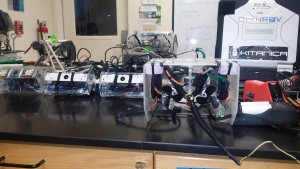
The team is working very hard to prepare for the trip, we are bringing 3 of our OpenROVs, and two our UAVs including Paul’s aerial mapping UAV. Our ROVs have all been through the ringer in the last few months and as we always have funding, we have been amassing the parts, piece by piece. In addition to needing the parts, our parent laboratory, the PIRatE lab, has been exhibiting research at events, performing ecological surveys at the Refugio Oil Spill incident, all while moving into many brand new laboratories. This is great news because we finally will have a dedicated space to work on our Remotely Piloted Systems (RPS) endeavors. Currently our robots live next to sand, oil and animal samples, marine experiment tanks, and much more! The final batch of parts arrived last week, along with some upgrade parts that we’ve been waiting for.
In the next 5 days, the team must accomplish the following:
Repair the three main ROVs: The Black PERL, Leviathan and R.U.M.
Finish 3D modeling and printing new parts for the ROVs and UAVs
Create new tether management systems for the main ROVs
Create a neutrally buoyant tether with enough tension to recover the ROV
Build and set up the aerial mapping UAV
Field test all units before leaving
So far the damaged parts consist of:
Two Beagle Bones
Two tethers
Wiring harness and end caps
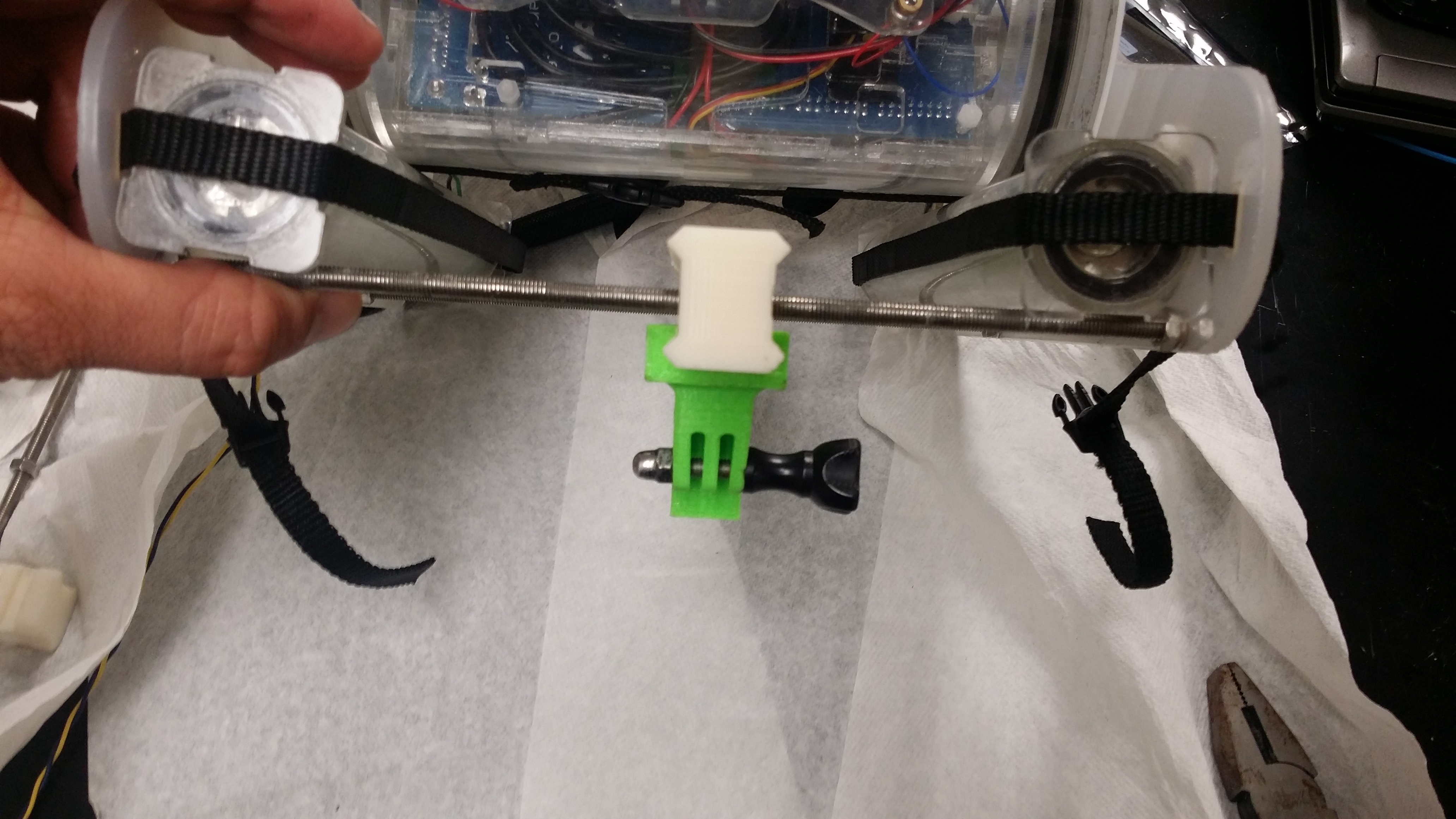
R.U.M. is fully operational and is in the process of being upgraded with Paul’s 3D printed accessory rail, and the new 2.0 IMU. The new rail can hold more than three GoPros or other equipment!
Leviathan is semi-operational and is awaiting tether replacement with the new neutrally buoyant tether. It has had the Blue Robotics motors replaced with the stock ones, and is awaiting the upgrade with the rail and IMU.
PERL is non-functional, the tether damage led to corrosion which reached into the electronics capsule. This unit will require a new wiring harness and end caps. This unit already had an older version of the accessory rail, so it will only receive the IMU upgrade.
The accessory rail is designed around a slotted rail, which bolts onto the payload bars of the ROV, then allows the payload to be positioned and bolted into place. This is especially important when trying to properly balance an ROV, and it opens the door for many options. The 3D file will be released in the near future on the OpenROV forums.
As part of the Cook Islands expedition, the CSU Channel Islands Aerial and Aquatic Robot Research Team (AARR) will be performing a number of different studies. I lead the team which is comprised of many multi-disciplinary students, under Dr. Sean Anderson I am excited to visit the islands to help the country explore and conserve […]
https://cikeys.com/wp-content/uploads/2026/09/ci-logo-ciKeys.png00Sean Andersonhttps://cikeys.com/wp-content/uploads/2026/09/ci-logo-ciKeys.pngSean Anderson2015-07-21 09:14:512015-07-21 09:14:51Remotely Piloted Systems
In collaboration with our OpenROV/OpenExplorer friends from the Plymouth Marine Laboratory in the United Kingdom, Cal State Channel Islands will be travelling together to the capital island of Rarotonga, and then to a more remote island, Aitutaki. This trip is a multi-faceted research, education and service trip. We will be brining a group of roughly 24 university faculty and students to provide support the native people of the Cook Islands with scientific investigation to the marine ecosystem health with the goal to establish long term ecosystem monitoring. We have many projects that are planned for this trip, and will be breaking into small teams. This blog will cover the Remotely Piloted Systems aspect.
We will use OpenROVs to survey the lagoons and coral reefs, with an added twist. Guy Trimby from the Plymouth Marine Laboratory has been developing a system to detect novel fluorescent proteins which we suspect are present in the corals. These proteins are important because they can be used for the detection of biochemical markers which have a huge implication in research and in medicine. Paul Spaur the leader of our Aerial and Aquatic Robot Research team has been working to set up an ROV that is capable of supporting the payload. In addition to that, Paul has been building a fixed wing UAV and will be doing aerial mapping of the coastlines and patch reefs. We will be also doing terrestrial mapping of total biomass, agriculture, and other aerial surveys.
Other teams will be doing more traditional vegetation, sandy beach, snorkel, and ecotoxicology surveys!
We will have greater coverage and pictures of our endeavors available on our blogs:
Remotely Piloted Systems aarr.piratelab.org
General Research and Travel Blog cooks.piratelab.org
https://cikeys.com/wp-content/uploads/2026/09/ci-logo-ciKeys.png00Sean Andersonhttps://cikeys.com/wp-content/uploads/2026/09/ci-logo-ciKeys.pngSean Anderson2015-07-21 07:05:132015-07-21 07:05:13Preparing for the Cook Islands Trip!
After I got over the shock of getting accepted to go on this amazing trip I first started to look at the history of the islands. I found it interesting that the British captain whose name was James Cook, that found the islands in 1773 named the group of islands Hervey Islands. It didn’t get […]
https://cikeys.com/wp-content/uploads/2026/09/ci-logo-ciKeys.png00Sean Andersonhttps://cikeys.com/wp-content/uploads/2026/09/ci-logo-ciKeys.pngSean Anderson2015-07-21 06:39:462015-07-21 06:39:46Some history
BSEE analysts have used inspection and accident incident reports from 2011 through 2014 to show that (surprise, surprise) a dangerous work place last year is also a dangerous workplace this year. Perhaps more interesting is the fact that our low-rig density region in the deeper offshore waters of the northern Gulf of Mexico have an aberrantly high number of accidents.
The red blobs in this figure are abnormally high frequencies of accident regions. See this legend:
+4SD is really, really high.
What can we take away from this? Offshore drilling is dangerous to be sure. But deep- and ultradeepwater drilling is manifestly different from the more common shallow water drilling efforts. Regarless if this is due to the inherent logistical difficulties of such deep drilling, the greater complexity and coordination that must be manifest, the relative naïveté of the operators in this new frontier, or the increased pressure for results and profit that follow in the wake of the intense capital outlays that are required to play in these worlds, it all amounts to greater risk and a more dangerous oil extraction endeavor.
See a webpage about this BSEE data here.
Note: there are no authors listed on the poster, but the program attributed the work to Allison Fischman of BSEE.
Here is that overall poster:
This poster was presented at the ESRI Users Conference in San Diego on July 20, 2015.
https://cikeys.com/wp-content/uploads/2026/09/ci-logo-ciKeys.png00Sean Andersonhttps://cikeys.com/wp-content/uploads/2026/09/ci-logo-ciKeys.pngSean Anderson2015-07-21 02:20:422015-07-21 02:20:42Accidents beget more accidents…especially in Deepwater
Medicinal Plants of the Cook Islands Link to an interesting article on uses of plants in the Cook Islands. Click on the plant below: Saltbush (Scaevola taccada)