
Archive for month: October, 2015
challenge 3 component 3
What I did this week is search my topic ” Refugee Crisis” on twitter and Facebook. The first thing is I typed it in twitter and it popped up a lot of tweets about refugee crisis and updating every once in a while about a problem in the world. The one that got me the most was a recent tweet that happened and it was a man carrying a young boy which I think it was his son not to sure maybe his nephew. But it got to me because its sad seeing that there are young kid also suffering and having to move to different countries because of problems that are happening where they live. Its really a sad thing to imagine a kid fleeing with his family. Sometimes its just the kids that leave their own family at a really young age and have to travel by themselves. . On Facebook I found a post where it took you to a website that was about the European Commission and Turkey forming a plan on helping the refugees in their country. They also finding other ways on how to come up with the money so they can create more centers in there country. A lot more other post showed up about how many countries are trying to solve this problem and how can they help refugees in their own country when they cross the border. Still some countries are strict on refugees coming in from different countries and some are boosting up their security rates and guards to stop them.
Challenge 3, Component 3 – Social Media Opens Eyes
“What is the point of being alive, if you don’t at least try to do something remarkable?” – John Green
This week we were asked to search social media for insight on our topic. The refugee crisis is such a fresh topic that I was unsure if people even knew about it, but I was surprised that I was able to connect a previous article to an event on Facebook. The University in England that I mentioned in my last post has a page for the march they are going to put on for the refugees and to raise awareness. All of the pictures and posts that they have on their page brought tears to my eyes because they are making the change. 2.2 million people were invited to this even and as of now 503 people are planning to attend. Although I wish that number were bigger I am happy that some people realized the severity of this tragedy. When I searched the hash tag #refgueecrisis on Instagram, I was in awe. I found a picture that broke my heart. On a coastline there were hundreds of lifejackets washed up on the shore along with floating tubes. This made me think about how many people didn’t make it to a safer place and had to suffer such a tragic death. We are in the year 2015 people, this should not be happening. Everyone deserves a fare chance at life. After seeing this picture and seeing that people on the other side of the world are making a difference just makes me realize that we need to do the same.
Hello world!
Welcome to WordPress. This is your first post. Edit or delete it, then start blogging!
Challenge 3 Component 2: Database Reasearch
This week we were asked to search for more articles on our topic of the refugee crisis, except we were given specific directions to search websites that are known for more credible resources. Searching the database from the library took me on a whole different path than searching the web. I came across many articles from students and journalists, and there were so many more newspaper articles from all over the world. Reading these different articles made me realize that many people are becoming more aware about the refugee crisis and some of them are actually taking action. This particular article stressed the importance about how important it is to take action and help these people who are living a nightmare. (http://infoweb.newsbank.com.summit.csuci.edu:2048/resources/doc/nb/news/1584A8EA6E3BF000?p=AWNB ) It brings up how this crisis became such a big deal to the rest of the world, which I have mentioned in m previous posts. The three-year-old Syrian boy whose body washed up face down on the shore of Turkey made the whole world upset about this situation and wanting to take action. One of my biggest questions is “Why did it have to get so bad before anyone started helping?” This led me to searching through many more articles; then I stumbled upon one that was more about information, but information that made me a very happy camper. In England there is a group of university students who have created a committee that is having a march on October 16th at 7:00 PM in order to raise awareness and bring out the humanity in people around the world to want to make a difference. This inspired me to be a part of something like this in order to make the world realize that we need to be the change we want to see in the world.
Challenge 3: Social Media Search
One of the most profound inventions created this generation has been the development of social media. Social media allows people to connect on various levels with people all over the world. With these connections the ability to share information is the highest it has ever been. With these week’s assignment we were tasked with searching through social media to find information on our topics. Through the weeks I have narrowed my search from Healthcare to just Mental Health. Lucky for me this week is Mental Health Awareness week and I was able to find many incredible stories and articles about mental health using #mentalhealthweek2015
The first social media site I used was Twitter. On twitter I searched for #mentalhealth with then lead me to the hashtag #mentalhealthweek2015. Using that hashtag it drew me to the most recent posters that were discussing mental health week. Some of the recent posters included celebrities, politicians, athletes, and various doctors. Through the assortment of posters many people were posting personal stories about themselves or others close to them who had suffered mental health problems. Searching through the posts I was able to find a couple dedicated mental health twitter accounts such as @TheWAAMH (The Western Australian Association for Mental Health) who’s tweets were dedicated to tweeting information on workshops and tips associated with getting help mentally.
After searching through twitter I decided to use the same hashtag in Instagram. Since Instagram is more focused on pictures I was not really sure what to expect would come up. Once I did my search I found various people who had suffered from either anorexia or bulimia posting before and after pictures. The users who posted these pictures then had captions insisting that anyone who believes they have a self image problem to seek help because if they can recover from their disorder then so can anyone else. Other pictures associated with the hashtag were usually motivational pictures with captions either telling a personal story or telling people to make sure they seek help with anything if they believe they have a problem.
After searching through Twitter and Instagram I found that using the hashtag #mentalhealthawareness2015 provided an abundance of personal stories and calls to action from regular users and from people who work in mental health. Well that concludes my blog for this week!
Blog #6 Challenge 3 Collect Part 3
Hey everyone. Challenge Three Part 3 was really interesting. I researched via Facebook and Twitter and found multiple great articles, tweets, and ideas from people all over the globe. What I found most interesting about social media, was that it was great to learn about different opinions from people who are not professionals in certain fields, or media members. It gave me a different lens from which to perceive the refugee crisis. For instance, some Americans may think one way about the refugee crisis, but people closer to the refugees can feel different.
I really enjoyed the results from Twitter. The Ted Talk we watched about the Twitter explosion was correct when the gentleman talked about how many news organizations use Twitter to give real time updates. The television is no longer the only way for people to communicate news, we can actually receive quick and updated tweets from across the globe. On Twitter, people can find pages and pages of tweets, articles, or videos with a simple search. I found many tweets about Kickstarter working with the White House to raise funds for the refugees. As well as links to blogs and pictures and videos of this tragedy. One picture that stuck out with me is one from Voices of Youth. It is a website that allows people, mainly young adolescents, to blog and use their minds and words to reach out to people. “No human being can be illegal.” These words really exploded into my mind. Countries and people want to refuse people refuge, even though they have nowhere to go. Here is a young girl, Lara, offering sage advice and words full of hope via blogs on social media. It is simply incredible because this couldn’t happen 10-15 years ago.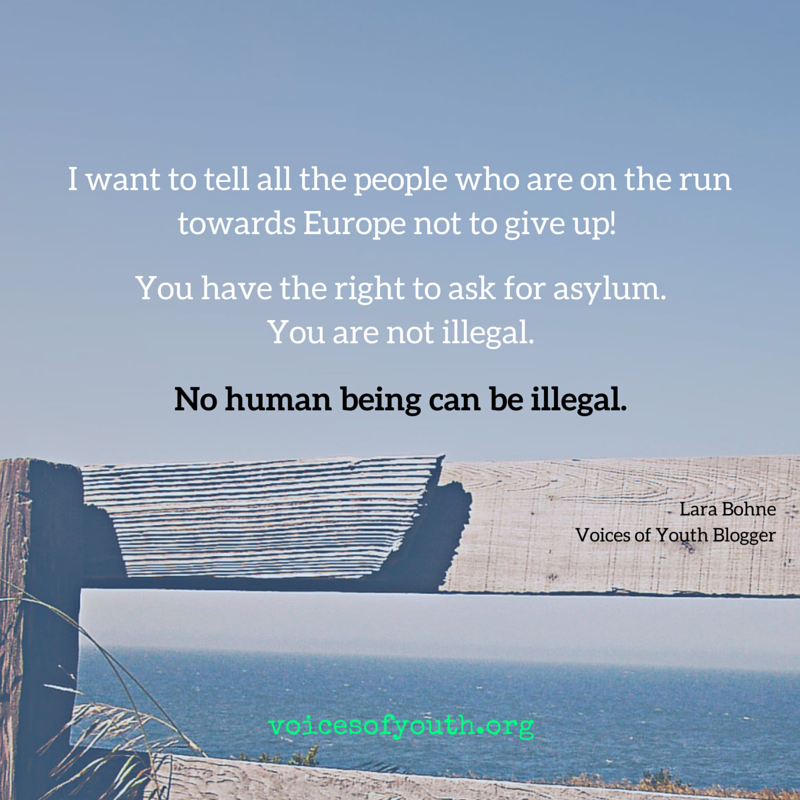
On Facebook I found similar results to Twitter. For instance, new stations like Fox News and CNN will use Facebook to post links to articles, or videos. This is also a very useful form of communication. Like Jill said, this kind of outreach that people, companies, and organizations have now was unobtainable only a decade ago. One article I really enjoyed was from Kickstarter. They teamed with the White House to raise money for refugees. The best part is all donations are completely tax deductible! It is a fantastic way to get people involved. There is also a video on the site explaining what Kickstarter and the White House are doing. https://www.kickstarter.com/aidrefugees
I believe that social media has more positives than negatives. In times of crisis or serious trials, social media is a strong tool to connect people for great causes. It was interesting to see how people view and think about the refugee crisis outside of an academic or professional atmosphere.
Social Media as a Search Tool
Good digital citizens “use the internet regularly and effectively,” according to the authors of the book Digital Citizenship: The Internet, Society, and Participation. By that definition, I think that most of us have some work to do on becoming better digital citizens. This post is the 3rd in a series that will target research on rising tuition costs (see Scholarly Research on Rising Tuition) for a Digital Citizenship class at CSU Channel Islands (CSUCI). Social media as a search tool for information sharing is the topic of this particular post.
I have never before considered actively using social media to find knowledge. I, of course, have used social media sites to read gossip and share little tidbits but never to pursue information on heavy topics. While rising tuition costs are a hot topic across the web and the world, I was intrigued by the types of conversations going on over the social media platforms that I frequent. Twitter, in particular, was a source of several jokes (see picture below) and pushing of political platforms for candidates in upcoming elections.

A large part of the conversation on Twitter about tuition is comprised of people cracking jokes
A basic search for tuition on both Twitter and Facebook generated the accompanying hashtags #FeelTheBern and #Bernie2016 which is understandable since that is a major part of the platform Bernie Sanders is running on, but I felt that these hashtags contribute little to the conversation on tuition. The focus of conversations that link tuition and Bernie Sanders, is Bernie Sanders, therefore tuition is a small piece that fits into the greater puzzle. Another trending topic on Twitter and Facebook revolves around Hillary Clinton attacking (unconvincingly, according to ALTERNET) Bernie Sanders’s stance. While I am thrilled that people are showing interest in the presidential election, these were not the types of results that I was looking for.
After sifting through the jokes and politics, I was able to find some new articles that didn’t come up in previous investigations, but little information on the major players that are discussing tuition on social media.
I will be looking more into researching this topic effectively on social media, but for the moment, I am somewhat gratified with the results and eager to improve my findings.
Until next time,
MGH, professor in Training
The post Social Media as a Search Tool appeared first on Professor In Training.
What’s Dumbing Down America?!
Chapter four’s title caught my attention and drew me into reading the chapter. Sternheimer elaborates on the recent news stories argue that the internet is “re-wiring young people’s minds, and not for the best.” That statement made me ponder, and it’s leaning me more and more to believe it. There is so much negative corrupted media out there that it could potentially send mixed signals to young viewers. These signals may have bad intentions subliminally hidden behind the message, but the young viewer isn’t aware of it and may conceptualize it for something else. Moreover, Sternheimer also refers to a Chicago Sun-Times story which discusses how the ability of graduating high school is based on the kid’s ability to reject all the nonsense he/she is exposed to in our pop culture.
Additionally, she also refers to Neil Postman’s book Amusing Ourselves to Death, which talks about how the United States has shifted from the “Magic of Writing to the magic of electronics.” I thought that was interesting because i can relate to that statement. Just thinking back on how i was brought up in a society where media didn’t have an effect on individuals, and observing what’s currently going on, has made me realize the enhancement media has gone through!
Genetically personalized dieting?
http://www.medicalnewstoday.com/articles/299364.php
This article discusses the concept that each individual’s normal intestinal flora determines what diets will work for them. Also provides an explanation as to why certain diets that some swear by, are not affective to others. Just some food for thought:)
