
A Day Without Technology

Our class assignment from last week was to attempt to spend a day without the use of technology. For me, this included Facebook, Snapchat, Instagram, and Pinterest. Unfortunately, because of my job as a nanny and Communication Chair position in a campus organization, I was unable to turn off my phone a computer completely for the full 24 hours. I did text and email during the day, but only for pertinent circumstances. Everything else I uninstalled from my phone and I’ve spent the last few days without.

I typically don’t spend much time anyway with social media or television, but it was definitely a new experience having no notifications on my phone from all the apps. I’ve kept the apps off my phone and it has been refreshing to not feel obligated to answer every single message, birthday, or update. I’ve found that I’m staying more focused on what I’m doing at any given time, rather than stopping to check something on my phone and then get back to work. I think this will be helpful in the upcoming weeks, when we are finishing up the semester, so that I can be sure that I am completely invested in my studying ans school work.

Generally, I think this is an important exercise for everyone to try every once in a while. It is obvious that many people spend a ridiculous amount of time using electronics, whether it be video games, social media, online shopping, etc, and not enough time focusing on the present. It seems as though we are so absorbed in the lives of others that sometimes we are lacking in the attention to ourselves and to the people around us in our own lives. I hope this becomes a more common realization and people are able to take a step back, leaving the technology aside to truly experience life.
24 Hour Disconnect

Let’s just start off by saying, no matter how many days I tried to disconnect from social media and electronics for a full 24 hours, I failed EVERY TIME. Although it may not be why you think I failed. I am not addicted to social media and I have an easy time putting my phone away to study and do homework. The problem is that my phone has become my lifeline. It has everything in it. This includes my work schedule, events, study groups, and homework assignments. I can promise you this: if it is not on my phone calendar or in my notes on my phone, then it might not get done. I also have a planner that helps to keep me organized, but I do not always have access to it, whereas I always have access to my phone. Another reason is that I am a nanny and must have my phone with me at all times in case the parents need to get in contact with me. I am also listed as an emergency contact for the children, so if for some reason the school could not get ahold of the parents I would be called. I take my job very seriously, so I always have my phone on me just in case. Lastly, being a nursing student, double majoring in psychology, and working is really stressful. At the end of the day everyone has their own ways of decompressing. My way is talking and venting to my boyfriend because he has been my biggest support system throughout this crazy journey. He always knows how to make me feel better. The issue is that he lives 200 miles away, so the only way we can talk is to call each other. All in all, I really did try to disconnect. It just isn’t a realistic thing for me to be able to accomplish, especially with my job.

Sepsis

Sepsis

Image result for sepsis


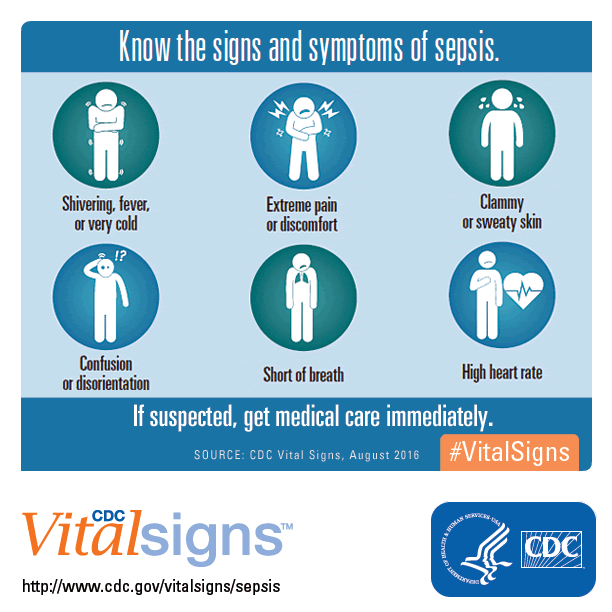
Sepsis is a state of complete body inflammation. Inflammation is normally one of the first lines of defense during the invasion of the body by pathogens. However this inflammatory state must be short lived or systemic inflammation can lead to organ failure. First we need to recognize sepsis before we can treat it. So in order to do this we need only remember the acronym

I see Sepsis patients each shift and they really exhibit all these signs and symptoms. And after a while it becomes really obvious who is a candidate for a Sepsis protocol and once you have seen one sepsis patient you will not forget it. So the next question then should be how to we treat Sepsis. There is currently a Surviving Sepsis campaign that includes early recognition and treatment of this condition. It is also becoming a core measure at most hospitals. And a core measure is Evidences Based Practice that results in optimal clinical outcome for the patients.

According to the surviving sepsis campaign the following care bundles must be implemented

TO BE COMPLETED WITHIN 3 HOURS OF TIME OF PRESENTATION:

  1. Measure lactate level
  2. Obtain blood cultures prior to administration of antibiotics
  3. Administer broad spectrum antibiotics
  4. Administer 30ml/kg crystalloid for hypotension or lactate ≥4mmol/L

TO BE COMPLETED WITHIN 6 HOURS OF TIME OF PRESENTATION:

  1. Apply vasopressors (for hypotension that does not respond to initial fluid resuscitation) to maintain a mean arterial pressure (MAP) ≥65mmHg
  2. In the event of persistent hypotension after initial fluid administration (MAP < 65 mm Hg) or if initial lactate was ≥4 mmol/L, re-assess volume status and tissue perfusion and document
  3. Re-measure lactate if initial lactate elevated.


References

Surviving Sepsis Campaign. Society of Critical Care medicine. Care bundles retrieved from

http://www.survivingsepsis.org/Bundles/Pages/default.aspx

Protected: Disconnect

This content is password protected. To view it please enter your password below:

No electronics!

This weekend I attempted to go 24 hours without any electronics (emphasis on the word attempted). I was only able to go about 5 hours without picking up and using my cell phone or laptop. Most of this time was spent reading and studying. I found this challenging because I don’t live with my family and most of my friends live too far away to see on a daily basis. For me this cell phone connection to the ones I love is important. I don’t think I could go 24 hours without texting or calling my mother. I do acknowledge the importance of “being disconnected” when the situation is appropriate.

I only ever use my cell phone in clinical to look up medications or send quick messages to my instructor. There is always a time and place to be on ones cell phones and during patient interaction this should NEVER be the case.

I paid special attention to other’s using their cell phones, laptops, iPads, etc. this weekend and found that their use was seen everywhere. I went to the grocery store and noticed people talking on their cell phones or texting when at the checkout line instead of interacting with the cashier or even those around them. I thought this activity was interesting and wish to be able to complete it one day.

Disconnecting

bansky cell phone love

This is literally what I see everywhere I go. Mothers crossing the streets holding their child’s hand in one hand and glaring at the glowing screen in the other. Couples on dates so disinterested in one another that all they do is stare in to their phone screens. It’s a sad state of affairs. I’m not immune; I’ve caught myself wasting so much time on my dumb phone sometimes that I literally do turn it off. It’s kind of disgusting the time spent on phones. There are some people that are better than others, but many are absolutely tethered to the device. I’d be concerned with how some people would function without them. Mind you, they’re not terrible. They’re very helpful for looking up medications, etc in the hospital or directions for travel. But they become a problem when we’d rather use them then interact with other people. Personally, I’m the type of person that tries to do interactions in person or at the very least via phone call. Important things I try not to handle via text or email. And I try to NEVER bring my phone out EVER in a patient’s room. That interaction is solely person to person with no phone involved. Only once has my phone come out and that was to confirm a parameter for a medication for the instructor. How about everyone else? How do you prefer to conduct important business?

(The painting is by a street artist named Banksy.)

Sepsis Bundles applied in MICU

resuscitation-in-sepsis-10-638

The Surviving Sepsis Campaign was designed to create a reliable system to take care of patients with severe sepsis. It is then broken down into “Bundles” to simplify the steps in care. Each hospital can individualize their protocol but it has to have the basics of the bundles.

Bundle one needs to be done within 3 hours. This is usually done in the emergency room.

    1.    Measure lactate level

    2.    Obtain blood cultures prior to administration of antibiotics

    3.    Administer broad spectrum antibiotics

    4.    Administer 30ml/kg crystalloid for hypotension or lactate ≥4mmol/L

Bundle 2 needs to be done within 6 hours.

    5.    Apply vasopressors (for hypotension that does not respond to initial fluid resuscitation) to maintain a mean arterial pressure (MAP) ≥65mmHg

    6.    In the event of persistent hypotension after initial fluid administration (MAP<65 mmHg) or if initial lactate was ≥4 mmol/L, re-assess volume status and tissue perfusion and document findings according to Table1.

    7.    Re-measure lactate if initial lactate elevated.

To evaluate tissue profusion and volume assessment there are two recommended options.

EITHER:

Repeat focused exam (after initial fluid resuscitation) by licensed independent

practitioner including vital signs, cardiopulmonary, capillary refill, pulse, and skin findings.

OR TWO OF THE FOLLOWING:

    •    Measure CVP

    •    Measure ScvO2

    •    Bedside cardiovascular ultrasound

    •    Dynamic assessment of fluid responsiveness with passive leg raise or fluid challenge

I had a patient in the MICU with suspected sepsis and even 24 hours her lactate levels were being measured. She had cultured performed in ER and was being administer broad band abx. We were monitoring her MAP >65 and she had received vasopressors prior to ICU placement. We did give her 2 500ml bolus which increased her pressure and reduced her HR. We performed focus exams every 4 hours and continually monitored her CVP and ScvO2. I didn’t look at the Cottage Hospital sepsis protocol but compared to the  Surviving sepsis Protocol we were following the recommendations.

Protected: Disconnect

This content is password protected. To view it please enter your password below:

Disconnecting

I was not able to disconnect for a full 24 hours because I had to use my laptop to complete some assignments but I did make some time to get out and enjoy my day. I normally go for a bike ride at night but I decided to go during the day. The route that I take leads me to a senior apartment complex and it was very heartwarming to see the older adults walking with their dogs and family. I really enjoyed seeing them walking and enjoying their day because I’ve been getting used to seeing older adults in a hospital seating. I also decided to go to my parent’s house that day and have dinner with my family instead of just calling them to see how they were doing. It was a great day and it is very rewarding when you actually take the time to visit family (or anyone) instead of just calling or sending a text.

Disconnecting

Our assignment this week was to try to ‘disconnect’ for 24-hours. My first thought was, how am I supposed to do that? I have homework, study guides, and papers to type.

As amazing as disconnecting from technology sounded, I realized how difficult disconnecting has become and felt an immediate sense of sadness. So, I decided to take on the challenge to see how long I could disconnect (without loosing too much time for homework of course).

My weekend began with grocery shopping. I went old-fashioned and handwrote my grocery list (which I usually type on my phone). While at the store, I could not help but notice that the only ones carrying paper lists were older people. They were also the only ones who smiled when I walked by. This was also the case at the art supply store I went to later in the day.

That evening, my fiancé and I went to visit his family, since his sister was visiting from Georgia. It was the perfect opportunity to keep me from going back to my computer/phone screens.  I also made a point to not take my laptop or any books (which I usually do) so that I could devote my entire attention to spending quality time with family.

It was interesting to hear everyone’s reactions when I told them what my assignment was. And by the end of our night, they even mentioned how difficult, almost impossible it was for them to even try it for a few hours.

Overall, I was grateful to have had an excuse to disconnect, even if it was less than 24 hours.