
Knowledge from the heart

To begin I want to start with constructivism relating to learning engagement. Constructivism says when students are more interactive with an activity or assignment they are more likely to be engaged. In correlation chapter eight talks about learning engagement and supports this idea stating to learn you must be engaged. Cognivism also supports chapter eight’s section on learning engagement by stating it is more helpful when students are given information they can relate to. To tie this section all together we can use active learning to see the correlation between chapter eights section on learning engagement. When chapter eight talks about self-regulation it is important to know how vital self-regulation is to our abilities to learn. Without taking the initiative to be responsible enough to show up to class the learning theories would be pointless. A good first step towards learning is just showing up to class. Self-Regulation can then lead to the next steps on understanding the type of learning theories and how one can use the knowledge of these theories to their own benefits. Next I want to jump into learning demands and knowing yourself. It is important to know yourself and understand what is your learning style and which learning style can benefit you most. Once you understand self-regulation and know yourself to a level where you can utilize your best learning styles it will be much easier to improve your learning. Other factors such as stress and time management can be very effective to your type of learning style. The less stress the better your ability to perform will be. I believe when you reach your peak of confidence and ability you can adjust to a number of learning styles and be more open to new ways of learning. When we talk about the exploration stage I really believe it can help you understand how a person can work on all these areas of self-regulation, knowing yourself, time, and stress management. I believe it is a huge step on knowing how you can improve your learning and progress as a person. Of course once you understand you can start stepping out of your comfort zone and start assessing these new ideas to your life. Also the understanding stage will really help you see how far you progressed as a person and how you can further improve day-to-day.

I personally loved all the ideas in chapter eight as I see them all tie together. The one I see myself utilizing the most is the exploration and understanding stages. As a EOP mentor and future RA I will be communicating a lot and listening as well. Of course this is active listening, by active listening  you can build a better understanding on where each individual stands and how I can help them progress both academically and as a person as well. I feel being a compassionate person would make the exploration stage much more effective for me. I believe compassion is more than just showing sympathy and emotions, it shows that you truly care within your heart and signifies something that goes beyond words. Being compassionate will help me transition to the understanding stage. Understanding what someone is going through as a person can help me understand where they need to go and help them find the place they truly want to be. I can also easily reflect on their thoughts and show them ways I could relate to make them feel more encouraged to raise the bar and exceed to greater heights as a person. I think its important for individuals to start recognizing their strengths and weaknesses and embracing them. The first step to progressing is realizing your areas where you have flaws, you can then use these to build as a person. Now it is important to note your flaws are what make you who you are and help you find the direction of where you truly want to be. Having someone to help you explore the most important things in your life can be a powerful aspect on your abilities as a person, your confidence, and sense of direction. As an EOP mentor and future RA I look forward to applying my knowledge of learning theories along with my personally skills and skills gained from this course to help others prosper both as an individual and academically.

Santa Paula Hazard Spill

I focused my research on the hazard spill that occurred in Santa Paula on November 18, 2014. For those of you who don’t know, I actually live in Santa Paula and thus I was really interested in examining this event.

On November 18, 2014 at 3:45 a.m. there was a spill of approximately 1,000 gallons consisting of an unknown liquid organic peroxide. The spill was a result of a leaking truck which then later exploded. At the time of the first explosion there were two people injured. In response to the explosion, firefighters responded and they noted that when they stepped on to the dry area, in which the chemical had spilled, their rubber boots began to melt as well as the tires from their fire truck. As a matter of fact one of the fire trucks ended up exploding as a result from the mysterious chemical. At this time the Ventura County Geoff Dean declared the situation as a local emergency and ordered for an evacuation plan to be made. The evacuation plan consisted of any people living within a one mile radius, and people living within a 3-mile radius were asked to remain in their homes with all their windows and doors closed. As a result of the evacuation, the American Red Cross created a temporary shelter on Main St.

As for the 44 people that were exposed, they were all sent to VCMC to be treated. Unfortunately, this led to further explosion of the mysterious chemical; not only were the people coming in exposed, but the healthcare workers as well as their patient exposed as well.  Despite the help of many individuals (public health workers, environmental health workers, fire fighters, and etc.) none of them were able to identify the chemical or an antagonist to stop all chemical reactions from occurring.

Overall, I personally believe that this event was very eye-opening for a lot of people, like myself. I was really happy to hear how many people actually responded to this event. Santa Paula is a fairly small city and thus often times I feel like when something happens in Santa Paula it is not really a big deal; but this definitely proved me wrong. I think, because of such event local hospitals have now implemented a response team if such event ever were to happen again. The reason why I say this is, because at the time that this occurred I was in my leadership rotation and thus I saw how Ojai Valley Community Hospital implemented a plan if ever such event was to happen again.

References:

Small fire ignites in chemical spill area outside of santa paula (2014). Ventura County Star. Retrieved from http://www.vcstar.com/news/local-news/santa-paula/small-fire-ignites-in-chemical-spill-area-outside-santa-paula_98585274

Quednow, C.V. (2014). Santa paula chemical explosion causes injuries, evacuations, and road closures. Ventura County Star. Retrieved from http://www.vcstar.com/news/local-news/ventura/officials-working-to-decontaminate-people-at-vcmc-exposed-to-substance-in-santa-paula-explosion_29956958

Update

Here is the updated abstract !

Abstract

California State University Channel Islands (CI) is the youngest of the California State University campuses, and is planning to double its current student population by 2025. Located in Ventura County, CI is within the Calleguas Creek watershed, an impaired body of water listed under section 303(d) of the Clean Water Act (CWA). During major storm events, CI’s runoff flows into the Calleguas Creek Reach 2. It is known that population increase leads to an increase in land development, pollution runoff, and higher surface area volume of impermeable surfaces causing harm to its surrounding environment (Davis 2005).  In order to protect the significant nexus that surrounds CI (Rapanos v. United States 2006), Best Management Practices (BMP) technologies have been tested for their ability to reduce the adverse effects of elevated runoff pollution from non-point sources on CI’s campus. We collected storm water runoff samples from identified outfalls, possible high risk MS4 sites, and a controlled study site location. We tested for 37 parameters, including California Title 22 metals and other organic materials during wet and dry weather events. We have found that certain parameters we tested for at our monitoring sites are higher than TMDLs considered safe, thus contributing to the impairment of the Calleguas Creek Watershed. By strategically placing BMPs across CI campus, these pollutants can be maintained below TMDLs and can help Calleguas Creek Watershed recover. Through our monitoring we have also benchmarked pollution runoff at these locations, which is necessary in further identifying high risk MS4 locations at CI. Though some pollutants were not detected over TMDLs, it is best to reduce storm water pollution as much as possible. The continuation of monitoring storm water runoff is essential and required for CI’s future plan to enforce a MS4 permit.

U.S. Disaster

The Joplin, Missouri EF-5 tornado of May 22, 2011 claimed 161 lives, resulted in over a thousand injured, and damages were an estimated $3 billion worth making it the deadliest tornado in United States history since 1947 (Wheatley, 2013; Smith, 2011). This deadly tornado significantly impacted the Joplin community’s access to care as it demolished nearly ½ of its healthcare resources including the St. John’s Regional Medical Center (Missouri Hospitals Association, 2014). Emergency responders, volunteers (from over 400 different organizations), federal, and state responders all arrived to Joplin following the tornado to scour debris for human life and brought patients to designated triage areas such as the Memorial center where critical care patients were being cared for in-between stadium seats (Missouri Hospitals Association, 2014).Socioeconomics played a role in the number of fatalities related to this event due to many lacking safe rooms which can cost $6000 to $8000 to build (Johnson, 2013). The Joplin recovery efforts were still in progress as of 2013 with the new building of homes, safe rooms, schools, and a new hospital (Johnson, 2013).

I cannot imagine being a healthcare provider during this incredibly stressful time however; I know that if I had lived in this area it would have been required of me to know the emergency operations plan (EOP) of the state’s healthcare facility (Missouri Hospitals Association, 2014). According to the Missouri Hospitals Association (2014), hospital severe weather plans implemented a watch status at 5:11 PM on May 22nd and all three area hospital’s moved patients into safer locations such as hallways. St. John’s Regional Medical Center immediately evacuated to neighboring hospitals as protocol stated (Missouri Hospitals Association, 2014). And all neighboring hospitals set up triage areas in all possible waiting areas and because of this all hospitals were able to properly triage the large influx of patients the first 24 hours after the tornado hit (Missouri Hospitals Association, 2014). I can only imagine what must have gone on in a healthcare provider’s mind during this time, thinking of the status of their loved ones at home and their children all while trying to care for their patients. I think the only thing that would have kept me calm and focused would have been the fact that my patient is someone’s mother, father, son, etc. and just as I would be hoping someone was helping my family, I know my patient’s family would be depending on me as well.

According to recent research, it appears states in Tornado country, especially Missouri, are currently making progress to increase their preparedness evident by the Missouri Hospital Association release of a document (in partnership with the Joint Commission )called “Preparedness and Partnerships: Lessons Learned from the Missouri Disasters of 2011: A Focus on Joplin” (Missouri Hospitals Association, 2014). And according to the Missouri Hospital Emergency Preparedness Assessment, hospitals have made significant progress since 2011 in areas such as planning, their national incident planning system, communication, and safety and security (although much needed progress still needs to be made regarding a structured decontamination plan (42%)) (Missouri Hospitals Association, 2014). Evacuation-specific lessons learned from the Joplin tornado include the installation of battery back-up lit stairwells and disaster equipment in ready to go bags (Missouri Hospitals Association, 2014). With the tornado demolishing the St. John’s Regional Medical Center, a new hospital called Mercy Hospital has been built and has been constructed to better withstand future tornadoes (Johnson, 2013).


References

Johnson W 2013 Progress continues 2 years after Joplin tornadoJohnson, W. (2013, May 21). Progress continues 2 years after Joplin tornado. Retrieved April 22, 2015, from http://www.usatoday.com/story/news/nation/2013/05/19/progress-after-joplin-tornado/2322167 20150422225539387434840

Missouri Hospitals Association 2014 Preparedness and partnershipsMissouri Hospitals Association (2014). Preparedness and partnerships. Retrieved April 22, 2015, from http://www.jointcommission.org/assets/1/6/Joplin_2012_Lessons_Learned.pdf 201504222250231861290455

Smith A 2011 Deadly Joplin tornado could cost $3 billionSmith, A. (2011, May 24). Deadly Joplin tornado could cost $3 billion. Retrieved April 22, 2015, from http://money.cnn.com/2011/05/24/news/economy/tornado_joplin/ 201504222245461039591432

Wheatley K 2013 May 22, 2011 Joplin, Missouri EF5 TornadoWheatley, K. (2013, May 22). The May 22, 2011 Joplin, Missouri EF5 Tornado. Retrieved April 22, 2015, from http://www.ustornadoes.com/2013/05/22/joplin-missouri-ef5-tornado-may-22-2011/

Julia Greiner 2015-04-23 00:38:17

Cyclone Nargis, which happened in 2008, caused the worst natural disaster in the recorded history of Myanmar. It wreaked havoc, created catastrophic destruction and caused at least 138,000 fatalities and involved approximately 2.4 million individuals. This number of deaths may be inaccurate due to those occurring after the natural disaster due to health issues such as disease and lack of resources for health care. The WHO reported that the Government of Myanmar formed an Emergency Committee that had priorities of providing adequate food, safe drinking-water and shelter to the affected people. The WHO Regional Office for South-East Asia and the WHO Country Office in Myanmar were also involved in response to the crisis. The WHO published that the major health problems in Myanmar are communicable diseases (malaria, dengue, measles) and malnutrition. The State Peace and Development Council in Myanmar spend less than US$1 (i.e. 60 cents) per person per year, on healthcare. Approximately, 1 in 4 households live below the poverty line therefore lack of healthcare resources are commonly found in Myanmar. The structural damage caused by the cyclone and the flooding of water supplies, there was also an increase of waterborne diseases affecting the populations. Subsequently, damage to infrastructure and distribution systems will increase the risk of foodborne diseases.

5-8-08_articleimageimages

One report written by an international rescue team called Team Singapore found that the most common diagnoses seen amongst adults were: upper respiratory tract infection, gastritis/gastroenteritis, and lower respiratory tract infection. Many adults and children also suffered from post-traumatic stress disorder from the experiencing the crisis. Emergency rescue teams like Team Singapore broke into teams that focused on different cities to offer aid to due to the lack of government set up emergency plans. Injuries from the cyclone were the highest reported cause of death (lacerations, blunt trauma and puncture wounds). Doctors without Borders in the first two months, aided 460,000 individuals with primary treatments geared towards diarrhea, malaria, dengue fever, and malnutrition. The British Red Cross reports that in 2010, Myanmar is on its way to recovery and has rebuild 24 schools and has been working to make sure the most vulnerable (elderly, disabled, women) are given the right assistance and support. They are focused on providing clean water and improving sanitation which has been successful due to the improvement in water quality and prevention of water-borne diseases. The British Red Cross is now offering basic first aid courses to encourage community-based disaster risk management training. In times of crises, local government often have to take the initiative to make certain policy changes or implement programs and training, in alignment with being prepared as a community in case of another catastrophic emergency.

I can’t imagine being a healthcare provider in Myanmar at this time. It would have been in such a hectic state especially due to the lack of resources and government set up emergency agents. It would have been very important to maintain hand hygiene in the efforts to prevent the spreading of disease during the crises and to offer the best educational support to affected individuals especially when medical resources were scarce. I think that the United States is better set up for a natural disaster if one were to occur because of increased resources and different government set up agencies such as FEMA. I reflect on natural disasters such as Hurricane Katrina and hope that our government and the citizens of the United States are better equipped and educated about what to do during a natural disaster.

References:

Doctors without Borders. (2008). Myanmar: Two Months After Cyclone Nargis, Needs Remain

Critical. Retrieved from http://www.doctorswithoutborders.org/news-stories/field-

news/myanmar-two-months-after-cyclone-nargis-needs-remain-critical

Lateef, F. (2009). Cyclone Nargis and Myanmar: A wake up call. Journal of Emergency Trauma

Shock, 2(2), 106-113.

The British Red Cross. (2010). Myanmar recvering two years after Cyclone Nargis. Retrieved

from http://www.redcross.org.uk/en/About-us/News/2010/April/Myanmar-recovering-

two-years-after-Cyclone-Nargis

The Who. (2008). Communicable disease risk assessment and interventions: Cyclone Nargis:

Myanmar. Retrieved from

Click to access MyanmarCycloneNargis090508.pdf

Watson, J. T., Gayer, M., & Connolly, M. A. (2007). Epidemics after Natural Disasters.

Emergency Infection Disasters, 13 (1), 1-5.


“Deadliest Railway Accident in Metrolink’s History”

The Chatsworth train collision occurred at 4:22pm on Friday, September 12, 2008, when a Union pacific freight train and a Metrolink commuter train collided head-on in the Chatsworth district of Los Angeles, California. A northbound commuter train, holding mostly Moorpark and Simi Valley residents, collided with a Union Pacific freight train, killing 25 and injuring 135 others; 46 of them were critical. The scene of the accident was a curved section of single track on the Metrolink Ventura County Line just east of Stoney Point. The Simi Valley Acorn writes that according to the National Transportation Safety Board (NTSB), which investigated the cause of the collision, the Metrolink train ran through a red signal before entering a section of single track where the opposing freight train had been given the right of way by the train dispatcher. The NTSB faulted the Metrolink train’s engineer for the collision, concluding that he was distracted by text messages he was sending while on duty.

The crash left 25 dead, including the engineer, Robert Sanchez, who had reportedly sent or received 43 text messages while on duty that day. His last message – to a teenage boy who he had told could operate the train later that day -was made just 22 seconds before the crash. Following the 16-month investigation, the board recommended to the Federal Railroad Administration that trains be installed with audio and video recorders to be assured that railroad employees are following safety rules. This event became the deadliest railway accident in Metrolink’s history. There was more than $7,100,500 in damage.

Responders: this “mass casualty event” brought massive emergency response by both the city and county of Los Angeles, but the nature and the extent of physical trauma taxed the available resources. The captain of the LAFD called for every heavy search and rescue unit in the city. Responders included CEMP (California Emergency Mobile Patrol Search and Rescue) as first responders, requested by LAPD. Firefighters, EMTs, air ambulances, public health officials, sheriffs, police officers, and healthcare providers responded to this event in order to triage those involved. Hundreds of emergency workers were involved.

This disaster is incredibly significant to me because I watched it unfold for hours on my television screen. My education was scheduled to begin the following month, but I knew that I wanted to be there. I contemplated driving to the scene but knew I was not qualified to help even though it occurred less than 15 miles from my home. This is when I knew I wanted to enter the healthcare industry, somehow, someway. Seven years later (today), I would drive to the scene without hesitation. I hope that we are better prepared for a similar event. There was no discussion about Ventura County responders, but I would assume that they could help in any way they could. All I know is that I will be there as a responder who is now qualified to help next time something of this nature occurs!
Information and images included are courtesy of Simi Valley Acorn and Foxnews.com

Santa Clara Waste Plant in Santa Paula, Ca

The Santa Clara Waste Plant in Santa Paula had a chemical explosion in mid-November 2014. The plant had mixed sodium chlorite and waste that caused an explosion. The mixture exploded when chemical introduced in a vacuum truck. Over 1,000 gallons of the material spilled, crystalized, dried and ignited into flames. The mixture was not identified when fire fighters went into care for the injured individuals of the explosion. Once the fire fighter trucks went over the mixture the tires began to burst into flames. The fire fighters and injured party were treated at the local hospital for inhalation injury, and rashes.

I believe some of the barriers for healthcare providers and providing care included dealing with an unknown chemical substance. If the environment is not safe for health care providers to be at it is almost impossible to expect the injured individual to be provided adequate care. Fire fighters responded to the injured individual, but caused more injured because the environment was not cleared before emergency responders charged into provide care. As a health care provider I feel that it would be better to neutralize the chemical first then to increase the number of individuals that need to be cared for by exposing myself. If the disaster occurs in the future health care providers should have a list of chemicals that were involved in the explosion.

After the explosion the 126 free way was closed down while detoured traffic and caused local schools to shut down. The plant made a pledge to clean up the spill and remain closed until they went through the proper channels for approval to be reopened. Environmentally, the effects of the mixture are still unknown because the sodium chlorite and waste made a new chemical. Socioeconomically, the plant employed hundreds of workers that lost their jobs when the plant shut down. These workers had to seek unemployment. I feel that we can continue to learn from this disaster.


Chen, T., & Goff, K. (2014). Dozens Treated After California Waste Plant Fire. Retrieved April 22, 2015, from http://www.nbclosangeles.com/news/local/Firefighters-Hospitalized-After-HazMat-Explosion-283059521.html

Wilson, K. (2015). Chemical that triggered Santa Paula blast . Retrieved April 22, 2015, from http://www.vcstar.com/news/local-news/county-news/chemical-that-triggered-santa-paula-blast-identified_47049879

Hurricane Katrina: Healthcare Perspective

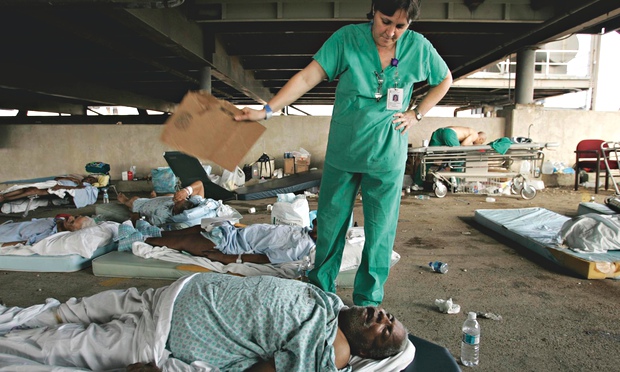
Image Retrieved from: http://www.theguardian.com/world/2014/feb/07/hurricane-katrina-after-the-flood

Hurricane Katrina was the most destructive “natural” disaster in US History. It impacted about 90,000 square miles and displaced over two million people.  The healthcare infrastructure in New Orleans ranked among poorest in the nation and the hurricane greatly impacted the healthcare infrastructure. Hospital basements were flooded and medications, food, equipment and supplies were lost. Electrical systems were destroyed and hospitals eventually ran out of fuel to power their generators. For many hospitals running water was not available and sewage systems did not function and communication was not possible. Food had to be rationed among individuals in the hospital and more problems occurred by additional patients seeking care and other members looking for temporary shelter. There were 16 hospitals in the New Orleans area and 8 were closed permanently. Of the practicing doctors 2,000 of the 3,500 were displaced. The available resources were insufficient to care for the community and affected individuals after the hurricane (Rodriguez and Aguirre, 2006).

The hurricane affected the quality of care of many patients. Not having running water inhibited hand hygiene putting patients at risk of HAI’s. Not having a running sewage system also did not work in their favor. Medications were not available, beds, and chaos occurred. The hospitals were filled to their maximum capacity and they were probably short staffed. The Hurricane depleted all the hospitals stores and not being able to communicate and know when assistance was on their way must have been a frustrating situation. Eventually other states, government, the Red Cross, volunteers, etc… were able to help and it has been a long journey in making New Orleans what it was before the disaster.

I cannot imagine being a nurse in this situation. It must be very frustrating knowing that your patient needs care and you are not able to provide it because you do not have the necessary supplies. Also it would be important to prioritize care and provide comfort measures. Also non-pharmacological interventions would be necessary due to lack of medications. It would be very difficult to be a nurse in this situation, but very rewarding. In order to be able to function properly you need to be organized, calm, and think out of the box. We all need to be prepared for any kind of disaster. After Hurricane Katrina, a few more hurricanes have occurred and the response has been better. I believe that we are now more prepared for any disaster, but we will never fully be prepared.

References:

Rodriguez, H. and Aguirre, B.E. (2006). The impact of hurricane Katrina on the medical and healthcare infrastructure: A focus on disaster preparedness, response, and resiliency. Disaster Research Center (DRC) University of Delaware. Retrieved from: http://udspace.udel.edu/bitstream/handle/19716/2380/Australia%20PP%20-%20Havid%C3%A1n%20DSPACE%20READY.pdf?sequence=1

Final Reflection

    Wow! I can’t believe this semester is almost over! Actually, the last three years have truly flown faster than I had ever expected. It is true what the students from prior semesters and faculty shared with us at our first orientation regarding the cohesiveness and strong bonds we would form with one another by the end of the three years. It is strange to think that we all sat together in a room three years ago, and didn’t speak or know one another. It feels as though we have become a family – in the truest sense of the word, with all the ups and downs all families experience.

In reflecting on my learning this semester, I can’t help but think of the large role technology has played. I remember sharing in our first ever blogpost that I was slightly skeptical about the idea of forming an “online identity.” I also felt skeptical about reconstructing our way of learning and shifting to a lot of voice thread, blogposts and videos. I have to say however, that I personally felt like I learned a great deal more after transitioning over. Additionally, I felt more efficient when creating voice threads, recordings and videos and felt that a significant amount of learning took place in a shorter amount of time. When I look at my growth over the span of three years however, it is remarkable to see myself as a completely different person.

It is almost strange to think of myself 3 years ago, before having learned as much as I have. I remember being told our first year that the program was designed like a spiral staircase, where each year we would have the opportunity to build on those things we learned the first time around. As I entered critical care, I was able to see how true that statement was. This semester I was able to utilize the concepts I had worked so hard to learn our first and second year and adapt them to the new material we were covering. Although I know that there is a large learning curve up ahead after graduation, I can say I feel confident to confront it. I feel I have learned a lot – but more importantly I now know where and how to access the resources needed when I come across something new. I feel prepared to move on to the next chapter as I develop my skill set as a novice nurse and put into action the values and knowledge I have gained from this amazing institution. On to a new adventure!

Protected: Japan Earthquake and Tsunami

This content is password protected. To view it please enter your password below: