week 13

I cannot believe that this semester is already almost over! There is so much to do between now and the end of the semseter. I am looking forward to getting more of my capstone research done and also to attending the Marine Mammal Conference in San Fransisco as soon as the semester ends. So far I have surveyed all of my Santa Rosa sites as well as Ormond Beach, 5th Street in Oxnard Shores, the Santa Clara River Mouth, and Hueneme Beach.

Pop Culture

I found chapter 9 interesting. I think the topic that Sternheimer wrote about is a popular topic. Adults are quick to blame media for the cause of alcohol or drug use in teens, but I don’t fully agree with this assumption. I think that alcohol and drug use in media does spark curiosity in teens and may make them wonder how they would act when drinking or doing drugs. By watching certain TV shows, I can see why teens would want to drink or do drugs. Growing up there were a couple of shows that I would watch that showed people drinking and it made me curious what they would feel when they would drink because the people in the show appeared to be having fun. Although media may spark some curiosity in teens when it comes to alcohol or drugs, at the end of the day it is the teens’ decision to do drugs or drink.

November 16th

Chapter 9 on Alcohol:

I found this section of chapter 9 most interesting because I can see how college students can relate to the statistics about alcohol usage. However, it’s still surprising to know how much the percentage of teen drinking has dropped. “It is more than popular culture that encourages young people to think drinking is normal”(Sternheimer, 2013, p. 229). I personally do not believe a drink on a special occasion is not normal. I do however agree that the percentages rise with age regardless of popular culture. The majority of young adults living with their parents and under the age of twenty one may not drink as much as desired due to their living situation. Getting home to your parents drunk may not result in a good conversation with them. Especially if you are not twenty one and older.

“The peak age group for binge drinking was twenty-one to twenty- five, and rates only gradually level off for people in their thirties and forties” (Sternheimer, 2013, p. 229). I was surprised at this statistic because I can’t image being a binge drinker. I do have a drink on special occasions and I do not live with my parents, so to fit into this statistic I would have to drink a whole lot more. However, there are those who feel they need to drink to release stress and not only because they don’t live with their parents.  In addition, I don’t believe we should blame media for encouraging kids to drink because like mentioned in this chapter parents influence their children the most. Parents who drink often are most  likely to encourage their kids to drink heavily. Kids may not drink while their parents drink; however, once these kids are old enough to drink they may drink heavily like their parents once did.

Drinking and driving is another issue I can see related to age. Many people who drink and  drive do so because they are most likely at an age to buy alcohol. In my opinion, there needs to be more education on drinking alcohol. We only know what we know about drinking based on what we see or have seen from our parents. Could there be a more positive approach to avoid drinking problems. Why is drinking so popular and why do percentages rise as we get older? Could it be that young adults are more cautious of their surroundings and see how harmful drinking can be compared to older adults.

Street Art: 

I enjoyed watching the video on Ron English. Using billboards as an expression for freedom of speech is such an awesome idea. Rather than expressing emotions about corporations and politics in pictures or drawings he expresses himself using words anyone can understand. This method is definitely helpful for media education because the majority of the billboards address many problems in society today.  Like Ron English said “Corporations don’t have the right to freedom of speech, people do.” If we can’t stop corporations from selling and advertising harmful products why should someone like Ron English be stopped for advertising how bad some products or politics are.


Week 12 Readings

Happy Sunday, everyone.

This week we had the Sternheimer reading as well as some other outside readings. I’ll start with Sternheimer. I did find this week’s chapter topic interesting. As someone who falls into the age group of those who seem to “party”, I was excited to read Sternheimer’s take on why media portrays teens and even college students as those who do a lot of drinking and smoking. Once again, Sternheimer made it very clear that there are always more factors at play than those the media focuses on. This was seen on when she discussed the link between teens and smoking, saying that there is an association, but not necessarily a casual connection (Sternheimer, 2013, p. 224). She also said that the differences in education and socioeconomic status are important factors that determine who smokes (p. 226). In the next section about alcohol, I noted that Sternheimer said that positive beliefs about drinking are the most important factor when it comes to teen drinking (p. 233). I think this is very true and is something I have experienced during my time in high school as well as now in college. My family is not big on alcohol and usually focuses more on the negatives associated with it rather than the positives. I never ever drank as a teen and I’m sure my parents’ views played a big part in that. None of my friends were big drinkers either, so my beliefs were not changed very much at the time. I found Sternheimer’s comment that adults need to teach moderation (p. 234) very nicely put. I don’t think parents always realize what an impact their behavior makes on their children and that the way they behave will usually be mimicked by their kids.  Another comment that I liked was that “society encourages better living via chemistry” (p. 239). This is so true and I never thought of its connection to legal and illegal drug use/abuse. Think of how many ads we see promising us a thinner waist, a healthier and better body? I also see this in terms of psychiatry, as a lot of people believe that antidepressants and the like can be a cure all to their problems. It makes a lot of sense to me that people would seek out other drugs that could also work to make their lives better, even though they may cause more damage or may be illegal. Lastly, Sternheimer discussed the relationship of substance abuse and social structure, saying that pop culture is not necessarily central to the understanding the key factors that predict substance abuse (p. 240). I wish I could have several adults read this section of the chapter. As we have come to know, pop culture and the media rarely accurately depict things like drug use and substance abuse (perhaps with the exception of shows like Intervention, but even then  who knows how much is “reality” television). I completely agree with this last piece of the chapter and thought it was a nice way to tie the discussion back into the relationship between drugs/alcohol and the media. What were your takes on it? Did you agree or disagree with her statements? Am I blinded by my lack of partying ways?

Now, on to the fun stuff.

20131005-15030174-1 (This is one of my favorite Banksy pieces, done during his month-long residency in  New York City a year or so ago. The idea was to have a paradise amidst the crazy and hectic city life, a place of calm and tranquility that was mobile. I found it really beautiful and this photo really captures the idea behind it, rather than ones of mobs of photographers trying to get a glimpse.)

I am a really big street art aficionado, so when I saw the extra readings for this week I got really excited. I do think that Kaia proposed a really interesting question: how does this kind of “art” relate to media education? Is it helpful or hurtful? I have been following Banksy for a long time now, so my opinion may be a bit different. I do think that at a time, this kind of “street art that makes you think” thing was really great and actually was helpful towards media education. I think this art can point out the problems that we don’t want to hear about, the ones that the media doesn’t focus on it. For example, earlier this year Banksy did a series of pieces in Gaza, drawing media attention not only to his work but to the situation going on in the Gaza strip. In the Ron English clip, he had many anti-media sentiments (“The media is the massage”, “Shop while they drop”) (Wrayer-Battle For A Free Mind, 2006). However, I do think recently people have begun to focus less on the message and more on the price of the work or the experience of being witness to it (especially in Banksy’s case). I think this really distracts from what once was (and still kind of is) a really interesting commentary on media literacy. Nowadays, the media frenzy surrounding the reveal or finding of a new work by artists like Banksy is not about what the piece says, but about who will become the owner of it. This is almost a subversion of what these people set out to do with their art, which I find kind of funny. I see this, especially with Banksy’s Dismaland. I remember reading about it a few months ago and I absolutely loved the idea. I felt as though Banksy was poking fun at consumer culture and contrasting the beauty and pristineness of Disneyland with this dirty and run down wasteland. However, the media focused instead on how many people had bought tickets and how temporary the place was (so people should be concerned about whether or not they could go and see it in person). I’m really interested to hear everyone else’s thoughts on this part of our reading. Do you think it is helpful or harmful? Has anything by these artists made you stop and think, especially about media?

3d699e2e3f33712ce88bcb2552ae188a(Probably my favorite Dismaland piece :) )

November 16th

Ch. 9 “Does Pop Culture Promote Smoking, Toking, and Drinking?

This chapter as I have mentioned in previous posts did a good job in explaining statistically that it isn’t just the “crazy teens” who are drinking and smoking, but more so adults. The book says that people are quick to blame pop culture and the media in general because it is easy to do and is the most simple and logical explanation. However people really do become blind to other reasons when they are focused on just one of many factors. Differences in family stability, education, socioeconomic status, race/ethnicity, gender, peers, ads and so on all have an effect in substance use. Something that stood out for me in the book was when it said a 1998 report said “that much of the racial and ethnic differences found disappear when income is taken into account.” (Sterheimer, 2013, p. 226). I have issues with this because people compare income with race all the time, to say that these differences disappear, just sound odd when are society knowingly or unknowingly makes these connections. When the chapter moved on to the topic of alcohol I thought it was important to note that “gatherings often involve alcohol as a normal part of adults life.” (Sterheimer, 2013, p. 229).  Our society has made it such the standard to have alcohol as part of our normal life’s when it doesn’t have to be. I also found it interesting that music videos have a rather big impact on teens and their usage. There are many grey areas to understanding the hows and why of substance usage and abuse among teens and adults, however age and gender where reoccurring themes in this chapter as to who are the heaviest users. There were several points in the chapter where is spoke about men needing to be taught to handle a certain amount of alcohol and women were not as heavy of users are the men where. And back in the day when women were caught smoking they were seen as rebels. Another note away from the age and gender is that Latinos and Asians are the least likely to use drugs out of any other minorities. However “men have been and remain more likely to smoke than women”. (Sternheimer, 2013 p. 225). The book also explained that white and African Americans are the largest groups of smokers. There are various factors as to why but if anyone has possible explanations as to why they think this is I think it would be an interesting conversation. Especially when a previous report said that when looking at income the difference between race and ethnicity seem to “fade away”.

Street Art

This section was a bit difficult for me to comprehended and write about, and honestly I mix graffiti street art and any other related thing into one big group. When something is illegal I am really closed minded that it is bad and shouldn’t be looked upon as good behavior. Many of these people try to say a certain message about ads or other issues in society. As I said in a previous comment creating art for a cause, or issue to inform the public is different than just going out and doing something just because you can. What I have issue is with where the line is drawn with this repetitive behavior. I understand some look at these people’s work and think highly of it while others find it a public disturbance. These people are certainly daring and ambitious but does that make it right to do it?

Refugio Spill Talk at WSN

Last weekend our sandy beach troupe made the long (6.5 hour) drive up to Sacramento for the 96th annual meeting of the Western Society of Naturalists.  This is a core meeting for our research group and one of the few meetings we attend every year, rain or shine.  This year’s meeting saw several of our students and professors presenting their recent work related to our continuing efforts to monitor and explore the sandy beaches of southern California and the greater Pacific.

I presented our research group’s first formal academic talk about the ecological and socioeconomic impacts from the May 2015 Refugio Oil Spill in northern Santa Barbara County.  The abstract of our talk and my actual presentation are below:


Ecological and Sociological Impacts of the May 2015 Refugio Oil Spill

Anderson, S.S.1*, Wormald Steele, C.L,1, O’Hirok, L.S.1, Rodriguez, D.A.1, Spaur, P.A.1, Schmitt, T.J.1, Tillman, C.1,2, Pratt, R.T. 1, Newell, A.L.1, Anderson, S.S.1 and Anderson, G.D.3

1 – California State University Channel Islands, 2 – Moorpark Community College, 3 – Oaks Christian Middle School

The Plains All American pipeline rupture on May 19, 2015 spilled an estimated 79,000 l (21,000 gal, 500 bbls) of unrefined crude oil onto Refugio State Beach (Santa Barbara County, California) and into the Pacific Ocean. Heavy littoral oiling affected Refugio and El Capitan State Beaches immediately. Highly variable tarring episodes impacted beaches as far as 170 km from the break over the ensuing weeks, creating a unique arena in which to test tarring impacts. Sandy beach ecosystems dominate the shorelines of these regions and so bore the brunt of the impacts from this spill. Infaunal diversity dropped and heretofore unobserved conspicuous dead Emerita analoga (sand crabs) were common in the swash zone across several beaches although an independent decline in sandy beach infaunal diversity/abundance across the region over the past year made impact detection problematic. Laboratory experiments confirmed the toxicity of deposited tar to developing Emertia embryos, juveniles, and adults. The spill had immediate but mostly ephemeral effects on people: reducing summer spending at the most heavily tarred beaches by an order of magnitude, halving the number of people who felt Santa Barbara-area seafood was safe to eat, and bolstering support for offshore drilling bans.


I am at a loss for why my voice was so fried during my above talk.  It may have something to do with the student auction I co-hosted (along with the good Dr. Mark Steele from CSU Northridge) the night before, but then again it was generally a regular Saturday night…

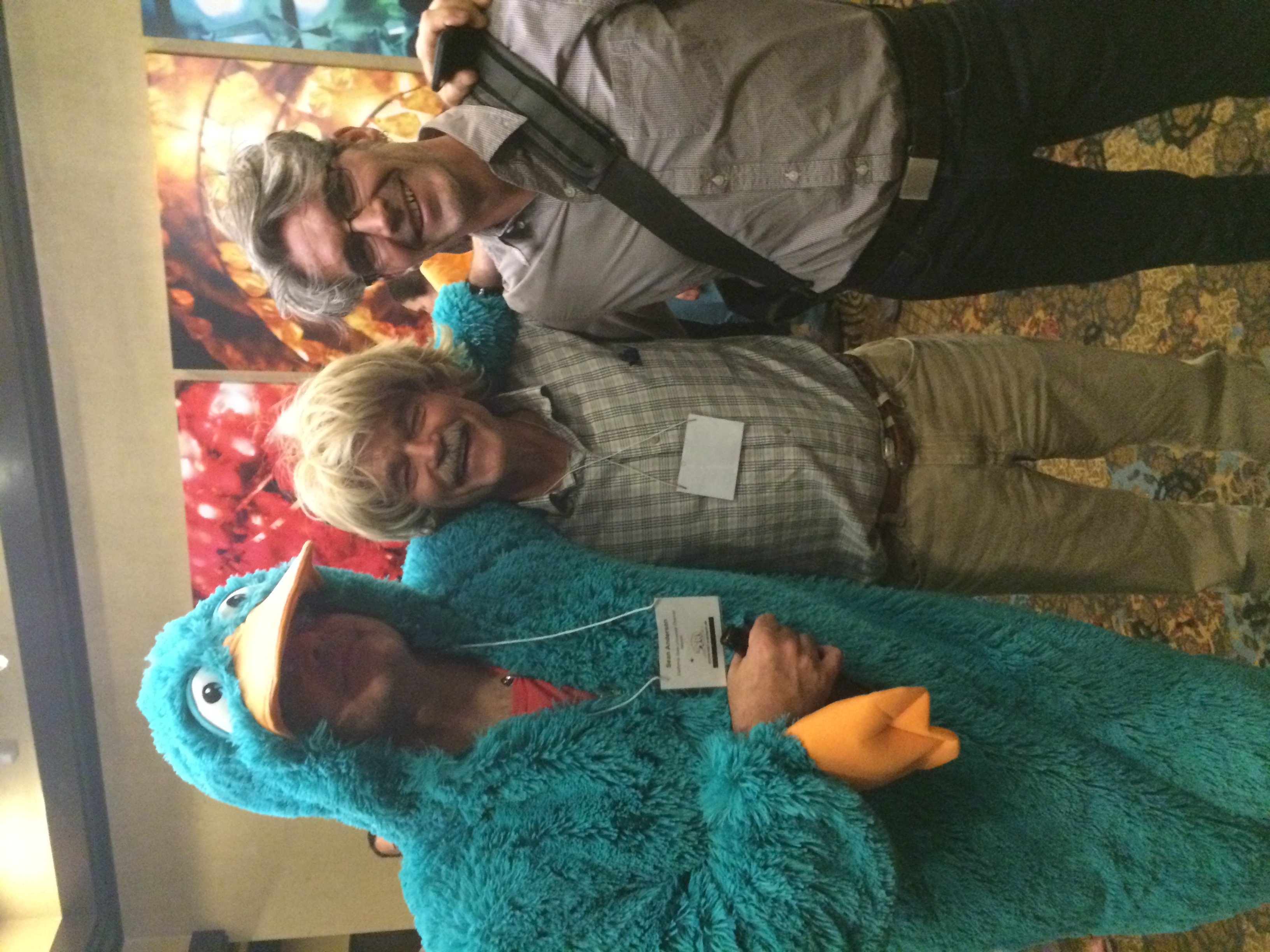
Drs. Sean Anderson (disguised as Perry the Platypus), Mark Carr (disguised as Marilyn Monroe), and Mike Dawson (disguised as a UC Merced Professor) engage in witty banter in the wake of the Student Auction. Western Society of Naturalists Meeting, Sacramento, CA on November 7, 2015.

Drs. Sean Anderson (disguised as Perry the Platypus), Mark Carr (disguised as Marilyn Monroe), and Mike Dawson (disguised as a UC Merced Professor) engage in witty banter in the wake of the Student Auction. Western Society of Naturalists Meeting, Sacramento, CA on November 7, 2015.

Clearly, my talk enthralled all who attended…

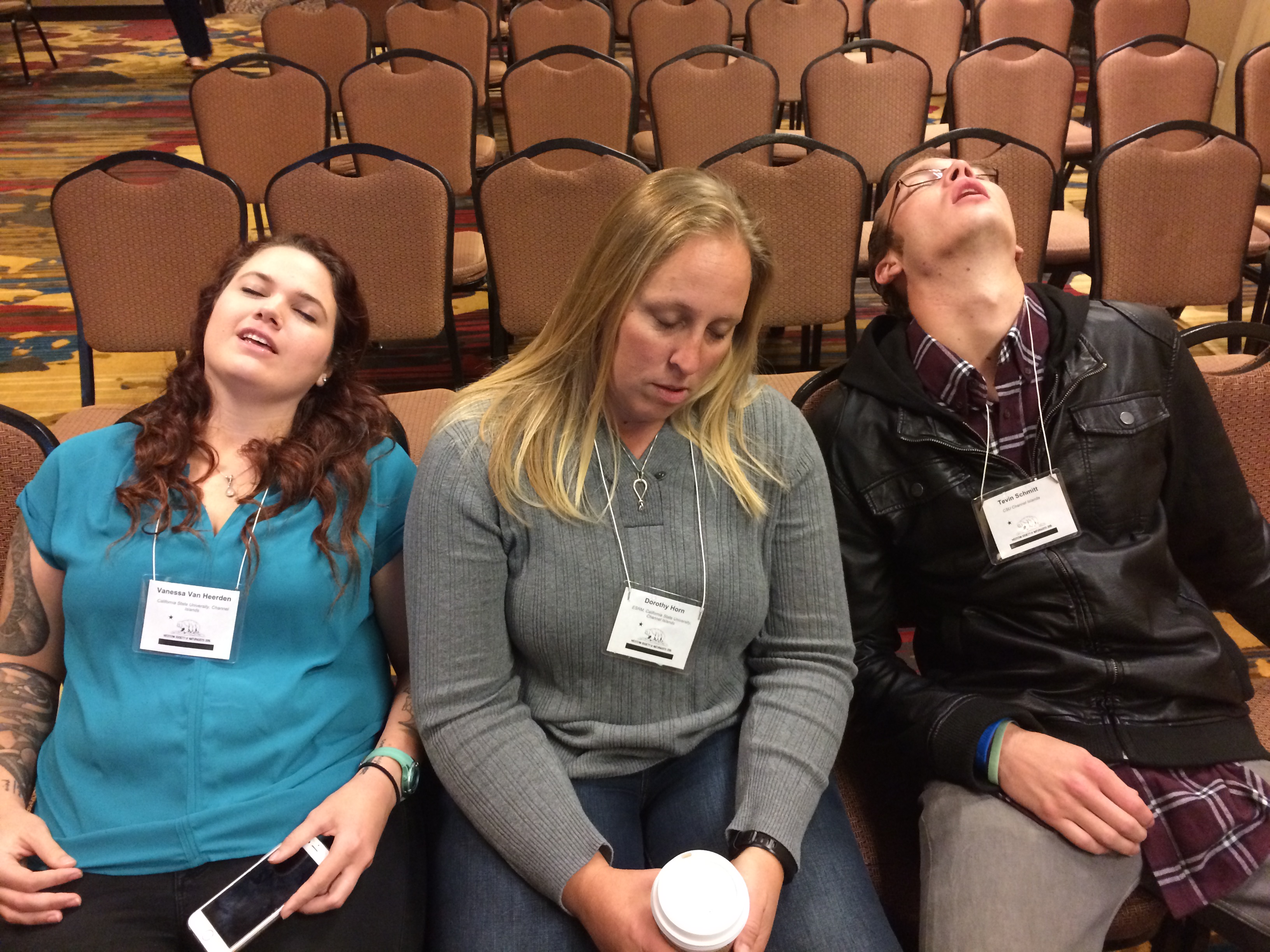
Vanessa, Dorothy & Tevin are tired WSN 2015

Vanessa, Dorothy, and Tevin are enlivened by my incredibly interesting and engaging talk on the Refugio Oil Spill.


Extra Extra…..Read all about it!

Hello and good morning, as we have all heard over the radio, or seen on the news cast, there has been a horrific event taking place in France. Multiple bombings causing thousands of casualties and 129 deaths,(My heart goes out to all of the family and friends of the victims). As most of the readers of this blog know that I am involved in a university and we are digging into social media and how it can be beneficial for everyone. Facebook and Twitter got the call on Friday and they stepped up to the plate and hit one out of the park.  First, just moments after the first attack in Paris occurred, Facebook launched a new feature called the “I am safe” page. People that were in the attack zone were notified that such a page was available and could be used to notify all those friends and loved-ones that they were safe and out of danger. I was at work Friday night when a person at the bar received a notification from Facebook informing her that her friend had checked in and was indeed safe. The new setting that has been introduced by Facebook is a marvel in many ways, it notifies everyone on your friends list simultaneously saving precious time that would be taken by texting or calling each individually, thus getting the information train running much quicker. Also Twitter came through like a champ as it was a major player in the crisis.  As French government put a strict curfew in place and almost a marshal law, many were out on the streets with no-place to go or stay. With word traveling fast of multiple bombing locations, and other areas being threatened, Twitter users all over Paris sent tweets out to direct those in need of personal housing, shelters, or hotels offering shelter for the night. Those caught out in the mayhem were now finding shelter through social media. This is a prime example of how social media can be used for the good of the people and how powerful it has become. I cannot say for sure that lives were saved, but  can say that many slept better that night by either having a place to stay, or knowing that a loved one was alive and safe.

Even though terror has tried once again to break the spirit of the people, the world has shown that the free will can never be broken. The French Red White and Blue is being flown around the world in support of our friends the French, on Facebook, Twitter, lighting on national monuments, capitol buildings and religious figures. The message is clear that we stand together against fear and terror.

CDR


Comprehensive Med- surg Reflections

As I reflect on my progress through this semester, I believe that I have learned and grown a lot from the beginning of the semester to compared to where I am now. I now approach each situation in the hospital with critical thinking by “putting the puzzle pieces together.” For example, I had a patient admitted for sepsis who had an EF of 75%, trending hypotensive BPs and presented with 4+ pitting edema. Upon finding the edema, I quickly thought of why this could have happened to the patient. I then assessed whether the patient was getting too much of the NG tube feeding solution or whether it was a result of CHF exacerbation. I then assessed for any other signs and symptoms of CHF exacerbation such as crackles, JVD and his current EF for that day, which I found out was 30%. Looking back at the situation, if I would have had this patient in my first semester, I wouldn’t have approached the situation as I did during that clinical day. I wouldn’t have gone into further assessing the edema and probably would just have focused on the patient’s over all general diagnosis and getting tasks done for the day. Based on my self assessment, I believe that I am ready to take on the role as a registered nurse. I now feel more confident with my assessment and interventions skills compared to when I was a first semester nursing student. As I get ready for my final semester, my concerns are passing all my final classes, networking with hospital employees that could get me a job at Cottage Hospital, applying and passing the NCLEX, and lastly getting a job as an RN. I have come such as long way and I have learned that nursing is more than just performing tasks,  but a mixture of compassion, critical thinking, and task completion to steer patients back into optimal health.

Nov. 14 Chapter 9 and 9

I found the terminology and idea of Social Frontiers, boundary spanners, border crossers, and advocates particularly valuable. I think this philosophy creates a clear understanding of the leadership role, in a variety of situations, not limited to diversity and social justice. I like the way boundaries were described, not as divisions, but as ”ambiguous middle ground where something is held in common”. I think this kind of thinking, will decrease the instances of having to do “border crossing” which can create a negative, or hostile position to operate from. I believe the more you can turn a border into a boundary will increase better chances for success in creating change. It made me think of situations which might require a personal border adjustment from me, and how can I determine the difference should an occasion arise.

The Scanlan and Johnson state that “school administrators–particularly building-level principals–ar uniquely positioned to engage with others–such as neighborhood residents, community activists, and colleagues in local businesses, government, and faith communities–to find and build common ground and pursue shared goals.”  I see parents/principals coming forward to make these types of connections with the school and community in more affluent neighborhoods. Unfortunately, I do not see the same thing going on in lower socio-economic communities where the resources require a little more diligence to ascertain, or the families are reticent to involve themselves because they feel like they do not have valued assets to contribute. I also see a doublespeak in schools where administration decries a lack of parental involvement, yet daily praxis discourages it. Underlying this is what the book mentions about many educators wanting ‘limited’ participation from parents or community, but are not offering agency or voice to them. At the beginning of the school year I was very disturbed by something that happened. A beginning of the year packet was sent to all students. Among the various documents and emergency forms was a bright purple letter inviting parents to participate in the school. There were several items the parents could check mark to volunteer: clerical office help, clerical help at home, cafeteria help, classroom help, etc. I collected paperwork form all my students and set aside the purple papers that parents offered classroom help. The rest of the papers (3-4) had check marks for cafeteria, home, or office help and I took them to our office secretary. She told me to keep them. I explained that I had kept those pertaining to me, and that these were volunteers for other areas of the school. She took them from me and dropped them into the trash can as I walked away. When I question her action I learned that this is their routine procedure! How devaluing to these parents! How disrespectful! I addressed this issue with a new assistant principal, and we discussed a change for the future. I will be following up on this for next year. I rarely see a principal who meets with families outside of school in community spaces as suggested in the reading, however I worked for one principal who made a point to attend various community events which students or parents invited her to. I feel this added to her effectiveness as a principal in many ways.

Chapter 9 from Theoharis was, in my opinion, the most valuable of the book. My big take away is this quote, ” Many of the strategies outlined in the previous chapters will not emerge naturally, nor will they be sustained without effort. Diversity efforts (indeed any deep changes) require intentionality. As an educational leader, more than personal example is required. “Discerning how the new with both invigorate and preserve the traditional”, while effecting necessary change requires “enough diversity around the table to make those judgements and develop those processes.” Skills in building connections, spanning boundaries, crossing borders, advocacy, communication, logic, rationality, invention, empathy and understanding are essential to develop in preparation for the challenges ahead. For change to arise bottom-up, there must be effective leadership top-down as well.

The discussion about affirmative action  and surrounding attitudes was interesting. I agree with the authors point here. Affirmative action may have been a positive change for it’s time, but it wasn’t good enough as reflected in minimal change. There is some reframing to be done! I believe we are ready for better answers…Answers that will come through  the increased diversity we are currently working with. I believe there is more ‘diversity around the table’ and more awareness than in the past and it will be reflected in new ideas moving forward. I believe whole-heartedly that there is more good and positive in the world than bad and negative, and that the social justice story will continue to become more positive with time and continued resolve. “The only thing necessary for the triumph of evil is for good men to do nothing.” Edmund Burke

Is Pop culture Promoting Drugs and Alcohol

Thinking of this problem before reading Sternheimer’s pontiff view I would have said that all media and pop culture promotes drinking and drugs but I would’ve been wrong. Studies showing that drinking among teens was a bigger problem in the 60s and 70s and has slowed down in the recent years. Children are also more likely to drink alcohol if they see a parent or guardian drinking and we thought it was pop culture. I found it very interesting that 40 percent of television shows are showing alcohol and drug consumption and the media keeps it going. A study following high school students showed that “video games and television shows with people consuming alcohol, including teens,is not the main problem, but the music videos is where the problem lies”Pediatrics(230). That is a part of pop culture though and with all these new videos popping up how do children stand a chance? It is way more effective to have the hot new artist drinking or splashing in champagne rather than our favorite fruit juices. Maybe it is a way for the different parts of the media to blame each other then nobody hasty where to turn.  With all the new information out and ads for everything in our faces for hours of the day it is easier forbids to get the things they want weather its a beer or some pills. With the declining numbers of substance users since the 70s and 80s a new problem has climbed the ladder and that is prescription pills. “In 2009 marathon 1 million emergency room visits were the result of prescription drug use”(238). I found this crazy but I believe it and the text also stated “Oxycodone was 3 to 1 and Hydrocodone was 4 to 1″(238). This was a 98 percent increase form 2004 and that means that parents and schools have even more responsibility to communicate and counsel their kids and students.

Scott Lang