Day 5: Field Day 2

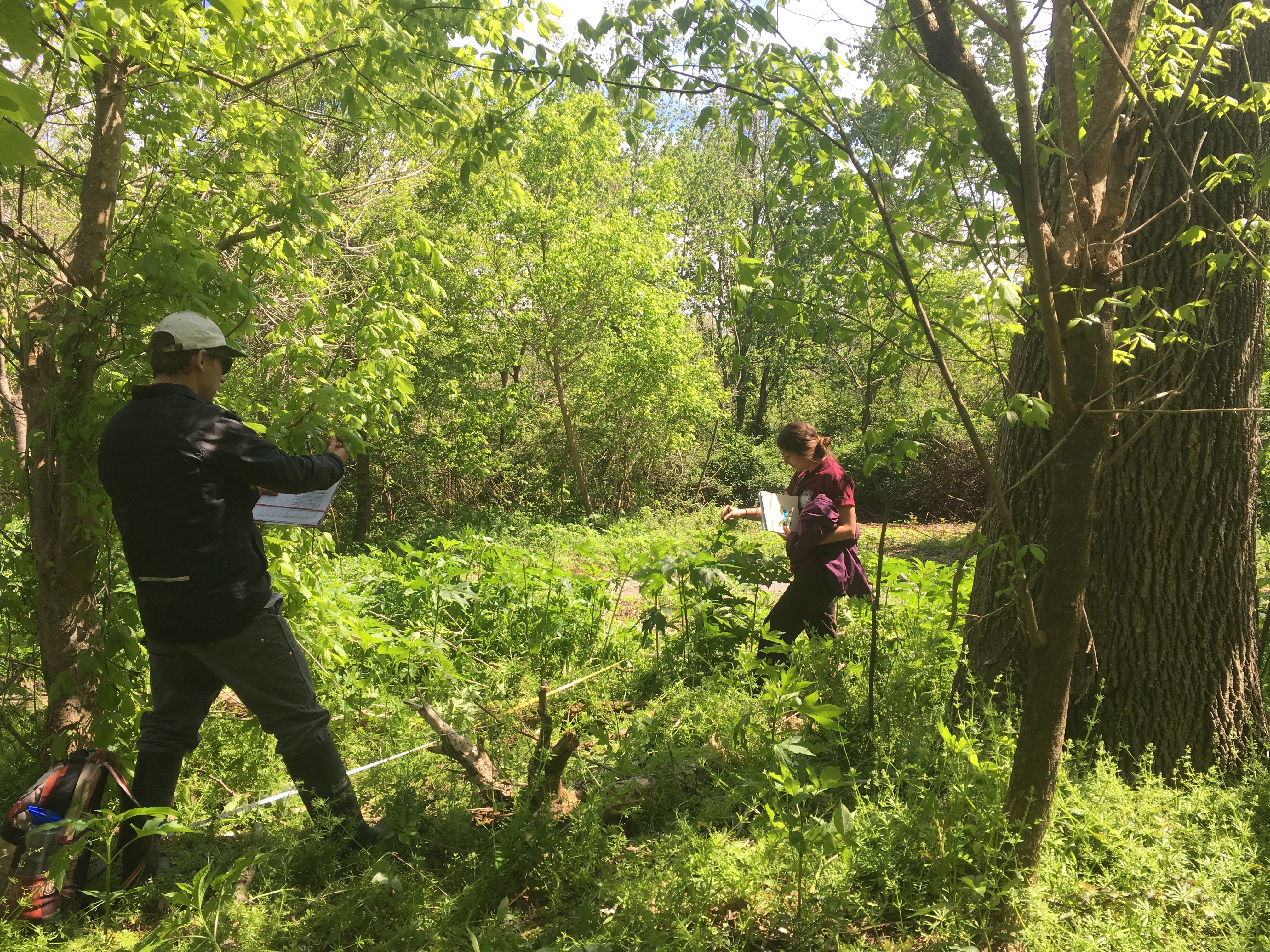
Second day in the field was a success. Michaela, Sadie & I blew through 3 transects on Trail A and moved to Trail B where we did 6 more. (9 in total today!) We had quite a few invasive (Tallow & Chinaberry) in our Trail A transects and not as many on Trail B. Trail B was also not as difficult seeing also our first few transects were only 6 meters in length as opposed to 100m.

image

So for those of you reading our blog, we are probably using many terms that may seem foreign to our readers. I will attempt to explain what we are talking about. A transect is the line that that we run through the wetland for 100 meters. The tape we run through the forest is the “transect” tape.
For myself, being the data recorder, I have many duties. On my data sheet I am I’m charge of recording the transect stop, the natural & exotic overstory, the understory’s percent of ferns & blackberry, the amount of leaf & wood litter, and if there is or is not a fallen log on the quadrant.  Now to explain all of these concepts.  The transect stop is the length of the recording.  For example, if the transect stop is at 4 meters, we are recording everything in between the last stop (2M) and 4 meters.  Our quadrant for that stop is 1 M on each side of the quadrant.  The overstory is the amount of cover over the quadrant we are observing; native percent is the amount of native vegetation that covers the area and exotic is the amount of invasive species that cover the space.  The understory is self-explanatory in that we record the percent of ferns and blackberry we observe.  The leaf and wood litter is just the amount of leaves and sticks/branches that cover the floor; this section is measured in centimeters.  The final section I am in charge of is whether or not there is a fallen log, which is also self-explanatory because I literally circle yes or no. 
The last section of the data entry that I complete is along with the help of Sadie and Michaela.  The space calls for the identification of all plants in the quadrant we are focused on.  This calls for the name of the species, the height of the vegetation and the DBH (Diameter Breast height).  The DBH is determined only of the vegetation is larger than your breast height.  If so, we measured the diameter of the steam/trunk.  I hope these explanations were helpful!

image
image

image

More work at the Woodland site

Today we continued to work on collecting data at the Woodland Trail and Park site. We completed path A at 1200m and moved on to path B. We had some folks who help fund the project visit the site. We discussed two reasons why keeping this site preserved is important. One reason is that it acts as a resting site for migrating birds. They have few places to rest already and the decimation of this area could severely affect migrating bird populations. Another reason why this site is important is that it has a much higher chance of persisting through time compared to other sites that are likely to be affected by sea level rise or development. 

While working the transects we encountered a lot of blackberry just as we did yesterday. The three main invasive species we looked for included: tallow, chinaberry, and privet. All of these plants are from China and have had major impacts on the landscape. Efforts have been made to fight these plants. One way is to girdle the invasive tree and spray it with herbacides. We saw this today on some tallow trees within the site. Some of the trees haven’t bloomed yet which makes identification difficult. Our next step is to finish surveying path B and move on to the next site.  


3/21

Research day number two was today, we got a botany lesion today which was very interesting. We learned about various species identification due to some confusion yesterday which helped groups go much quicker today. 


Finally, Torrey pine growth!!!!

I finally have Torrey pine sapling growth! It took longer than expected to see grow within the Torrey pine seedlings. Currently, I am monitoring the growth of these seeds every three days. They are on a strict water regime, which is based off of the Western Regional Climate Center’s weather monitoring system. This climate monitoring system allows me to determine how much water to water these plants every month. This is calculated by taking the average rainfall of that month from each year dating back to the early 1900’s, and distinguishing what will be calculated for the high and low watering regimes.

Torrey pine saplings!!!

Service Learning in New Orleans 2016-03-21 11:32:54

Yesterday was our first day doing vegetation surveys at the Woodlands Trail Conservancy. Holly, Hayley, and I teamed up to form the Gumbo Gang and spent the day learning the lay of the land and the different vegetation which inhabits it. We finished two transects and will be completing more today!


20/3/2016

Ich hab keine Ahnung was Tag ist was seit hier sein! Die Post von gestern war den 19/3/2016. Heute waren unser erster Arbeitstag und in meine Meinung ein bisschen langweilig, aber meine Gruppe (die Madames Leveaus) sind mit Aspen und Vanessa gut. Wir arbeiten gut und schnell zusammen. Wir identifizieren Bäume und Pflanzen und was ist was und was ist wo, aber ich hab keine Ahnung sooo ich bin sehr frohe, dass ich zwei Umwelt Majors in meiner Gruppe hab lol. Morgen glaube ich ist die gleiche… Ja voll!

Team Machete Mamas

Today was our first day doing vegetation surveys at the Woodlands Trail Conservancy. Sadie, Lauren, and I teamed up to form the Machete Mamas and spent our afternoon fighting blackberry and getting to know the plants. We finished two transects today and tomorrow I think we will all be even more productive.  


First day of field work

Today was our first day of field work in the woodlands, it was slow going, but will pick up soon!  The forest is thick with trees and blackberry vines, so much green!!


3/20

Today was a great day we learned new methods and plant identification. The methods today included setting up 100 meter band transects. These consisted of Bush whacking through the brush laying out the 100 meter tape and using a 2 meter pvc pipe to delineate a 2 meter by 2 meter square band and identifying all species in the square. The first 2 bands are done as 1 by 2 meter band 1 meter down the tape by 2 meters wide. The transects numbers were written as the higher of the point (if it were point 0-1 it would be recorded as 1).

Than we looked at multiple aspects such as leaf and wood litter. Percent blackberry, ferns, native vegetation canopy and exotic vegetation canopy. We also recorded gps waypoints off of a Bad Elf gps attached to an iPod at 0, 50, and 100. We also took pictures showing the vegetation at these locations looking towards the 100 mark and out past in to vegetation. We also took plant samples for plant identification.


 Patrick and I using spicy food to keep the bugs away!

Day 4: First Day in the Field !

image

Today was our first day in the field. We went into English Turn and starred collecting data on our transects. I was paired with Michaela & Sadie. We started on 250M trail marker and team or transect tape 100 meters to the right at a 90 degree angle from the trail.  After Michaela had hacked through all of the blackberry,  Sadie and I began make observations within our different quadrants along the transect.  Sadie did a great job with identifying the plants and I was the one recording all of the data.

image

Each quadrant was 1 meter wide on the left and right side of the transact tape. This process was related every 2 meters with the exception of the first two, which was from 0-1and 1-2.  We had to identify things such as the plant/tree species, the amount of overhead vegetation cover,  the amount of leaf liter/sticks on the ground and the percent of blackberry present.  We ended up getting through 2 transects. The plants we encountered the most were Box Elder, Elderberry, and our favorite,  Blackberry…. Tomorrow we will be doing the same thing.