
Pills, Pills, Pills

This assignment could not have come at a better time because my family gathered for a barbeque over the weekend. At the barbeque, I had the opportunity to ask several family members and friends about their knowledge regarding the medications that have been prescribed to them by a physician. Many were not on a daily drug regimen therefore I asked them to explain the indications and side effects for common over the counter (OTC) drugs such as Tylenol, Aleve and aspirin.

To my surprise, about seventy percent of the people for which I sampled (n=14) were knowledgeable about their personal daily medications. This did not apply to OTC drugs or drugs they were unfamiliar with. They were able to explain what their medication was for, discuss the common side effects they had personally experienced, and also name both the generic and trade name for each. Their extensive knowledge on their medications can be explained in part, because they have been able to successfully manage their chronic diseases for years or because they have work closely in the medical or healthcare field.

pills box

On the other hand, the remaining twenty percent (n=6) had a difficult time explaining medication indications, side effects or the contraindication for some of the more common OTC drugs. Reoccurring key themes included 1) following physician orders without question, 2) inability to recall the information or 3) simply never bothered to look them up. The identification of side effects did not pose too much of a problem because lets face it seems that every medication can cause stomach pain, nausea, vomiting and diarrhea. Measuring the proper dosing was a bigger problem than I thought. A couple of people mentioned eyeballing what they assumed to be a teaspoon verse a tablespoon for liquid medications. Others even admitted to taking more than what the label clearly stated. My grandmother referred me to my father who helps her manage her medications. Unfortunately these examples are not uncommon, especially for individuals whom English is not the primary language or are no longer unable to manage their health conditions due to their age as in the case of my grandmother. Fortunately, this assignment opened the discussion about medication safety and proper drug management in my family.

Homeopathic and herbal medications are very common in Mexican heritage and culture. Many of these remedies have been passed down from generations to generation and are built upon hope and faith. I can remember my grandfather going to the back yard to cut aloe vera leafs to treat minor cuts instead of going to the store to by Neosporin. My grandmother is known for grinding several herbs together to make remedy teas for our ailing sore throats. Unfortunately many of these alternative treatment measures have not proven to work or provide better results. Some herbal medicines can in fact be toxic and result in detrimental effects including death. Nonetheless, these traditions have been strongly ingrained and will continue to be performed for years to come.

Automédication #4  / Self medication #4

Roger & Me

In a recent article, University of Denver political scientist Seth Masket claims that the Netflix series “House of Cards” is “the worst show about American Politics. Ever” After elaborating his list of grievances about the show, Masket proclaims: “…if you want to understand American politics, watch just about anything else.”

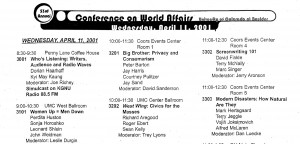
In 2001 I was invited to participate in the World Affairs Conference at the University of Colorado. The WAC is unique in several regards. Participants are assigned to panels with minimal regard for their expertise. Sessions are valuable for the ability of the panelists to provoke passions, and promote vigorous discussion with the audience. For decades, the World Affairs Conference has attracted prominent individuals who pay their own way to Boulder for the week. Attendees are not paid. This year the Conference celebrates its 67th year.

Among the half-dozen panels scheduled for me was one titled: “The West Wing: Civics for the Masses.” The panel was scheduled for one of the largest rooms at the conference; at least 400-600 people were there, and there was not an open seat in the house.

But they were not there to hear me speak.

Kelly WAC 2001

On stage I was joined by Richard Aregood, a Pulitzer Prize winner, and then-Editor of the opinion page of the Philadelphia Daily News; and Roger Ebert, also a Pulitzer Prize winner, and nationally-renowned movie critic for the Chicago Sun-Times. For many years Ebert attended the conference, paying his own way, and spending four days deconstructing a movie that he selected, on a first-come-first-seated basis. The sessions were always packed.

As it turns out, the organizers chose the right panelists for a discussion of The West Wing. Aregood admitted to having seen one episode; Ebert none. Upon hearing of my upcoming conference, my then-student John Celock recorded some episodes on video tape for me to watch. I managed to watch three episodes; two more than my Pulitzer-winning compatriots, and three more than I could stand.

My conclusion: It was the worst depiction of American politics I had ever seen. From the lionization of the presidency, to the utter contempt of the West Wing staff for Congress, there was nothing about the show that was a “civics lesson.” And I told the audience.

They did not like it. Not one bit.

What I failed to realize, in retrospect, was that there was not a question mark at the end and of the panel title. It was a declarative statement: West Wing was, in fact, a civics lesson, and the 400 people in the audience would not accept any other conclusion.

Ebert, of course, was far more savvy than the professor from Niagara University. Noting my disdain for the show, and the audience’s displeasure with my critique of it, he remembered for them the letters he received from archaeologists complaining about the inaccuracies in “Indiana Jones.” One should never listen to the criticisms of an expert, he told them. And then, as the love of the audience swelled for him, he promised them that, based on their deep love for the show, he would go back an watch every episode of The West Wing.

The applause was thunderous.

For 90 minutes I was Roger Ebert’s foil. The loved him, and hated me (at least it seemed that way). It was as good as it could get. I loved being the foil. Especially in Boulder.

To this day I have seen only three episodes of The West Wing. I have seen every episode of House of Cards. For my love of Kevin Spacey I choose to remember Roger Ebert, and suspend disbelief. House of Cards is an atrocious depiction of American politics, but great Shakespearean drama.

It is a wonderful piece of art. That was Roger Ebert’s point.

If one is interested in a more real-to-life depiction of American politics in action, I suggest a show from 2003 titled Mister Sterling. Starring Josh Brolin as an appointed Senator from California, this “modern day Mr. Smith goes to Washington” captures quite a few of the details about American politics more accurately than House of Cards or the West Wing.

Then again, it lasted for only 10 episodes and is now long forgotten. Politics and great art do not necessarily go together. Just ask the ghost of Richard III.


Some new developments!

I have recently, within the past few days, received some relatively new data from the months of December of 2014 trough this past February of 2015. The data highlights the amount of pieces of trash found within all sites (1, 2, 5, 8, and 9) that I have decided to focus on. Through the encouragement of my directing professor, I have decided to see if there is a correlation between the amounts seen in the past few months with the same months of past monitoring years and amount of rainfall within those months. I also plan to see if there is a correlation between trash and the number of windy days within these months. Hopefully I can find a trend!