Hello world!
Welcome to WordPress. This is your first post. Edit or delete it, then start blogging!

Welcome to WordPress. This is your first post. Edit or delete it, then start blogging!
My experience in New Orleans went above and beyond my expectations had before the trip. As I sit here in the library on a Thursday night frantically working on unfinished work mini flashbacks pop into my head as if I was back in New Orleans. These flashback are of course with friends, friends that share the exact memories, friends that helped me rally when energy levels were low, and more importantly friends that I have stronger connections with now than ever before. I relish in the random memories that uncover throughout the day these memories will surely aid me in the next couple weeks of school work. Although memories gained from the trip will fade in time the people I met and interviewed are burned into my soul and will forever change my view on New Orleans.
The most memorable part of the trip was hacking my way through blackberry bush with two of my fellow colleagues. Equipped with a machete, 100 meter transect tape, clipboard, and data sheets we successfully gathered important vegetation data that could one day aid the response in wetland recovery. I am proud to be a part of the 2015 NOLA Service Learning trip and would highly recommend it to future students no matter what discipline you study.
Thank you for the enlightening trip
Cheer,
Alex Greene
“I have not failed. I’ve just found 10,000 ways that won’t work.”
Thomas Edison said it best when describing the role of failure in research. Failure is not the end of your research as you will see after trying and trying again to achieve something significant. Failure only means that what you tried before does not work, but something new and different might work. The failure of one experiment will allow you to question and experiment new and thought provoking ideas that you may or may not have thought of previously. I believe that admitting failure is step 1 after a failed procedure. Then, step 2, must be working on a new procedure that may achieve the results you are looking for. Failure in the field of chemistry or biology can be seen anywhere. Is it bad to say that failure can be seen all over science and medical research? I don’t think it is. Failure has allowed new vaccinations, medicines and even cures for particular diseases to emerge. Human life has been prolonged dramatically over the past 150 years due to “failure” and one outstanding example is that of penicillin. Alexander Fleming was studying bacteria in his own messy way, with no intention of discovering the 20th century’s most vital antibiotic. Some of the accidental fungus had been tossed away, but looking more closely, Fleming noticed that bacteria wouldn’t grow near some of the stuff. It took the work of other researchers and scientists to refine and mass produce the extracted antibiotic substance, but if Fleming kept a neater shop, we may never have found it to begin with. The finding of penicillins helped treat many known bacterial maladies and to this day is used in some way.
So failure, after all, might just help shape the world and better mankind. Or it might just allow you to rethink what it is you are doing and improve yourself. Either way, improvement and success in some way proceeds failure.
This trip was everything I expected it to be and much more then I could put into words. At first I was a little skeptical about how it would go and the mix of activities we had to get imursed into it all. But Dr. Anderson was unbelievable in the activities and content he provided. From the culture, art, history, social and ecological aspects of the trip. We got to experience it all. Everyday was non stop and it was best this way. There was so many things to experience, it seemed like for 10 days we’d finish one lecture or tour and immediately begin one just as interesting and relativent to the city and hurricane Katrina.
The city, suburbs and swamp were all amazing. Running swamp transects for the woodlands conservancy was challenging and what seemed like a never ending process, but at the end of the day it truly felt as though we had collected some good feasible data. The material we learned was moving. The Cajun cuisine was some of the best in my life and I’ll miss having it every night But it was the human element and the interactions with the people who were affected by such a tragedy in our own nation that made the biggest impact on myself. Between wetland lose and the human element that led to defects in the leeve system that protects the town from floodwaters, it is amazing to understand just how multi casual the disaster was 10 years ago. Also just how much climate change will affect the gulf coast of Louisiana. Much of the land will be underwater in my lifetime unless something drastic and incredible is done fast. It felt great as a student helping with service learning to be shown the appreciation we were given for just our small contributions to this area. I would recommend this trip to anyone who has the chance to go on it. I would take the position that going on this experience has made me a more aware person and more willing to be active in helping others. It was a once in a life time experience.
-Robert Whitfield

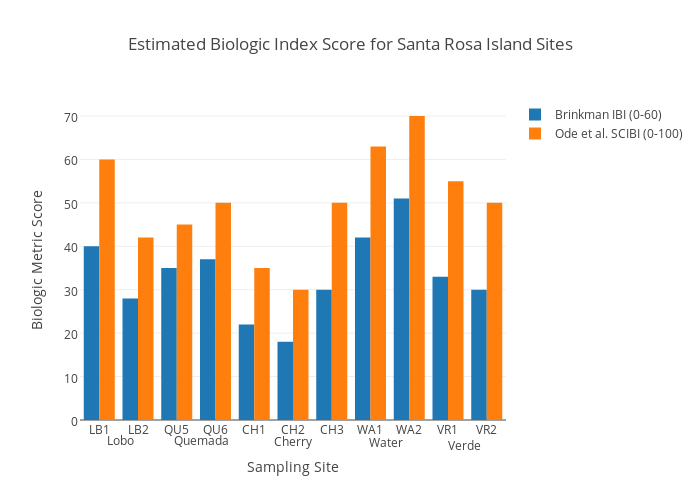
Here is the newest data figure I have created featuring the predicted biological index scores for each sampling site. Each scoring system was created to evaluate the health of California freshwater streams by examining the composition of invertebrates per reach, the higher the score, the healthier the aquatic habitat. Please notice that the graph is interactive if you scroll over it.
March 26th, 2015
 Following the March expeditions, the invertebrate sampling at Santa Rosa Island is complete. Now, the heavy lab work is my main focus; identifying and analyzing being the main goals. One by one, the data from each site is examined to compare temporal, spatial, chemical and environmental factors to see if the health of this southern California habitat has improved since 2008.
 This past spring break I spent another week on Santa Rosa Island. This time I re-measured the 329 tagged Torrey pines from July to determine their growth and survivorship. Seedling recruitment increased substantially, with 53 newly emerged seedlings in my demography plots. Despite having another year of drought, precipitation in the form of fog drip and the shading of larger Torrey pines has allowed over 70% of the seedlings I encountered in July to persist until now.
But moisture protection in the form of shading is a two-edged sword. It does protect the soil and plants from losing water in a dry Mediterranean climate, but it is also preventing much needed light from reaching the photosynthetic tissues of the younger pines. The result is that most seedlings under the canopy usually die within 2 or 3 years due to their lack of light.

Stephen Bednar with Cuscuta californica

Dudleya sp.

Platystemon californicus

Abronia umbellata

Castilleja affinis

Leptosyne gigantea

The endemic island fox


Bloomeria crocea

55 specimens collected during Spring on Santa Rosa Island.
 Scroll to top