Medication Awareness

I think this was a very interesting assignment to complete because people really do have such a wide variety of knowledge of their medications. Some people report that they take a “water pill” because of their heart while others might say that they take spironolactone 10mg to reduce their blood pressure. Others might be aware of their medications but simply have too many to keep track of them. As a result, it is so important that we evaluate an individual’s knowledge regarding their medications before we assume they know what their taking and understand why they’re taking it.

Of the five family members and friends that I talked to, I was partially surprised to learn that all five of them were able to give me the name of the medications (both prescribed and OTC) they take and why they take it. On one hand, I was not surprised to find out they all knew this information because this is a medication that you are putting into your body, and you should at least know what it is and why you’re ingesting it. However, from the other point of view, I was surprised to learn that they did know these medications because so many people don’t know the names of their medications or why they’re taking it. They just know that the doctor prescribed it, so they need to take it. In a way, it puts a lot of faith into the healthcare system when errors can happen.

Once I delved into more detailed questions, such as what dose they take, what side effects there are, and what the safe dosage range is, more people started to be unaware of their drugs. One individual knew all the information as he had researched it in depth while a second one stated that she always reads the box before she takes the medications. A third knew everything except the safe doses. The last two knew how many pills they took, but not the dosage, side effects, or safe range. One even laughed and stated that she just always takes two pills, and it’s not a problem. One also stated that she uses herbal remedies in conjunction with her medications, but is not aware if they interact with each other.

The medications that people had lower knowledge regarding were the OTC drugs. The individuals who were taking prescription drugs had a much greater knowledge, and one was even able to tell me the safe dosage range. However, while the OTC knowledge was lower, I do feel that the knowledge about OTC was greater than I anticipated. Both individuals discussing OTC were able to tell me what the generic names were as well as side effects of them. The ability to tell me the generic name was definitely surprising because I feel that many people aren’t aware of generic names, which creates problems with people taking too much of the main drug (e.g. acetaminophen with Tylenol, cough/cold meds, etc.). I was definitely happy with that range of knowledge.

Overall, I feel that the amount of knowledge people knew about their medications did surprise me, but it could be improved. It’s important that people have this information about medications so they can better protect themselves in case changes happen. This could easily be done when we are discussing medications with our patients in the hospital (explain the medications, provide medication handouts, etc.) or our family and friends when they are given a prescription drug or go to take an OTC medication. It is our job to help educate the community, and while we’ve made progress, we can still help improve their knowledge.

Medication Knowledge


This week’s exercise truly gave me a greater appreciation for patient education in nursing. I took this opportunity to ask my family members about specific medications that are commonly used such as Tylenol, Advil, Aspirin and Insulin. I was surprised to find such a limited knowledge about commonly used medications. I found that many in my family honestly believed Tylenol and Advil to be the exact same medication. My husband for instance, only knew that you take Tylenol for headaches, and “are not supposed to take Advil before working out” according to his high school cross-country coach. When asked about common side-effects on Tylenol and Advil, all of the family members I asked could not come up with any. However, Aspirin tends to be a better known medication in my family it seems. Both my mother and husband were aware of common uses of the medication, such as heart attacks, heart conditions and common side effects, such as bleeding. Although most of my family members understood the use of insulin, they did not know the various types of insulin and potential adverse effects. I really enjoyed completing this assignment, as it gave me a better understanding of baseline knowledge our patients might have in the clinical setting. It also gave me the opportunity to open-up this discussion with my family and practice educating. The assignment also reminded me how unrealistic it is for a patient to be sent home without a proper explanation of each medication prescribed. If my own family members, who have regular contact with a health care professional, know so little about common medications, there is no doubt in my mind that many others know even less. I hope that as I enter the nursing field, I am able to use the knowledge I’ve gained throughout this program to educate my patients about the treatments they’re being prescribed.


Who Knows About Drugs?

I asked a couple of family members what they knew about the current medications they were taking and these were their responses:

My grandma: Today my grandma turned 84, I decided to visit her and then I remembered about this assignment. I asked her what medications she was taking and she said she was taking two pills. When asked if she knew what they were for she said, “The white one is for my blood pressure.” She did not know the name of it, but then again she does not know English and I don’t even think she would attempt to pronounce it. She said the other pill was for her heartburn. She did not know any side effects, she only knew what time she had to take them.

My uncle: My uncle takes many medications. This is only because he had a kidney transplant a year ago due to his diabetes. He said he takes about 10 medications a day. He did not know their name but he knew the color of the medication and what it was for. His nurse has helped him organize his medications, she has marked the ones that are extremely important to take (anti-rejection medications) with a red X. He also carries a list of his current medications with him at all times. I asked him if he knew what would happen if he stopped taking the medications and he said “I am not really sure, but I just know that it is very important to take them.” He also did not know any side effects.

My cousin: My cousin is 20 weeks pregnant. She is taking prenatal vitamins and iron. I asked her if she knew what the prenatal vitamins were for and she said no, but the doctor said it was important for the baby. I was excited to explain to her why it is so important to take them. She knew the iron was for her anemia, and she did not know any side effects but she did know to take it with orange juice.

Pills, Pills, Pills

This assignment could not have come at a better time because my family gathered for a barbeque over the weekend. At the barbeque, I had the opportunity to ask several family members and friends about their knowledge regarding the medications that have been prescribed to them by a physician. Many were not on a daily drug regimen therefore I asked them to explain the indications and side effects for common over the counter (OTC) drugs such as Tylenol, Aleve and aspirin.

To my surprise, about seventy percent of the people for which I sampled (n=14) were knowledgeable about their personal daily medications. This did not apply to OTC drugs or drugs they were unfamiliar with. They were able to explain what their medication was for, discuss the common side effects they had personally experienced, and also name both the generic and trade name for each. Their extensive knowledge on their medications can be explained in part, because they have been able to successfully manage their chronic diseases for years or because they have work closely in the medical or healthcare field.

pills box

On the other hand, the remaining twenty percent (n=6) had a difficult time explaining medication indications, side effects or the contraindication for some of the more common OTC drugs. Reoccurring key themes included 1) following physician orders without question, 2) inability to recall the information or 3) simply never bothered to look them up. The identification of side effects did not pose too much of a problem because lets face it seems that every medication can cause stomach pain, nausea, vomiting and diarrhea. Measuring the proper dosing was a bigger problem than I thought. A couple of people mentioned eyeballing what they assumed to be a teaspoon verse a tablespoon for liquid medications. Others even admitted to taking more than what the label clearly stated. My grandmother referred me to my father who helps her manage her medications. Unfortunately these examples are not uncommon, especially for individuals whom English is not the primary language or are no longer unable to manage their health conditions due to their age as in the case of my grandmother. Fortunately, this assignment opened the discussion about medication safety and proper drug management in my family.

Homeopathic and herbal medications are very common in Mexican heritage and culture. Many of these remedies have been passed down from generations to generation and are built upon hope and faith. I can remember my grandfather going to the back yard to cut aloe vera leafs to treat minor cuts instead of going to the store to by Neosporin. My grandmother is known for grinding several herbs together to make remedy teas for our ailing sore throats. Unfortunately many of these alternative treatment measures have not proven to work or provide better results. Some herbal medicines can in fact be toxic and result in detrimental effects including death. Nonetheless, these traditions have been strongly ingrained and will continue to be performed for years to come.

Automédication #4  / Self medication #4

Roger & Me

In a recent article, University of Denver political scientist Seth Masket claims that the Netflix series “House of Cards” is “the worst show about American Politics. Ever” After elaborating his list of grievances about the show, Masket proclaims: “…if you want to understand American politics, watch just about anything else.”

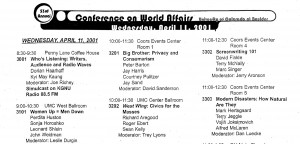
In 2001 I was invited to participate in the World Affairs Conference at the University of Colorado. The WAC is unique in several regards. Participants are assigned to panels with minimal regard for their expertise. Sessions are valuable for the ability of the panelists to provoke passions, and promote vigorous discussion with the audience. For decades, the World Affairs Conference has attracted prominent individuals who pay their own way to Boulder for the week. Attendees are not paid. This year the Conference celebrates its 67th year.

Among the half-dozen panels scheduled for me was one titled: “The West Wing: Civics for the Masses.” The panel was scheduled for one of the largest rooms at the conference; at least 400-600 people were there, and there was not an open seat in the house.

But they were not there to hear me speak.

Kelly WAC 2001

On stage I was joined by Richard Aregood, a Pulitzer Prize winner, and then-Editor of the opinion page of the Philadelphia Daily News; and Roger Ebert, also a Pulitzer Prize winner, and nationally-renowned movie critic for the Chicago Sun-Times. For many years Ebert attended the conference, paying his own way, and spending four days deconstructing a movie that he selected, on a first-come-first-seated basis. The sessions were always packed.

As it turns out, the organizers chose the right panelists for a discussion of The West Wing. Aregood admitted to having seen one episode; Ebert none. Upon hearing of my upcoming conference, my then-student John Celock recorded some episodes on video tape for me to watch. I managed to watch three episodes; two more than my Pulitzer-winning compatriots, and three more than I could stand.

My conclusion: It was the worst depiction of American politics I had ever seen. From the lionization of the presidency, to the utter contempt of the West Wing staff for Congress, there was nothing about the show that was a “civics lesson.” And I told the audience.

They did not like it. Not one bit.

What I failed to realize, in retrospect, was that there was not a question mark at the end and of the panel title. It was a declarative statement: West Wing was, in fact, a civics lesson, and the 400 people in the audience would not accept any other conclusion.

Ebert, of course, was far more savvy than the professor from Niagara University. Noting my disdain for the show, and the audience’s displeasure with my critique of it, he remembered for them the letters he received from archaeologists complaining about the inaccuracies in “Indiana Jones.” One should never listen to the criticisms of an expert, he told them. And then, as the love of the audience swelled for him, he promised them that, based on their deep love for the show, he would go back an watch every episode of The West Wing.

The applause was thunderous.

For 90 minutes I was Roger Ebert’s foil. The loved him, and hated me (at least it seemed that way). It was as good as it could get. I loved being the foil. Especially in Boulder.

To this day I have seen only three episodes of The West Wing. I have seen every episode of House of Cards. For my love of Kevin Spacey I choose to remember Roger Ebert, and suspend disbelief. House of Cards is an atrocious depiction of American politics, but great Shakespearean drama.

It is a wonderful piece of art. That was Roger Ebert’s point.

If one is interested in a more real-to-life depiction of American politics in action, I suggest a show from 2003 titled Mister Sterling. Starring Josh Brolin as an appointed Senator from California, this “modern day Mr. Smith goes to Washington” captures quite a few of the details about American politics more accurately than House of Cards or the West Wing.

Then again, it lasted for only 10 episodes and is now long forgotten. Politics and great art do not necessarily go together. Just ask the ghost of Richard III.


Some new developments!

I have recently, within the past few days, received some relatively new data from the months of December of 2014 trough this past February of 2015. The data highlights the amount of pieces of trash found within all sites (1, 2, 5, 8, and 9) that I have decided to focus on. Through the encouragement of my directing professor, I have decided to see if there is a correlation between the amounts seen in the past few months with the same months of past monitoring years and amount of rainfall within those months. I also plan to see if there is a correlation between trash and the number of windy days within these months. Hopefully I can find a trend!

CI Projects Selected for the 2015 CSU Student Research Competition

The Student Research Steering Committee selected ten undergraduate research projects to compete in the CSU Student Research Competition. Each campus is allowed to send up to 10 teams to the competition. The 10 projects were selected by an interdisciplinary committee of CI faculty. A total of 17 total entries were received.

Students submitted a 5 page research summary that was evaluated by two anonymous outside faculty reviewers, and the members of the selection committee. Papers were judged based on the quality of the research, and the ability of the author(s) to communicate their work to an interdisciplinary audience.

This year’s competition will be held at CSU San Bernardino, May 1st and 2nd. Students compete based on their written research summary, and an oral presentation to an interdisciplinary panel of judges. Travel for students is supported through funds from the State Lottery, student fees through the Instructionally Related Activities committee, and funding from the CI Foundation.

The 10 projects are:

  • Amanda Dellacort and Ashley Genovese (Business): “MAMMU and Social Business Fashion: Scarves as Symbols of Innovation for Latvian Mothers” Faculty Mentor: Maria Ballesteros-Sola
  • Cameron Embree, Gradon Faulkner, Kevin Scrivnor, and Fred Contrata (Computer Science): “CI Rainbow: An Infrastructure for Environmental and Wildlife Monitoring” Faculty Mentor: Andrzej Bieszczad
  • Gradon Faulkner (Physics) “Optimization of Associative Memory” Faculty Mentor: Geoff Dougherty
  • Shane Kennedy, Joshua Mytych, Katlynn Carter, and Stephanie Soriano (Biology): “Targeting Growth and Invasiveness in Cancer Cells” Faculty Mentor: Nitika Parmar
  • Jiovana Hermosillo (Chemistry): “The Effects of Coacervation on Polyelectrolyte Complexes” Faculty Mentor: Erin Lamb
  • Robert Camin and Lisa Marie Clark (Political Science): “Birds of a Feather: Congressional Foreign Travel and the Decline of Bipartisanship” Faculty Mentor: Sean Kelly
  • Cassandra Ludwig (Sociology): “The Relationship Between Ventura County Commission for Women and Ventura County Board of Supervisors” Faculty Mentor: Matthew Cook
  • Jason Amurao, Cesar Rivera, and Miguel Velazquez (Nursing): “The Effect of Using Mobile Technology for Patient Education on Nursing Student Self-Efficacy” Faculty Mentor: Jaime Hannans
  • Corie Hill and Amber Kramer (Chemistry): “Determination of Total Mercury in the Top Three Consumed Seafood Products in the United States” Faculty Mentor: Simone Aloisio
  • Andrew Carrillo and Grant Crater (Political Science): “You’ve Got to Support the Team: Partisan Fund-Raising and Assignments to the House Appropriations Committee” Faculty Mentor: Sean Kelly

The ad hoc selection committee was composed of: Matt Cook, Nitika Parmar, Mary McThomas, Luis Sanchez, Cindy Wyels, Jason Miller, Colleen Harris-Keith, Colleen Nevins, and Sean Kelly. Please direct questions about the competition to matthew.cook@csuci.edu.

facebooktwittergoogle_plusredditpinterestlinkedinmailby feather

Drugs

During this week’s blog, I decided to interview two of my close friends about their knowledge regarding drugs and over-the-counter medications. I was really excited about this mini experiment because we are exposed to drugs almost every day. We see drugs being sold in stores, drugs advertised in the media, and drugs taken by our own family and friends. There’s also controversy regarding drugs that affect many people’s decisions whether they should take certain drugs or not. Surprisingly, my friends knew a good amount of information about drugs.

When asked about taking any current medications, one of my friends stated that he only took Advil as needed if he had a headache. My second friend stated that he was not currently taking any medications. I then asked them about their knowledge regarding over-the-counter medications and they both stated that they knew that different drugs were the same but had different names. They both explained that they knew about the importance of understanding the active ingredient. Both of my friends also explained about drug overdoses and how one of their friends had died. It was sad to hear this, but a great way to understand their knowledge.

After discussing several medications with my friends, I educated my friends about understanding different drugs and how they can each take effect at different times. I also encouraged them to go online and find a trusted website to learn more about different drugs, especially the drugs that they plan to take. I found this to be a great experience because both of my friends and I learned something new about each other and about the importance of drugs. Happy posting!

Making vibrant videos

It wasn’t long ago that I began imagining the varied benefits that creating videos can provide for connecting with and teaching students:  a personalized introduction to students about me and the course, a tour of the syllabus, an overview of the upcoming module, a microlecture on a course topic, and more.  Imagining the possibilities was fun […]