Carpinteria State Beach

Well this week has been truly busy, we had a Steve Whitiker come in and talk about sandy beach monitoring to the high school students that was Wednesday 2/17. Then on Thursday 2/18 the two high school classes went out to Carpinteria State Beach to finally do the research that we have been training them for. It was a long day and it started out with all of us going to the Sea Lion rookery that is right there. We saw a lot of seals and there were a number of pups there. So that was really cool for them to see. Then there was a state park ranger that came by and talked to the kids about the Chumash and the history of the beach. After that we had pizza for lunch and the kids had time to explore a bit.


Now the research begins. This was a very long day because it was very windy and there were a lot of students that came up to the rocky intertidal area at the same time so it got a little crowded but over all it went very well and I am very happy with how it all went.

The same thing happened with the middle school but there was no wind but the surf was still really high and there were a lot more of them but it still went very well.

our little rock has so many people

Weekend Trip to Santa Cruz Island

I went out to Santa Cruz Island this weekend to see if there had been any successful germination in my plots from the seed mixture that I broadcasted about a month ago. I’m happy to report that there has been successful germination! I documented the progress and hope to go out to Santa Cruz in another few weeks to check again. I’m hoping for some more rain in March for continued success.

Samples from the remote end of Santa Cruz Island!

Michaela Miller, Robyn Shea (our research coordinator) and I were able to go to the west end of Santa Cruz Island for a quick trip this weekend.  This end of the island is owned by the Nature Conservancy and is travelled only by researchers with special permission.  We arrived on island Friday afternoon and left Saturday.  Even though our trip was lightning fast we were able to collect data for both projects from Christy’s Beach, Sauces Beach and Frasier Point on the west end of the island. Due to the earliness of the season I was only able to find adult crabs on one of the beaches but did collect sand from all three.

TPSNR and Common Garden Update!

Last weekend, I went to Torrey Pine State Natural Reserve (TPSNR) to collect cones for my common garden experiment. I was able to collect enough seeds from 20 trees that are feasible for my experiment. It was a very different environment than being out on the island, because there were a lot of people and the shrubs were over grown, above 6 feet.

TPSNR Extension in San Diego

Last week, I officially planted 800 Torrey pine seeds. I will be watering the seeds manually, every Monday, Wednesday, and Friday. I am excited to see how the results will turn out!!!

Common Garden - Seeds planted with leaf litter
Common Garden – Seeds planted with leaf litter
Common Garden - Seeds planted with no leaf litter
Common Garden – Seeds planted with no leaf litter

Preliminary Results

I have started to analyze the data from all of my field collection. So far, I have found that beach grooming significantly reduces sand crab population density. I have also found that the change in season has coincided with the reduction in invertebrate species richness. I hope further data analysis will reveal more significant relationships between invertebrate community health and natural or anthropogenic stressors.

groomingtemporal

harrison in the waves


The Great Oil Miscalculation

It is hard to underestimate the influence our Federal Energy Information Agency (EIA) has on energy markets.  Their annual and quarterly reports, littered with predictions, drive investments, public policy, and global understanding of energy production and consumption.

So the recent coming to terms with the fact that the EIA has of late been hugely overestimating American petroleum consumption is cause to sit up and take notice.  A very readable overview of this overestimate was pulled together this past summer by Lydia Cox for the World Economic Forum:

US oil production has transformed itself fundamentally in the past decade.  Between 1970 and 2008, US crude oil production fell by nearly half as conventional wells were depleted.  Since 2008, however, production has rebounded from 5 million barrels per day to an average of 8.7 million barrels per day in 2014.  The almost entirely unexpected increase – largely attributable to technological innovations such as advances in horizontal drilling, hydraulic fracturing, and seismic imaging – has helped the US become the world leader in oil production.

Whereas the developments in oil production have been widely reported and appreciated, far less attention has been paid to US petroleum consumption’s remarkable decline relative to both recent levels and past projections — one of the biggest surprises to have occurred in global oil markets in recent years.  Petroleum consumption in the US was lower in 2014 than it was in 1997, despite the fact that the economy grew almost 50% over this period.  As illustrated in Figure 1, consumption rose steadily from 1984 through the early 2000s, peaking in 2004 before decreasing in conjunction with rising oil prices.
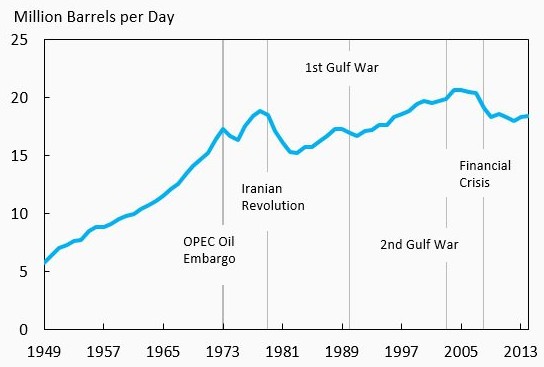
US petroleum consumption from 1949-2014 in millions of barrels per day, 1949-2014. Figure: Energy Information Administration (cited in Cox 2015).

US petroleum consumption between 1949 and 2014 (in millions of barrels of crude oil per day). Figure: Energy Information Administration (as cited in Cox 2015).

The deviation from the EIA’s estimation from more than a decade ago for our American consumption is sizable:

Deviation between historic (2003) and current (2015) EIA predictions of U.S. petroleum consumption to 2025. Figure: Energy Information Administration (cited in Cox 2015).

Deviation between historic (2003) and current (2015) EIA predictions of U.S. petroleum consumption to 2025. Figure: Energy Information Administration (cited in Cox 2015).

Unfortunately this massive deviation from the expected growth in oil consumption is a uniquely American phenomenon and primarily a transportation sector phenomenon.  Simply put, we are burning less gas a diesel in our cars and trucks due to two main factors:

  • reduced miles driven on average (formally referred to as Vehicle Miles Traveled, VMT)
  • improved fuel efficiency
Reduced oil consumption owes almost entirely to improved fuel consumption rate and reduced vehicle miles traveled in the transportation sector. Figure: Energy Information Administration (cited in Cox 2015).

Reduced oil consumption owes almost entirely to improved fuel consumption rate and reduced vehicle miles traveled in the transportation sector. Figure: Energy Information Administration (cited in Cox 2015).

To date the reduced miles driven accounted for the majority of fuel savings,   As Cox explained:

Between 2003 and 2014, gasoline prices explain a large share of the fuel economy increase of the light-duty fleet.  However, over time we expect fuel economy standards to have a growing influence on fuel economy — both for the light- and heavy-duty fleets.  Fuel consumption from the heavy-duty fleet accounts for one-fifth of total transportation sector consumption, and is the fastest growing component in the transportation sector.  New heavy-duty fuel economy standards that the Administration has announced will reduce actual transportation sector consumption relative to even the 2015 projections, which do not reflect these new standards.

Given the importance of miles travelled in explaining the surprises, we use household survey data to present new evidence on the factors underlying the changes.  Demographics appear to explain a very large portion of the vehicle miles travelled developments, but we also find evidence that the effects of demographics and economic variables on vehicle miles travelled have changed over the past 20 years.  Such changes present a major challenge to projecting future petroleum consumption.

On into the future, improved fuel efficiency via improving Corporate Average Fuel Efficiency (CAFE) standards will become to greater driver of lowered consumption:

In 2014, rising fuel economy explains roughly 25% of the consumption surprise, and vehicle miles travelled explain the remaining three quarters.  In the 2025 projections, however, the factors are more comparable, with fuel economy accounting for 45% of the surprise and vehicle miles travelled accounting for 55%, demonstrating the growing rule of public policies like fuel economy standards in shaping fuel use.

In sum, the high gas prices we have been seeing over the past decade have helped curb our driving habits and ultimately lead to our burning less fuel.  Over the coming decade, our current Clean Energy Strategy Policy will likely be at the root of this reduce oil consumption.  In and of itself it is not strong enough to get us to a sustainable future.  But this dramatic reduction in estimated oil consumption shows effective policy and clear drivers can indeed push our US economy into a low carbon future.  This can work.

References

Cox, Lydia.  2015.  The surprising decline in US petroleum consumption.  World Economic Forum Blog.  Posted July 10, 2015.  Accessed February 21, 2015.

Research Update 2/21/16

Hey guys, this week I started playing around with the dozens of collected aerial images I have. I also am meeting with my advisor within the next few days to touch base and maybe gather some additional resources.

In addition, I have also started to analyze the demography plot data and have found some very interesting results! As it turns out my original hypothesis that the SRI Torrey pine population was growing significantly due to the removal of the ungulates in 2013. However, there appears to be a decrease in the population as can be seen in the chart below

Height cm

July 2014

Jan2016

Change

Class 1 <30

84

44

-40

Class 2 30-160

122

129

7

Class 3 161-300

29

20

-9

Class 4 301-600

23

22

1

Class 5 600+

71

63

-8

329

278

-51


As the chart show, most of the change is from Class 1 trees, saplings/seedlings. These are very interesting results, however depict a very limited temporal scale, I am very excited to see future research and more long term results in the future.

Carpinteria State Beach Field Trip

This week we had a field trip to Carpinteria State Beach, the students had many activities one was to look a Harbor seals. The students really enjoyed looking at then and for most students this was the first time they saw a Harbor Seal. The second activity was a presentation from a park ranger about the Chumash and how they used Carpinteria resources. After that students either did sandy beach monitoring, rocky intertidal monitoring, and explored the tide pools. Every student on this trip was excited since it was the first time most explored a tide pool. Many expressed their excitement to me after the activities. Here are some pictures from the trip.

IMG_6075IMG_6069

Picture one are students exploring the tide pools and picture two are students doing sandy beach monitoring.

Why is writing so difficult?

As humans there is a series of things that comes to us as instinctively as breathing. Just as we all have the capability of forming thoughts due to our complexed minds. We often have the need or even obligation to write these thoughts down. Whether it is in a journal recapping the events in a day or for an essay in an English class. Writing and composing a paper is unavoidable and each time we write something we face different obstacles and learn to overcome them and in doing so we become a better writer.

English itself is known to be the hardest and most intricate language to learn and with writing already difficult as it is, it adds an additional thousand rules and barriers to the mix (Reid p.3). That is not to say just because there are rules there aren’t expectations; the English language is filled contradictions. We actually make English and writing itself more difficult when we try to write to the rules as opposed to connecting our thoughts and ideas (Reid p.4). Following these rules is actually the cause of writers block, but luckily for us Reid provides us with three easy steps to avoid scrolling through Instagram aimlessly with hopes that a picture would provide us with inspiration. Reid poses the idea that we simply write about what we know so we can show not just tell in order to adapt to our audiences needs and accomplish our goal (p.4). Take for example as I am writing this simple paragraph I have stopped and stumbled on my own words, simply because I was too focused on the structure of this sentence and not on the content of it. The funny thing about this specific metaphor is the example it demonstrates for us. It tells us to never repeat oneself, but in the book They Say I Say it had actually told us to repeat ourselves. These are the sort of contradictions that makes it difficult as a writer to compose a paper. We are constantly fed these ways in which we should and should not right and I just personally feel it’s a bunch of bologna. I feel as writer we should take into account these techniques but formulate our own and leave these in the back of our head.

Needless to say that since we are the writers and composers of these papers, and have these thoughts. We need to formulate these thoughts in the correct way not so much for us but for our readers. We as writers often get caught up in the subjects we are writing about and lose focus on what we are trying to achieve. With something as simple as trying to explain and describe a “little green ball” those necessary details to visualize the ball gets lost in translation from our brain to our papers. We all may be able to conceptualize what a green ball is but people’s definition of “little” may be severely different (Reid p.6). That would only be the half the battle because there are about a million different shades of green and an even more variety of balls that an author can chose from. Using this example it demonstrates just how difficult it is to get a point across using little too no details. Often enough if we are trying to convey a specific detail or example we need to spell it out for our readers if it is essential to the story. If we don’t the meaning behind the story may get lost due to assumptions that are being made. However if the details are not what is important and just the subject, it is perfectly fine to be vague (Reid P.7). Reid attempts to drive us off the path of “you know what I mean” a path which is often hard to strife away from simply because we house so much information in our heads that we can’t always project it out (p.8). I for one is a huge offender of this tragic mistake. Although I don’t use those exact words of “you know what I mean” I might as well. I often get caught up and excited about a subject, that I think I am spelling it for my readers but I am often vague and condescending. Just from this simple post I personally think I am making sense, but I know when I reread this I might confuse myself due to my mind moving faster than my hands.

th

As I said before English and writing alone are filled with these multi step complexed rules and regulations that we need to follow to “write correctly” and become “good writers.” Most of these rules are not even followed by some of the most famous of writers. So why should we or how could we follow them when writing can be compared to those overemotional teenage girls who at every second say “I hate you, no I love you” due to their inability to make up their mind. Well here we are again with yet another contradiction about repeating oneself. Reid herself even addresses the indecisiveness of writing instructors and their inability to decide if repeating oneself is good to the cause or not. Well as it turns out Reid is in fact one of those who do agree that repeating oneself is essential to keeping the message and the readers engaged (p.11). Now when one refers to repeating themselves they don’t mean reusing the same examples and sentences they refer to reemphasizing ones point and or conclusion. It has to be one of the worst feeling in the world when you spent hours on end on a paper for a reader to just ask themselves “what did I just read?” That is why it is always good to repeat a statement you want to get across in your writing so when it is fished being read, there are no questions being asked. I know firsthand how this feels when a professor or teacher looks at you quizzically as they finished reading your paper. That is why this metaphor about pink house is a very accurate rule that should be regarded highly, because it might actually save us some time from rewriting a paper (p.12).

At a point if it hasn’t already, writing becomes a real choir and as you further your knowledge in the subject it seems like writing instructors just beginning to make up rules because they had ran out of things to say. The length of your text is one of those rules where it just seems like it is an extra barrier that could have been prevented. Well according to Reid there is no such thing as a limitation to the length of a text she emphasizes that it all depends on one’s audience (p.15). She states it is perfectly okay to break up a paragraph as long as it is to shorten up the content and present the information in a clearer form. For the longest of time my teachers had also told me I had needed at least five sentences to complete a paragraph. Until one teacher of mine had said that as long there is one sentence that could be considered a paragraph. Well ever since that one teacher had told me that, I have just decided that I will just start and end a paragraph whenever I feel like it because I feel this is a pointless rule.

The last and the most annoying contradictions in the writing world I feel was the fact that when we were younger we were all told that we had to write in a standard format. Then all of a sudden professors and teachers would get upset when we write in a standard five paragraph format. Which as we all know is not acceptable in the level we are at now. Nevertheless there is never easy answers writing is and will always be difficult (P.22). Luckily for us using the rules that we learn and gain throughout our years of life writing can be less of a nuscience. In the end the only way that we can get better at writing is by simply writing more and just trying out new things to see what works. As we speak I am already trying a new writing style, and on the next assignment I will try another up until I can find the correct style for me.

Works Cited

Reid, E. Shelley. “Ten Ways To Think About Writing: Metaphoric Musings for College Writing Students.” Ed. Charles Lowe and Pavel Zemliansky. Vol. 2. West Lafayette, IN: Parlor P, 2011. 3-23. Writing Spaces. Web. 17 Feb. 2016.

I have some preliminary results!

Slide1

Today I finished processing the 20th sample population of sand crabs and put together a small graph to share.

The sample sites are listed from North to South along the California coast.  Each bar represents a percentage of the sample population collected that was found to have ingested microparticles.  Of the 20 sample populations, two did not have any micro particle ingestion, however the other 18 sample populations had sand crabs that ingested microparticles.    Each sand crab found to have microparticles was photographed and recorded. I am interested to see how the rest of my samples look and plan to have a more complete set of results in the next 2-3 weeks.